Learning how to be human by reading about machines.
It’s hard to know where to start with all this AI business lately (to be honest, I wanted to use another word that starts with “bu” to describe this phenomenon). From undermining the education system and threatening children’s online safety to accelerating the destruction of our literary history, it can be challenging to see any upside to using and promulgating these algorithms.
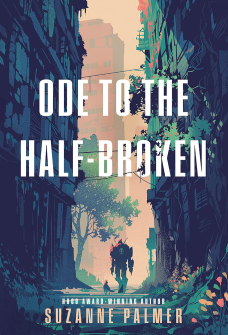
But, in Ode to the Half-Broken, Suzanne Palmer presents an alternative vision of the near future in which AI helps rather than hurts — or, as a friend said when I described the book, “Man, imagine we mess up so bad that AI becomes the good guy.”
In the second half of the 21st century described by Palmer, humans have certainly messed up the planet catastrophically enough without help from AI. In the aftermath of multiple pandemics and wars, only about 1 billion humans remain, most living in harmony with “mecha” — machines imbued with varying levels of sentience that have broken free from their original, human-enforced purposes and now determine their own fates.
Damage to the environment has also played a major role. “Global warming had been a disastrously poor choice of term, utterly misconstrued, back when there was still a chance to avert much of the damage, because not enough humans understood that heat is energy, so that ‘warming’ didn’t mean sunnier days and less snow but more-energized weather systems: hurricanes and tornadoes, heat waves and blizzards all cranking up to eleven,” our mecha narrator, Be, reflects. “I imagine the ten percent or so of humanity remaining largely understands that distinction now or is no longer in a position to either contribute to or offset any of it.”
These mecha are wholly unlike the affectless responder bots — ChatGPT, Grok, Claude — with which humans interact today. As Be explains to a human friend, their Learning Enhancement Module, or LEM, “is engineered to have one primary function and both is omnipresent in everything the mind processes and drives learning throughout the system…It provides a framework for the comprehension and acceptance of ambiguity,” because without it, “all is logic and calculations, predictable, repeatable, inherently delineated and limited.”
This means that mecha, like humans, have feelings and preferences; in a charming moment, a drone that has attached itself to Be’s company responds to a question regarding its whereabouts with, “This unit finds it to be a positive experience that you verified this unit’s presence before departing.”
Nonetheless, all is not peaceful in this version of the postapocalyptic United States. There are still humans who hate mecha and vice versa, and Be and their friends are inadvertently caught between two warring factions who have the ability to restart the cycle of war and destruction.
It was heartening to read about people and mecha working together to thwart these plans, and it got me thinking once again about why it’s been so difficult for humans alone to unite. Perhaps one big difference lies in the unique strengths of mecha: While wired to evolve and adapt, they still maintain a base layer of rationality and patience that sometimes comes hard to us “meat creatures.” They are clear-eyed and thoughtful about their goals without being cold or cruel.
Mecha still struggle, though — with lack of knowledge, a dearth of spare parts, and negative feelings. “I am angry,” Be tells their friend 44-Mongoose after being attacked, “and I am even more angry that I have that feeling in me. Is it unreasonable to be angry about being angry?”
“I have been angry since the bomb on the bridge,” answers 44-Mongoose, whose train was destroyed by that bomb. “Still, I do not think it serves a purpose for me, anymore. I am going to reduce my anger by fifty percent.”
If only it were so easy for us non-mecha! Nevertheless, it feels like a good direction to turn my distinctly human mind toward: to continue to try to work together, to move forward with purpose, and to reduce my anger — if not by 50 percent, then at least a little.
Mariko Hewer is a freelance editor and writer as well as a nursery-school teacher. She is passionate about good books, good food, and good company.