Kafka’s meditation on the limits of empathy.
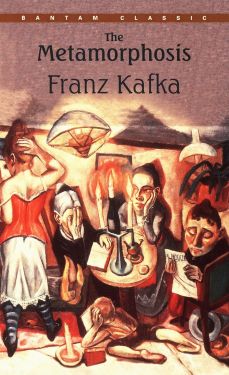
In Franz Kafka’s 1915 novella, Metamorphosis, Gregor Samsa wakes up one day to find he has become an insect. Lying on his armored back, he observes his new brown belly, his many “pitiful” legs. For the next 10 pages, he watches the clock, believing he might still get up and go to work. He speaks to his family through the bedroom door, but the words, so clear in his mind, come out as monstrous squeaks. By now, the family has realized something is profoundly amiss.
Gregor turns the key with his large, powerful jaws and emerges from his room. He is confronted again with the new version of himself, this time through the reaction of his parents: His mother collapses; his father cries. An office clerk, who has come to see why Gregor missed work, is so nonplussed that he catapults from the apartment.
If only they could understand, thinks Gregor, who still feels like his old self.
With words like “Kafkaesque” having crept into the English language long ago, one hardly needs to crack the book’s spine to be familiar with Gregor’s ordeal. Metamorphosis is nearly too famous to read. Everybody knows the story is about alienation from harsh society — specifically, the stinging rejection of Gregor by his family.
Conventional interpretations draw parallels with Kafka’s life: a German-speaking Jew, he was born in Prague at the close of the Austro-Hungarian empire, at a time when Czech and Slovak nationalism were amping up to form the Republic of Czechoslovakia. At home, Kafka’s father was a confident force who boomed into every corner, while Kafka himself was gentle, quiet, and uncertain. More than 100 years after its publication, Metamorphosis recommends itself to the contemporary pressures felt in the West, which have left many of us feeling like aggrieved outsiders.
Of course, there’s a case for Gregor’s indignation: We learn he has worked as a traveling salesman, a bleak necessity after the collapse of his father’s business. We are told Gregor is young (maybe in his 20s), and the text hints he has given up a promising career as a lieutenant in the army. He does not particularly like his job, but it supports his parents and his sister, Grete. Despite the stress and irregularity of being on the road, he had no plans to quit. In fact, prior to his untimely modification, he dreamed of sending his sister to a music academy to study violin.
Confined to his room after the change, it is Grete who shoulders Gregor’s care, bringing food twice a day and cleaning up. As the months crawl by and the family is driven to economize, each finding jobs and then taking in lodgers, the quality of his care diminishes. Eventually, his room is used for storage. At this juncture, the story appears less an allegory for alienation and more a guide to caring for an incapacitated loved one. Some critics believe Kafka foretold the rise of totalitarianism, and maybe he did, but in the scene where Gregor is collecting dust on his feet — owing to the disintegrating state of his room — it seems more likely the author was predicting the rise of nursing homes.
As for meaning, Kafka keeps it lush. If the story is about isolation, it is equally about the nexus of livelihood and masculinity, about being trapped in the wrong body, about how the passage of time diminishes us. Even the title offers food for thought because, in the end, the most significant metamorphosis belongs to Gregor’s family, each member bursting free of a cocoon in their own way.
The scene where Gregor’s father pelts him with apples is full of anguish, and one of many where Gregor tries, and fails, to make a connection. The family, which Gregor is now only marginally part of, does not recognize him inside the creature. They interpret his movements toward them as a sign of hostility.
The problem? Gregor is hostile. Early on, when Grete removes furniture from his room so he can crawl about freely, the insect in him is delighted, while the man burns with indignation. Perhaps this is Gregor’s mistake: that he never fully surrenders to the bug-ness of it all. Instead, he clings to a picture on the wall, thinking he would rather “jump at Grete’s face” than give up his furnishings.
This is understandable from Gregor’s point of view, as he struggles to safeguard what remains of his humanity. Yet a keen reader might ask: What about his family’s humanity? Whatever their shortcomings, they feed Gregor and keep him alive. To avoid exposing him, the Samsas work around the clock to remain in an apartment they cannot afford.
For all its credentials as a sad story, Metamorphosis offers charming particulars on becoming an insect — a cockroach, perhaps, though Kafka leaves the final word to us. We might smile at the satisfying account of Gregor’s body “working as a snuffling whole,” or his eyes “watering with pleasure” at a pile of stinky cheese. A description of him hanging upside-down (and enjoying it) is so soothing that readers might be tempted to try it. The episode where Gregor escapes his room, scutters across the ceiling, and falls into the middle of the dinner table is classic comedy, as is the scene where Grete plays the violin and we realize, owing to the reaction of the lodgers, that hers is not a blazing talent after all.
Eventually, though, comedy retreats, and empathy bows to self-preservation. Gregor’s family falls short when they fail to remove a rotting apple from his back. But the reverse is also true: Gregor registers their fatigue and despair but never connects it directly to himself, even when he realizes they’re selling jewelry and doing “absolutely everything that the world expects from poor people.”
The final conflict is spurred when Gregor leaves his room, alerting the lodgers to his presence. Grete’s reaction is heartbreaking, but only when you think about it from Gregor’s perspective, which is all he seems capable of doing. Consider his magical thinking here, about Grete:
“On hearing this, [that he’d wanted to send her to the conservatory] his sister would break out in tears of emotion, and Gregor would climb up on her shoulder and kiss her neck.”
Climb up on her shoulder and kiss her neck? Gregor has lost the thread, sealed away as he is in a special-interest group of one. This is the central tragedy of the story and perhaps the central tragedy of life: Like the proverbial drowning man, Gregor’s scramble for survival blinds him to the burdens of others.
You can join Dorothy in next reading As I Lay Dying, which will be the subject of her column on December 22nd, 2025.