A look at recent verses from the north.
Unlike other Canadian lyric poets of my generation (I’m 49), I’ve always loved Christian Bök’s hit, Eunoia, published in 2001. I defended his book-length univocal lipogram in the most aggravating way possible: by praising its lyric capabilities. Even my neoformalist friends admitted that writing a book like Eunoia required both verbal ingenuity and a work ethic that we hadn’t seen before. Their preference was to recognize it as a monument — affording it a kind of respect — but one to a kind of anti-poetry. My compatriots weren’t willing to give up a centimeter of their lyric turf.
To try to make them move, I conceded that the conceptualist was always present in Bök’s poems, encroaching upon possibility, enforcing certain programmatic properties and requirements, and making some of the lines foolish in a had-to-be-goofy-to-complete-the-deliberately-ostentatious-scheme way. Eunoia was like a novelty song that destroyed all hearing thereafter, perhaps even all sound. Reading it, I wondered: How could anyone possibly top this?
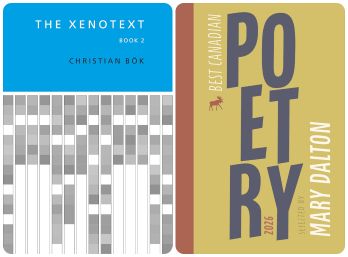
The question must’ve also stalked Bök. After a decade of delay, The Xenotext: Book 1 appeared in 2015 and was followed by Book 2 this past June. There was a very long tail to Book 1, for shortly after Eunoia was published, articles appeared in which Bök promoted his grand new project involving the encoding of poetry into an extremely durable bacteria named Deinococcus radiodurans. The apparatus he described seemed bold and impressive if one was easily blinded by science.
Thus, for a long time, The Xenotext appeared like it would be a partial failure on the conceptual level. In struggling so much with science, Book 1 ended up as a bio-art hodgepodge echoing other conceptualists, with a few cryptograms thrown in. The book felt like a placeholder for the much-heralded, nucleotide-encoded poem that would result in a “recited” complementary protein whose amino-acid sequence also encoded a poem. In other words, Eunoia as “Eureka!”
Only after another long delay did Bök manage to fill out his form with The Xenotext: Book 2. The rapidity with which Coach House published the book after the declared success of Bök’s bacteria-bioengineering partner, Lydia Contreras, suggests to me Bök had his book locked and loaded; all that was required was the drudge work of grad-student science to play out.
Judging by the contents of Book 2, there’s a moral here: Poetry shouldn’t wait for the completion of a token scientific feat. Bök’s lyric sensibility in both books is a mix of deliberately old-school genealogy — ranging from overwrought Milton spiked with visual sarsaparilla (e.g., QR codes) to late-Victorian verse — and modern, hyper-thesaurus-ized stanzas.
In Book 2, a whole section, “My Works, Ye Mighty,” was produced, seemingly contractually, as part of his virtual writer-in-residence gig at Athabasca University. It starts with a long, stilted lyric comprised of couplets that come off, like the book’s title, as either arrogant or sarcastic:
Let rivals frown and sneer if, like a king,
I stamp my passions on all lifeless things;My final words outlasting all these foes,
for whom my epitaph has bred despair;this anthem seeded in each algal bloom,
sown long ago to yield a plinth of reefs;
It goes on. For anyone excited by language’s death-defying high-wire act in Eunoia, this poem’s performance comes off as C-grade gangster-rap run through a late-Victorian LLM. The remainder of the seven-page poem sticks to the “I’m the greatest” theme; the final couplet reads, “Alas, these peers who strive to know me fail, / unless they first surpass what I have dreamt.” One begins to wonder if there’s insecurity here.
You might be interested in Bök’s bioengineered poems “Orpheus” and “Eurydice.” I’ll transcribe the first three stanzas of each, respectively:
any style of life
is primoh stay
my lyrewith wily ploys
moan the riff*
the faery is rosy
of glowin fate
we relymoan more grief
with any loss
Again, what’s to recommend here? “Oh stay my lyre”? “The faery is rosy of glow”? The only recommendation is that the works were the result of great toil. As I see it, Bök’s problem is that both his ideas and his poetry are old hat.
*****
One of the gifts America gave Canadian poetry was Molly Peacock, a famed poet who, upon arrival in Toronto, originated the Best Canadian Poetry series, transplanting your grand tradition here.
Now in its 18th year under the helm of a new series editor, the fine critic/poet Anita Lahey, Best Canadian Poetry 2026 features Mary Dalton as volume editor. (Full disclosure: One of my poems appears in the book.) Dalton, known for her sonnets and careful use of Newfoundland vernacular, has curated a selection that my formalist friends would love and that post-conceptualists would rightly criticize as lyric-privileging.
After a perceptive foreword by Lahey, Dalton’s introduction follows. The main weakness of most previous BCP volumes (Carmine Starnino’s in 2012 being an exception) has been the editor’s prose. Volume after volume offers slack versions of an “I guess I just like what I like” selection rationale. Readers might suspect Dalton knows the score when she suggests they proceed to the poems first, before her words impose an order upon what could otherwise be pure discovery.
This reviewer will obey. Sue Sinclair’s outstanding “Pfeilstorch” thinks through mortality in the form of a stork with an arrow through its body. Of a piece with Sinclair’s corpus of thinking at the intersection of being, beauty, and the body, the poem closes with:
I’ve read the old stories, which tell that immortality is got through hardship,
always. I know I can stare into your glass eye in a way most
animals won’t tolerate. I know what pain looks like when it’s gone.
Richard Greene’s “On the Use of the Sextant” inhabits a new regionalism, where the familiar tropes of Atlantic life, most especially the sea, are used overtly as metaphors for being rather than decoration or description:
I think the best
of hearts can trust only upon occasion,
as banks of fog give way to sun, moon, stars,
in the ocean of things as they obscurely are.
Dalton’s recommended delay is worth it, in part, because I read Sinclair’s poem as Dalton herself put it, as a “communion.” Had I read the introduction first, I might’ve been led into the discovery rather than making it on my own. My take on Greene — that the poem is less a meditation on existence than a metaphor for it — is quite different than hers. Neither of us is wrong.
Speaking of Dalton’s introduction, she offers the star-nosed mole — “snuffling along for the spoor of the genuine” — as a metaphor for her editorial sensibility and selection process, whilst also borrowing from tradition to signpost her thinking, quoting beloved advice from Dennis Lee, Edward Hirsch, Adam Sol, and William Carlos Williams. Reading Dalton, one really gets the sense that there was a poetic process enacting the selection process.
If I have a criticism, it’s that the editorial process may operate according to an unconscious bias, for, as she writes:
“A surreal element operates in several poems, as does humour, often of a wryly ironic sort. The dominant mode is free verse, with its music derived from chains of consonance and assonance. In some instances, anaphora drives the rhythm. The couplet, that wily stanza with its capacity to evoke now confinement and now a ramped-up surging energy, is a frequent structural device.”
I note no particular nod to a conceptualist/experimental poetic here. The closest possibilities (catalogue, diary, online comment) turn out to be not close at all. But I thank Peacock for bringing the series to life, and Lahey and Biblioasis for keeping it alive, because having BCP makes the need for an equivalent (Best American Experimental Writing) come closer into view. Just as we try to bring you, America, closer into focus under Trump 2.0, as Dalton summarizes:
“America looms as a site of dysfunction and decline in certain poems. [For example,] Evelyn Lau’s ‘Cursing, Flailing,’ a record of a post-pandemic road-trip across that country, paints a dystopian portrait of a nation wrapped in plastic, riddled with fear of nuclear war — a nation of tent cities, trailer parks, and bars, and, everywhere, chemical-laden food. The sound of the ocean is a ‘painful roar, the sound / of a million creatures dying.’”
Canada, of course, has its own decline, its own tent cities, and the dysfunction is covered well in poems like Sue Goyette’s “Excerpt from Monoculture,” which wryly asks in a Canadian accent, “The hard work of veneering corruption, eh?” You might not be able to get the news from this book, exactly, but you can find that which will keep you from corruption yourself.
Shane Neilson is a disabled physician who published What to Feel, How to Feel: Lyric Essays on Neurodivergence & Neurofatherhood in June.