Finding faith in ourselves during unprecedented times.
As the daughter of two areligious parents (one who drifted away from a vaguely Christian upbringing; the other who broke determinedly — and, in some ways, disastrously — from the Catholic Church), I’ve never given faith a lot of thought. It’s always seemed to me a murky concept full of a trust and yearning I don’t fully understand, and I’ve never been able to lean into it the way others do. Sometimes, I’ve envied them that certainty.
Lately, however, I’ve been thinking that faith, or something adjacent to it, is going to be necessary for the foreseeable future, which feels increasingly uncertain and untethered. In casting around for someone who might teach me more about it, I found an unlikely (for me) teacher in Bishop Mariann Edgar Budde, the first woman bishop of the Washington, DC, Episcopalian diocese.
Budde, already well known in Episcopalian circles, gained additional fame — or notoriety, depending on whom you ask — when, during her sermon for Donald Trump’s second inauguration, she made a fervent plea for mercy and compassion:
“In the name of our God, I ask you to have mercy upon the people in our country who are scared now. There are gay, lesbian, and transgender children in Democratic, Republican, and independent families, some who fear for their lives. And the people — the people who pick our crops, and clean our office buildings, who labor in poultry farms and meat-packing plants, who wash the dishes after we eat in restaurants, and work the night shifts in hospitals — they may not be citizens, or have the proper documentation, but the vast majority of immigrants are not criminals. They pay taxes and are good neighbors.”
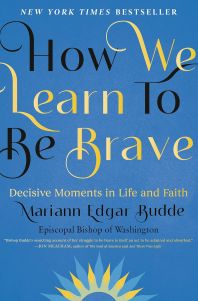
After hearing about the bishop’s courage, I checked out her book How We Learn to Be Brave: Decisive Moments in Life and Faith to see what more she might have to say on the topic of persevering during difficult times.
In the book, part memoir, part meditation on faith and ethics, Budde explores watershed times in our lives that lead to seasons of change:
“Decisive moments are marking events. They stand out in our memory and are what others often remember about us…We feel alive — so much so that the rest of our lives can feel dull and uninspired by comparison. Yet decisive moments are almost always preceded by seasons of preparation, and they are followed by an equally important season of alignment.”
Faith, Budde suggests, is absolutely present at points of great import, but it’s equally necessary as we move through the daily minutiae of life. Furthermore, she suggests, it’s not always a grand gesture or momentous decision that fortifies our bravery, but sometimes merely a decision to keep on going when we’re close to succumbing.
“Give up all the other worlds / except the one to which you belong,” urges poet David Whyte in a poem quoted by Budde, and I felt these words mingle with the bishop’s own as they found a home in my heart. At a time when people might worry that only extreme actions born of desperation will lead to change, deciding merely to persevere in the world we’ve been given is an act of bravery.
I’m reminded of that ironic toast, “May you live in interesting times.” As Budde notes, “Without question, the most helpful responses to suffering are empathetic presence and efforts to ameliorate the pain and prevent its recurrence. Yet when those efforts fail, we are left to find whatever meaning we can in the trials we endure.”
Perhaps this is what we can learn about the bravery of faith: It is sometimes a loud and aggressive act, and sometimes a quiet decision not to give up. So I will choose, in my own life and in the greater context of a world filled with suffering and also joy, to continue to move forward with love — and perhaps with a little more courage than before.
Mariko Hewer is a freelance editor and writer as well as a nursery-school teacher. She is passionate about good books, good food, and good company. Find her occasional insights of varying quality on Twitter at @hapahaiku.
22.png)