How the plight of refugees real and fictional casts the American Dream in stark relief.
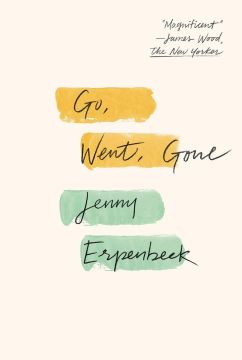
If you’d like a thoughtful novel about refugees and undocumented workers, try Jenny Erpenbeck’s 2015 Go, Went, Gone. It’s about a group of African refugees who make their way to Italy and on to Germany. An East German retiree named Richard encounters them in Berlin and finds himself involved in their lives.
In the words of Eugen Leviné, the refugees are living like “dead men on holiday.” They made it from Africa into Europe without being killed in civil war or drowning on the way. But this is just a matter of happenstance because they are haunted by memories, and “every one of the African refugees...is simultaneously alive and dead.”
Richard remembers that when the Berlin Wall came down in 1989, East German access to sudden prosperity felt like a miracle. “If this prosperity couldn’t be attributed to their own personal merit,” he reasons, “then by the same token the refugees weren’t to blame for their reduced circumstances.”
So, yes, they’ve made it to Berlin, but they can’t work legally or ultimately remain there. According to the law, they can only claim political asylum in the country where they first set foot, which is Italy. So, they spend their days being transferred from one refugee center to the next, unable to make any headway.
Since they cannot connect to society, learning the language doesn’t seem worth it. In fact, Richard communicates with the refugees mostly in Italian. They are mired in endless bureaucracy. They have skills and education, but their former homes and lives have been destroyed. Now, they’re being stripped of their personhood.
“The more highly developed a society is,” Erpenbeck observes, “the more its written laws come to replace common sense.”
When I lived in Rome several years ago, I used to see African refugees selling knock-off handbags along the banks of the Tiber. But the story of these refugees can be applied to displaced people everywhere. Today, I’m thinking mostly about undocumented people in the United States. Surely, there must be more compassionate approaches than the current policies.
A few weeks ago, I finally got around to Michelle Obama’s 2018 memoir, Becoming. Reading that book after all that’s happened since was so refreshing — a wonderful reminder of what is possible. “America is not a simple place,” she writes. “Its contradictions set me spinning.”
As I read, I came to realize that we are currently experiencing the “shadow” in America. This shadow was evident in the America built on land stolen from Indigenous peoples and developed on the backs of an enslaved population. The shadow is where the tired, poor, and huddled masses are stripped of benefits and even due process. The shadow is where we are not all created equal, where instead, a select few have all the money and power. It’s tough work coming to grips with the shadow but confronting it is part of becoming whole.
Reading Obama’s book reminded me of what that feels like. In fact, she finishes her memoir by recalling the feeling of coming into light:
“I think what I experienced during those years is what many did — a sense of progress, the comfort of compassion, the joy of watching the unsung and invisible find some light. A glimmer of the world as it could be. This was our bid for permanence: a rising generation that understood what was possible — and that even more was possible for them.”
Listening is key to confronting the shadow. Erpenbeck writes a lot about that in Go, Went, Gone. “The act of listening always contains the questions: what should you understand? What do you want to understand? What will you never understand but want to have confirmed?” Her character Richard asks something all of us should ponder:
“What are the questions that will lead to this land of beautiful answers?”
But let me change the mood a bit. I started writing this column in Falls Church, Virginia, and in a different mental space. Now, I’m at our family home in Rigny-Ussé in France. Yesterday morning, I practiced yoga in Max Ernst’s garden in the neighboring village of Huismes, which, along with the artist’s farmhouse and studio, is now a place of cultural heritage.
Ernst had an interesting story. As a German, he fought in World War I on the French front and said of that experience, “Max Ernst died in 1914 and was born in 1918.”
Living in France as a German national, he was jailed as an enemy alien in World War II. But he escaped in 1941 and fled to the U.S. After the defeat of the Nazis, he returned to France and lived in Huismes with Dorothea Tanning. Here, in the heart of the French countryside, he produced many stone sculptures, including a fountain in the center of Amboise which he built in thanks for the refuge he’d been given.
He had come into the light.
Amanda Holmes Duffy is a columnist and poetry editor for the Independent and the voice of “Read Me a Poem,” a podcast of the American Scholar.