A friend’s perspective on Carolyn Forché’s new poetry collection.
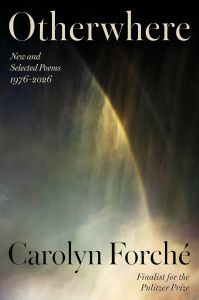
One new poem in Carolyn Forché’s Otherwhere: New and Selected Poems 1976-2026, just released by Scribner, draws inspiration from a boat builder in the Loire Valley whom my daughter Rosalind introduced her to. She writes:
In the carpenter’s atelier, there is the beginning of a boat that will
Someday move along the river.
It will take on water in the rain but will never sink.
It will know what it is doing among the reeds.
It will sail even in a heavy dew. As light a river as that.
Wonderous to be floating in a boat we have made from oaks sealed with pitch.
Wonderous to think that we are all floating in a boat we ourselves have made.
These images of promise and of simultaneous displacement and presence evoke a space that Carolyn knows well. And they hint at the significance of the collection’s title.
“Otherwhere” is different from “elsewhere.” I don’t think anywhere is an “elsewhere” for Carolyn. A few years ago, when working on her archive, I gained appreciation for her worldwide affinities and her sojourns in El Salvador, Lebanon, South Africa, and Hiroshima, to name a few places. Even then, she was perpetually on the go, off to Ukraine, to Slovakia or France, or across the United States for readings, retreats, and symposia, to run workshops and judge prizes. She still is. As I write this, she’s just returned from Oslo and is headed to Texas.
But just as there is no elsewhere for her, nor is anyone “other” to her. When I arrived at her home on the mornings we worked together, she’d sometimes tell me she’d been up at night talking to a doctor in Gaza, or arranging safe passage for wounded children out of the war zone. Some of this emerges in new poems like “What We Don’t Know” or “Texting with the tents.”
Her travels to Ukraine and her interactions with poets there inspired poems including “Lviv” and “On Being Watched from Above,” which I was privileged to hear in early drafts. Then again, she was off to the Midwest, where she was raised and where, after visiting Minneapolis, she wrote “On Living in the Hour of Cities Under Siege.”
So, what then, is the “otherwhere”? It doesn’t sit predominantly in words but, rather, in between them. It abides in the juncture between the mortal and immortality, beyond the mists of consciousness.
Her third collection, The Angel of History, demands particular appreciation for this quality. The mosaic of these poems is constructed from shards and fragments of conversation and the language of thought, through which the ineffable breathes. I think of this book as her Waste Land. There’s something you cannot fully grasp about it. Perhaps it’s her least-known work. In reading it, I find I must sit with the discomfiture and then see what emerges. What haunts you comes into focus.
Many years after that book, she produced Blue Hour, which she describes as “l’heure bleu, between darkness and day, between the night of a soul and its redemption, an hour associated with pure hovering.”
I first met Carolyn around the time Blue Hour was published, but then I moved to Rome for several years. It wasn’t until 2018 that we reconnected at Politics and Prose Bookstore in Washington, DC, and rekindled our friendship. The ARC of her What You Have Heard Is True: A Memoir of Witness and Resistance had just come out. I was stunned by it.
In the Lateness of the World was published as we began working together on her archive. That sense of hovering spirits is something I experienced firsthand with her — when, for instance, she told me stories of Grandpa Good Morning, whom she wrote of in her first book, Gathering the Tribes. As we conversed, something would shift in the atmosphere of the room.
One morning, we were preparing to unpack a shipment of books and manuscripts that had been in storage for many years when Carolyn received an email informing her of the death of an old friend and fellow writer. As we talked about her friend, I told her to wait for a sign from him. She had just gone downstairs when I opened up and began unpacking one of the boxes at random — only to discover, on top of the stack, several books written by this deceased friend and inscribed to Carolyn. Such experiences were not uncommon while I was working with her.
I believe she writes from this space. She describes scenes of deep human suffering with the sense that the souls are, as Shakespeare has it, “but a little way above our heads.” Then she gives us images like “a pouch of polished quiet from a locked church” — as if, as she writes in Blue Hour, “space were touching itself through us” or, from another more recent poem, “like wrapping snow in tissue paper.”
She sometimes writes of horrors that many prefer not to think about, although never gratuitously. In one new poem, “Written in pencil/left out of the manuscript,” she concludes:
“some said there is nothing we can do others said no there is something and they were like the roosters trying to wake us.”
Carolyn and I have shared many confidences over the years, and I consider her a dear friend. But I still don’t fully understand her. The secret of her creative impetus, of how it is she does what she does — of what Henry James called “the figure in the carpet” — remains, for me, elusive. But in reading her poetry, I do move a little downriver, floating in a boat that she has made into the mists of the otherwhere.
Amanda Holmes Duffy is a columnist and poetry editor for the Independent and the voice of “Read Me a Poem,” a podcast of the American Scholar.