The emotional geography of As I Lay Dying.
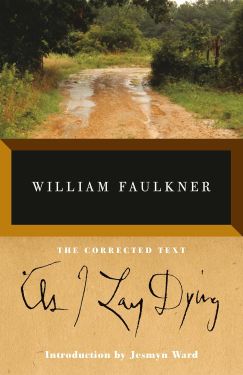
As I Lay Dying (1930) by William Faulkner is not a long book. With 59 brief chapters and punching in at just under 60,000 words, the novel, my AI overview tells me, can be read by the average person in less than four hours. Which goes to show the limits of AI.
Considering there are 15 discrete viewpoints narrated in the stream-of-consciousness style, you could say the heft of As I Lay Dying resides in the depth and density of its telling rather than the span of its contents. Most of the characters speak (and think) in the Southern dialect of Faulkner’s fictional Yoknapatawpha County in rural Mississippi. The reader must patiently, and sometimes painstakingly, discover the characters through their drifting thoughts and the drifting thoughts of those who observe them.
Meet the Bundrens, a poor farming family of seven. There is the middle-aged mother, Addie, who is in bed dying when the story begins. Her eldest son, Cash, is outside sawing wood for her coffin — within earshot. The next son, Darl, is the character readers will come to know best, given the total of 19 chapters told from his perspective. More eloquent and introspective than the rest, he appears to be the unstated head of the family but for one flaw: He hates his younger brother Jewel.
In the opening paragraph, Darl thinks anyone watching him and Jewel would notice the physical differences between the two: Jewel’s hat is “a full head above” Darl’s. Here, we’re alerted to the fact that Jewel stands apart from the rest of the family.
It might be because Jewel is Addie’s favorite. Independent and proud, he worked in secret one summer (night shifts on another farm) to buy himself a beautiful horse. When Addie dies, the Bundrens set out in a mule-drawn wagon to bury her where she grew up, 40 miles away in the town of Jefferson. That Jewel rides his horse instead of going in the wagon with the others is a powerful commentary on his relationship with them; he is both distant and superior.
Seventeen-year-old Dewey Dell is the next Bundren child, and when we meet her, she is fanning Addie on her deathbed. In the aftermath of Addie’s death, Dewey Dell assumes the care of her little brother, Vardaman (a small child of around 6), and cooks dinner for the family. Curiously, Dewey Dell and Darl can communicate telepathically. Darl witnesses scenes he is not present for. Though he (and Jewel) are away on an errand when Addie dies, that chapter is narrated from Darl’s perspective.
The Bundren father, Anse, is introduced as a puzzled, bumbling man who believes he’ll die if he breaks a sweat. Nevertheless, his insistence on their quixotic mission to Jefferson, where they will be met with both high water and hell, makes him sympathetic. At least at first.
“I give her my promise,” is Anse’s refrain throughout the journey. “She is counting on it.”
En route, obstacles abound. Bridges are flooded and washed away; the wagon overturns in the river, drowning the mules. Cash breaks his leg. Addie’s body begins to decompose and smell; vultures pursue the wagon. A barn goes up in flames, further threatening the family’s mission.
If you have yet to read the book and worry my summary spoils too much of the action, rest assured: The real story, the real stories, are found in the secret lives of each Bundren. And given the multiple-viewpoint structure of the book, those secret lives, along with the revelations and consequences they engender, are best understood as short tales in a linked collection that is simultaneously, brilliantly, a novel.
James Franco, who directed and starred in the 2013 film adaptation, evidently understood this when he deployed a split screen to signal different perspectives of the same events as well as the bimodal nature of the book.
In As I Lay Dying, the novel, the Bundrens are drawn together through their pilgrimage, a united front against nature and polite society. In As I Lay Dying, the stories, that same family is pulled apart; multiple snapshots depict the moments where characters’ hidden agendas boil over and threaten to tear them asunder.
Each member of the Bundren family has their own reasons for going to Jefferson. Cash needs his coffin to balance perfectly in the wagon; Darl wants to confront Jewel about the latter’s paternity; Jewel wants to show off his horse; and Dewey Dell is desperate for medical attention to solve her “female trouble.” Even little Vardaman needs this trip to understand the geography of his mother’s death:
“Did she go as far as town?” he asks.
The answer: “She went further than town.”
Anse wants false teeth. And Addie, even in death, wants to be as far away from these people as possible. It’s a brutal sentiment for a mother to have, yet it nevertheless becomes understandable.
The need to know whether the Bundrens complete their quest will keep readers pushing through to the end of this darkly comic work. That, and wanting to find out what the yearnings of each character will ultimately cost them. As the Bundrens think about their personal circumstances, another layer of the book opens up, the most important one: a lilting philosophy of the impoverished rural South and its inhabitants’ attempt to make whole the parts.
You can join Dorothy in next reading 1984, which will be the subject of her column on March 30th, 2026.
.png)