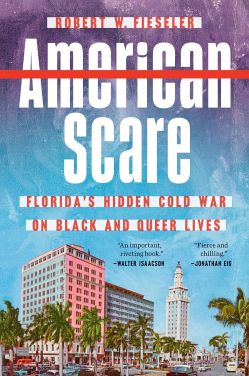
A Pride Month commentary on Robert W. Fieseler’s eye-opening American Scare.
The maxim was inscribed on the Temple of Apollo: “Know thyself.” That ancient Delphic injunction pointed inward, toward one’s deepest sense of personal truth. But that innermost sense, hardly existing in a vacuum, lived in dialogue with other selves attempting to manifest their authentic truths in a body politic.
Knowing oneself, then, was both an internal command and an external conflict. What about the ugly truth of bigots? By that standard, being gay meant understanding the long and dangerous history of discrimination, of “closeting” oneself, and of seeking safe places in coded ways.
Lesbian, gay, bisexual, transgender, and queer persecution throughout history has been driven by themes of scorn, prejudice, cruelty, opportunism, and blatant hypocrisy. Anti-gay laws, such as the Buggery Act of 1533 and its successors, made intimacy either impossible or dangerous. This “offense against God,” as ecclesiastical law long defined it, carried harsh penalties and public humiliation. There was also a cultural aspect, which involved shame, harassment, and discrimination both private and public. Even today, being outed in some countries can lead to a death sentence.
Pride (and Prejudice)
True, things began to transform in the United States in 2003 with the breakthrough case of Lawrence v. Texas, which decriminalized queer-sex acts and paved the way for the rights of gays to marry (see Obergefell v. Hodges). But since then, reactionary campaigns have set their sights on taking cases to the Supreme Court to overrule Obergefell and thereby delegitimize the landmark 2003 ruling.
For example, the Southern Baptist Convention has launched an anti-gay-marriage campaign, as have other national groups (see also here). Meanwhile, 31 states have trigger laws that would end marriage equality for future couples if the Supreme Court overturned its legalization of gay marriage. In short, gay rights are once again under attack in America.
Take heed.
Against that backdrop comes this year’s Pride Month, a time to reflect on the past with an eye on how best to continue securing LGBTQ+ rights. To that end, two enlightening books by a new friend of mine, Robert W. Fieseler, are well worth reading. I refer to American Scare: Florida’s Hidden Cold War on Black and Queer Lives (2025) and Tinderbox: The Untold Story of the Up Stairs Lounge Fire and the Rise of Gay Liberation (2018). For now, I’ll confine my comments to American Scare, a treasure trove of largely forgotten moments in time when homophobia merged with racism to oppress those “others” falsely deemed enemies of the state.
Since history often repeats itself, the lessons from American Scare deserve our attention, if only to remind us of the evils of bigotry and what can happen when silence promotes prejudice.
Florida Fanatics
It all began in Florida in 1956 and continued until 1965. That was when the seeds of bigotry started to grow in a society fed on the worst kinds of prejudice. The formula (still used today) was simple: Create unjustified fear, back it up with exaggerated hysteria against cultural scapegoats, enforce it with unjust laws, and then ruin lives and livelihoods while bystanders remain quiet. The tactic lasted until the evil behind it was defeated by courage and humanity, but it took a long time and many sacrifices.
That’s the powerful story told in Fieseler’s American Scare. Among other actions, Southern state officials met secretly at the De Lido Hotel in Miami. In such places, they conspired to root out so-called Communist insurrectionists (sound familiar?), meaning those with different political views. Soon enough, extra-judicial Florida commissions (i.e., the infamous Johns Committee) employed Red Scare tactics and used the hot-button word “Communist” to persecute and prosecute anyone who dared to speak out for social justice. Teachers were targeted, ministers were intimidated, and civil-rights activists were threatened. First, they went after purported “Communists,” then Blacks, and then gays, along with any “extremists” demanding constitutional equality and freedom of speech.
Over time, thanks to figures like the NAACP’s Robert L. Carter, the Supreme Court took up the case of Gibson v. Florida Legislative Investigation Commission (1963). The petitioner, Reverend Theodore R. Gibson (president of the NAACP’s Miami chapter), had earlier been held in contempt by Florida’s Legislative Investigation Committee, which refused to hand over an NAACP membership list. The court ruled against the state.
But that was not the end of such harassment. After a 1964 Florida legislative-executive-session committee meeting held at the Algiers Hotel in Miami, 2,000 copies of a purple-covered homosexuality report (aka the “Purple Pamphlet”) were distributed to legislators, police, reporters, educators, and parent-teacher associations. The goal: To expose gays, demonize them, and then let “the purple panic” begin. Lives were shattered, careers destroyed, and families torn apart. It was cruelty driven by bias without any legitimate justification.
Uncovering the Coverup
Once the dust settled, the cover-up began as Florida officials sought to erase, both formally and functionally, all evidence of their odious handiwork. Documents were shredded, while other records were made mostly inaccessible to the public. This effort to wipe away history might’ve succeeded if not for a paralegal and open-records advocate named Bonnie Stark, who, in 2021, came into contact with Fieseler and secretly shared copies of incriminating reports, the originals of which had been destroyed. With that disclosure and Fieseler’s historical findings and analysis, the Florida officials’ wickedness was finally exposed.
To be sure, there is more to the powerful and heroic stories in Fieseler’s American Scare. Meanwhile, there is a lesson here: Bigotry is kept alive by silence; evil is continued through inaction; social justice cannot exist without courage; and the lessons of past wrongs cannot be learned if they are erased.
Three-quarters of a century after Florida’s homophobic campaigns, the past seeks to reclaim its hold on those who are American enough to march to their own drummers, speak freely, and love openly without fear. They strive, through words and actions, to know themselves in the fullest sense. But to achieve this, they need a true history thoughtfully and thoroughly presented, as it is in Robert W. Fieseler’s American Scare.
Ronald K.L. Collins, a cofounder of the Independent and the History Book Festival, is a retired law professor and the author of 13 books. His most recent works are Common Sense in the Age of Trump: A Guide to Saving Our Republic (co-authored with Russell W. Huxtable, Amy L. Marasco, and Paul M. Sparrow; forthcoming Aug. 1, 2026) and Tragedy on Trial: The Story of the Infamous Emmett Till Murder Trial (2024). His upcoming book, Forbidden Freedom, is a Patricia Highsmith-like modern love story that navigates between fiction and realism, blending a true tale about the future of gay rights with prejudiced wrongs.
.png)