Why do so many of today’s fictional detectives embrace the dark side?
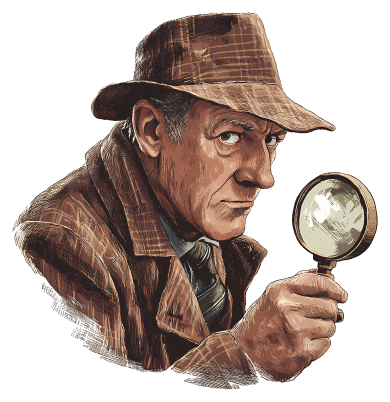
The classic detective in murder mysteries is someone who plays by the rules, using ingenuity and perseverance to catch a killer. In many modern mysteries, however, the lead detective is a thug — a guy who breaks the rules, lies, fabricates evidence, and uses unauthorized violence to achieve a rough sort of justice.
These detectives, whether cops, private eyes, or amateur sleuths, are out-of-control rogues. In terms of their moral character, they seem more like villains than heroes. If you regularly read murder mysteries, you’ve probably encountered one or two.
Good old Harry Bosch, Michael Connelly’s dogged LAPD detective, now retired and working cold cases, is, in fact, a rogue. In multiple books, Bosch bends or breaks the rules. As a younger man, he bent or broke arms from time to time. Even as a retiree, he sometimes engages in vigilante justice when he believes the legal system has failed.
Harry Hole, Jo Nesbo’s former police detective, is even easier to spot as a rogue. In Nesbo’s earliest books, Hole was so brutal and unmoored that he got demoted and then fired from the Oslo police force. As a USA Today reviewer once put it, Hole is “the reigning bad boy of Norwegian crime fiction.”
In recent years, several mystery writers have created detectives or sleuths who don’t seem like rogues but who are revealed to have some of those characteristics when you peel the onion far enough. One of these, surprisingly, is C.J. Box’s Joe Pickett.
A Wyoming game warden, Pickett is a straight arrow, but he’s often drawn into dangerous situations where he’s out of his depth. Moral integrity doesn’t help when you find yourself the target of cutthroat drug dealers, kidnappers, or saboteurs. In these situations, Pickett teams up with his best buddy, Nate Romanowski, a former Special Forces soldier adept at guerrilla warfare. When Pickett the moralist gets into a jam, Romanowski the rogue bails him out, making the former a rogue-by-proxy. He doesn’t do the dirty work himself, but he surely knows — when he reaches out to Nate — that laws will be broken, rules will be broken, and legs will be broken.
Or worse.
Of course, Box isn’t the first author to give a likable sleuth some moral camouflage for crimes committed by friends or associates. In Walter Mosley’s L.A. noir books, P.I. Ezekiel “Easy” Rawlins behaves honorably until the going gets tough, at which point he allows his scary friend Mouse to liquidate the bad guys.
A more complex case is Adrian McKinty’s Sean Duffy, a member of Northern Ireland’s Royal Ulster Constabulary in the time of the Troubles. Duffy’s ethical code is shaped by both his Catholic upbringing and his official duty to protect Protestants from the wrath of the IRA. When Duffy sees injustice on either side, his moral core is activated. Occasionally, he responds with violence. Over time, though, he looks back on some outbursts with regret, which makes him a “rogue with remorse.” In multiple books, McKinty portrays Duffy as a person with a strong moral core who tries to learn from his lapses.
Another rogue with remorse is Allen Eskens’ Minneapolis homicide detective, Max Rupert. When a person close to Rupert is brutally murdered by a cunning criminal, he takes matters into his own hands and achieves a rough kind of justice. But he feels so guilty about this that he resigns from the force without a word of explanation. Later, as a civilian, he’s sucked into a search for a man who has kidnapped the daughter and grandson of a retired sheriff. What will Rupert do?
Have you noticed that all of my authors thus far are men? That’s because female mystery writers often portray their leads as moralists or pragmatists, not rogues. P.D. James’ Adam Dalgliesh of Scotland Yard wouldn’t dream of cutting corners or cutting off the fingers of a prime suspect. Louise Penny’s Armand Gamache of the Sûreté du Québec puts his own job on the line in order to protect his staff and foil a criminal conspiracy. And Linda Castillo’s Sheriff Kate Burkholder investigates a case that implicates her and her family rather than allowing a murderer to go free.
Which brings me to the good news: In fiction, as in real life, both pros and amateurs run the gamut from moralists to pragmatists to rogues. If you’re thinking of writing a mystery, reading a mystery, or, hell, even committing a serious crime, you have plenty of role models — dubious or otherwise — to choose from. Come on in, the water’s fine!
Bill Gormley is the author of Too Many Bridges and The Silent Trumpet, murder mysteries published by Level Best Books. He is a University Professor Emeritus at Georgetown University.