An old book offers more than a glimpse into the past.
Louise Dickinson looked up from her canoe and toward the riverbank. There, a lanky man was chopping wood in front of a boarded-up house. He hailed Louise’s party of eight and told them it was his very first day at this house — or camp, as they call it in Maine — and would they like to join him for lunch to celebrate?
This isn’t the start of a horror story but rather a romance. Ralph Rich was 43 years old in 1933, when he invited Louise and her fellow travelers to join him on that forested riverbank. Louise was only 30, but she found Ralph’s dry sense of humor and commitment to leaving his urban life behind attractive. Eight months later, they were married, and Louise, too, could leave her city life to move to remote, backwoods Maine.
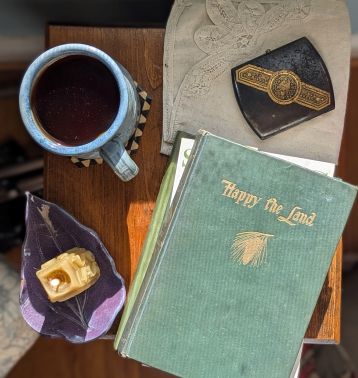
It was another August in Maine, over 90 years after Louise’s canoe trip, when I climbed the steps of a seaside bookshop and navigated the wobbling piles of books. In the dimly lit shop, overseen by a bookseller nearly as dusty as his wares, I picked up a pretty green book with a gold pinecone decorating the front cover: Happy the Land. The story of a woman living in Maine’s forests in the 1930s and ‘40s sounded interesting. I bought it.
In her foreword to Happy the Land, her second book, Louise explains that Ralph died unexpectedly on a snowy December night in 1945. Devastated, she turned to writing to remember and record the joy she found in their shared home.
Happy the Land is thus filled with anecdotes, as Louise recalls summer afternoons playing raucous baseball using sticks, or the fawn found desperately swimming in the lake that she nursed back to health using her own baby’s formula and bottles. Louise, by her own account, likes to “yak,” and she makes for very pleasant company.
The premise of the book, though, might be troubling for modern readers. Louise was raised, she tells us, in Massachusetts, “where every stone is stained with the blood of a patriot, every ancient elm once shaded a treaty signing…The weight of history lies upon everything.” And she is sick of it.
She loves her new home, which “had no past, in the accepted sense of the word.” The Native American (“Indian,” she says) stories are “purely personal” — like hers. I have to imagine the Abenaki people and others forced from those lands would disagree.
In fact, those personal stories are the only history Louise believes in here, and they give the book its title. She writes, “Happy the land, someone has said, that has no history.” History, she implies, has lost its moral standing, particularly when whole cities can be wiped out and “races subjected to unthinkable things in the name of History.”
From the distance of the 80 years since Louise published her book, that argument seems both understandable and myopic. Happy the Land offers both time travel (Louise cooks breakfast on a wood-burning stove, and when the grate falls out of that, in the living-room fireplace) and time blindness. The book was written during World War II and encompasses some events that took place during that timeframe, yet it only mentions the conflict in passing, by way of explaining the shortage of men to work. Louise’s disregard for the larger canvas of History is apt for her theme but uncomfortable.
We cannot escape the histories that have shaped us.
Still, as I delight in Louise’s peppy adventures canoeing and trekking around western Maine, I wonder, too, if she doesn’t have a point. Perhaps even a feminist point. Histories are, after all, just stories. They are stories that happened to people.
If we lose track of the individual in the sweeping panorama, we lose track of truth. Messy decisions seem, from the sanitizing distance of centuries, inevitable. Of course the colonists in Louise’s home state of Massachusetts would choose to throw the tea into Boston Harbor in protest of taxes; of course George Washington decided to cross the Delaware River.
But by reminding us that all we have are personal stories, Louise is also (inadvertently) reminding us that histories are complicated narratives of choice.
In this age of disempowerment, when it’s so easy to feel that, as individuals, we have no control over our lives, Louise’s stories of her beloved family home in Maine are both an entertaining balm and a useful tonic.
And I think she’s right about at least one thing: Every story matters.
Carrie Callaghan is the author of the historical novels A Light of Her Own and Salt the Snow. She lives in Maryland with her family and four ridiculous cats. You can keep up with her and her future columns on Instagram or Substack.