Why poetry is the enemy of myth.
In the dark times
Will there also be singing?
Yes, there will also be singing.
About the dark times.
– Bertolt Brecht
America isn’t merely a country, it’s a myth-making machine. From its founding onward, it has relied on narrative to explain itself. The circumstances of its expansion were often unpleasant and so, in the telling, became a series of creative interpretations, equal parts mechanism for narrative control and rationalization.
Thus, conquest was described as destiny, violence a means of enforcing virtue, and accumulation (of goods, territory, or, in the case of slaves, people) as the necessarily messy work of empire-building. The frontier, the self-made man, the city on a hill, the invisible hand — these aren’t ideas so much as reusable scripts, endlessly adapted to justify whatever comes next.
What gets lost in the recycling is not only the often-unsavory events but their consequences, the causes and effects of acquiring or enforcing power. The United States, from the outset, was seldom united; in fact, those jockeying for control utilized an “us vs. them” cudgel to rally converts to the cause. From George Washington to Ronald Reagan to Donald Trump, the legends have done heavy lifting in service of how history gets written.
This is where poetry enters, less as commentary or explanation but as interruption and clarification. Poetry finds meaning in the madness and helps us see through the dust and bluster.
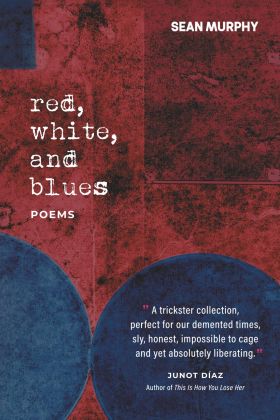
My new collection, Red, White, and Blues, is a book of poems about American mythmaking: how it forms, how it hardens, how it disguises itself as stability. The poems move across centuries and registers — biblical, colonial, cinematic, corporate — because America’s story does the same. Columbus becomes Custer; Custer becomes Reagan; Reagan becomes a slogan; the slogan becomes policy; the policy becomes collateral damage. Somewhere along the way, the story improves, while reality worsens.
Most presidents and CEOs are nothing if not storytellers. And America has always rewarded its narrators more generously than its witnesses. The true engine of American hegemony isn’t domination, it’s persuasion — at times cheerful, often violent, almost always unexamined. How does one party consistently convince an entire demographic to vote against its own interests? Good storytelling. And how does another party repeatedly fail to make clear to that demographic that it’s being duped? Bad storytelling.
Poetry works differently, moving sideways, obliquely, through individuals and moments, trusting accretion to do the work ideology cannot. This allows us to connect obvious dots between ideology and politics, faith and power, what gets sold vs. what is seen. A poem about Jeff Bezos’ billions isn’t really about Bezos, then — or only him. It’s about distraction, about how technological spectacle diverts attention from infrastructural decay. Ditto a poem about Elon Musk, who has been coolly packaged for years as an eccentric genius: Playing by the rules can only slow him down, so he goes about dismantling the planet unhindered and unaccountable.
Understanding how greed has been legitimized via the tragic approbation for Gordon Gekko helps us understand how — and why — a billionaire buys and then bankrupts a beloved newspaper. A poem about Rupert Murdoch isn’t biography so much as entomology: seeing a man like Murdoch — and his appetites — under a microscope helps diagnose the pathology.
America doesn’t suffer from a lack of information so much as an excessive, compulsive belief in false narratives cynically told and sold. We are surrounded by data, statistics, recordings, receipts, and yet we continue to live by stories — those durable, seductive myths that turn violence into destiny, exploitation into innovation, and acquisition into inevitability. These stories don’t merely mislead us; they organize us, establishing who is forgiven and who is forgotten.
Poetry doesn’t replace journalism or history; it interrogates the stories they propagate. If it fails to tidy things up, at least it helps us find meaning in the mess. This is what the best art has always done, and this is why poetry still matters, even — especially — now. “It is difficult to get the news from poems,” William Carlos Williams famously wrote, “yet men die miserably every day for lack of what is found there.”
Williams, of course, was right: People don’t die from lack of news. They die from lack of attention, of precision, of language that refuses to politely lie. Red, White, and Blues doesn’t pretend poetry can save us. It suggests something quieter and more radical: that seeing clearly might be the beginning of refusing the stories that keep killing us.
[Editor’s note: Sean Murphy will speak during the Alan Cheuse International Writers Center’s “In the Writers’ Studio: the Critic” event on May 14th in Washington, DC. Learn more here.]
Sean Murphy is the founder of the nonprofit 1455 Literary Arts and directs the Center for Story at Shenandoah University. He has appeared on NPR’s “All Things Considered,” and his writing has been featured in Salon, the Village Voice, Washington City Paper, the Good Men Project, Writer’s Digest, and elsewhere. He also hosts the podcast and Substack “Some Things Considered,” where he interviews bestselling authors, acclaimed critics, and celebrated musicians.