On Birmingham, civil rights, and good trouble.
“Join me in Birmingham after the April meeting,” my daughter suggested in January, knowing I’ve wanted to visit sites along the Civil Rights Heritage Trail there. I booked my ticket.
Reading is as necessary as packing before a trip, and I started with Taylor Branch’s America in the King Years trilogy. The three volumes combined are 2,200 pages. I needed this epic to be portable, so I shifted to an e-reader, completing the first volume and beginning the next before departure. I read hard, cramming, wanting to make up for all I did not know, did not remember. Branch provides complex context to my memories and partial understanding.
Early on the first morning of our trip, we walked through Kelly Ingram Park. We’d visited it the afternoon before, and the adjacent Civil Rights Institute. Now, we passed slowly among statues commemorating marches, demonstrations, prayer and song, and assaults on participants by bystanders and police with dogs, clubs, and fire hoses. Adults and children were arrested and jailed. On the park’s corner, across from the 16th Street Baptist Church, four bronze girls dance and skip, frozen forever in a moment of joy.
Sunday, September 15, 1963, five girls — Cynthia Wesley, Carole Robertson, Denise McNair, and sisters Addie Mae and Sarah Collins — chatted in the church basement’s ladies’ room, getting ready for the morning’s Youth Day ceremony. Men drove by and tossed bombs, killing four of the girls and reducing much of the church to rubble. Three of the dead were 14 years old, one was 11. The sole survivor, Sarah Collins, was 10 — my age in 1963. The identity of the perpetrators, Klan members all, was immediate common knowledge. The first was not tried and sentenced to life in prison until 1977, the next two not until 2001 and 2002.
We took a long moment, gathering ourselves, and crossed the street for our appointment to visit the church. The guide, a congregant, double-checked our reservation. This was the only tour on a busy day: April 4th, the anniversary of Martin Luther King Jr.’s assassination in Memphis. The church would close soon for an event. He directed us to the basement.
I attended Sunday School in the basement of a Unitarian church in the suburbs of Washington, DC. This basement reminded me more of the Midwestern Presbyterian church where church ladies served lunch after the funeral for my grandfather, a minister. But the basement in Birmingham had been the site of murders, had become a tomb. Now, it is a museum documenting the church’s history and role in the Civil Rights Movement, the bombing, and the nearby killings of two young Black boys later the same day.
A busload of students arrived, an integrated high-school group. (The bombing occurred days after Birmingham schools were forced to integrate.) The tour guide escorted us all upstairs to the sanctuary. We sat in pews facing the altar as he recounted the day of destruction. Brick walls collapsed; stained-glass windows exploded into shards. Frantic congregants searched for family. The guide spoke of the years of rebuilding, the congregation’s resolve. Light again streams in through stained glass. He pointed out a large, modern window, a Black Christ on the cross, given by the people and children of Wales.
The guide invited us to return for Sunday services. We would be gone by then, but I wished we could. Standing for a last moment in the sanctuary with my grown daughter beside me, years of living behind me, I thought of the lifetimes stolen from the murdered girls. We embraced and wept.
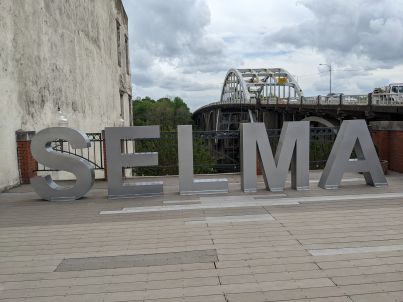
We left the church and the bustle of Birmingham, heading for Selma. An hour later, we drove into town. Many businesses stand vacant. It was easy, too easy, to park near the Edmund Pettus Bridge. John Lewis was bludgeoned here on Bloody Sunday, March 7, 1965; voting-rights marchers crossed the bridge on March 21st on their way to Montgomery.
Beside the bridge, a young Black man stood at a table of souvenirs. He welcomed us to his hometown, introducing himself as a veteran, college graduate, and substitute teacher.
We walked across the bridge. A pick-up truck drove past, then a car. Two elderly Black men approached, heads low, hands outstretched.
Crossing back, we found the private National Voting Rights Museum boarded up, for sale. The United States Civil Rights Trail’s Selma Interpretive Center was locked behind a chain-link fence, “Closed for Renovations for the Foreseeable Future as of March 2025.”
A few blocks away is Brown Chapel AME Church, the launch point for the voting-rights marches to the courthouse in Selma and to Montgomery. Peering in the locked door, we saw only shrouds of dusty, plastic sheeting. It’s been closed for renovations since 2020. The Historic Brown Chapel AME Church Preservation Society needs funds to resume the interrupted work.
Beside the church stands a stone memorial honoring three martyrs: Deacon Jimmie Lee Jackson of nearby Marion, volunteer Viola Gregg Liuzzo of Detroit, and James Reeb, a Unitarian minister from Boston. The inscription reads, “They gave their lives to overcome injustice and secure the right to vote for all Americans.” The adjacent memorial bust of Dr. King is inscribed, “A Tribute to Those Who Planned, Encouraged, Marched, were Jailed, Beaten and Died to Change Black Americans from Second Class to First Class Citizens.”
Leaving Selma, we crossed the Pettus Bridge, following Route 80, the road the marchers walked, now the Selma to Montgomery National Historic Trail. Easy driving, marker to marker, site to site, for two white women, pilgrim tourists in 2025. Humbling to imagine the danger and bravery of walking this route in 1965, camping in fields and forest, surrounded by hostility. Disturbing to consider how vulnerable sites, rights, and people are now. It was a harsh road then; there’s a challenging road ahead now to safeguard hard-won achievements.
I’d arrived in Alabama over-studied yet unprepared. Being there stirred everything up and pulled it together. The sites testify to evil made ordinary, to suffering, courage, faith, and defiant nonviolent action. The power of place delivered strong medicine for the mind and spirit, a necessary, timely dose of John Lewis’ good trouble.
Ellen Prentiss Campbell’s collection of love stories is Known By Heart. Her story collection Contents Under Pressure was nominated for the National Book Award, and her debut novel, The Bowl with Gold Seams, won the Indy Excellence Award for Historical Fiction. Her novel Frieda’s Song was a finalist for the Next Generation Indie Book Award, Historical Fiction. Her column, “Girl Writing,” appears in the Independent bi-monthly. For many years, Campbell practiced psychotherapy. She lives in Washington, DC, and is at work on another novel.