Why opponents of CRT work so hard to mis-define it.
“Antisemitism” describes a despicable worldview held by those with extreme disdain for people of Semitic, particularly Jewish, descent. It has justified horrible crimes against humanity, including genocide. Even in its less physically violent forms, it often forces Jewish people to live in fear. It is, however, different from healthy critiques of the state of Israel or Zionist doctrine. Such critiques — in present-day political discourse — are themselves anti-hate and anti-genocidal.
“Woke” is a term used by Black people to refer to a state of mind in which one is aware of potentially harmful dynamics at play in a given situation. We (Black people) use it this way: “Stay woke!” We use it to encourage other Black people to (a) educate ourselves to anti-Black realities, (b) remain alert to such things, and (c) not be fooled by attempts to deceive us.
“Indoctrination” is a term used by people who value truth and critical thinking. It describes a form of communicating ideas that limits listeners’ ability to understand a thing or to think. Indoctrinators indoctrinate by restricting, manipulating, or misrepresenting information. According to educational philosopher Rebecca M. Taylor’s “Indoctrination and Social Context,” indoctrination occurs when “actors with authority contribute to the production or reinforcement of closed-mindedness, which threatens both knowledge and understanding.”
“Critical Race Theory” (CRT) is a term that evolved among Black and Latinè legal scholars in the mid-1970s. It explored the impact of race and racism on judicial justice. It made waves and impacted other fields, like education, through which it became a useful frame for teachers wanting to be more effectively culturally inclusive in their classrooms. In none of its forms is Critical Race Theory “reverse racism” or a “divisive concept.” It, in fact, seeks to dismantle racism and do reparative work in an already divisive society. It gives anti-racist educators terminology useful in discussing both problems and effective interventions.
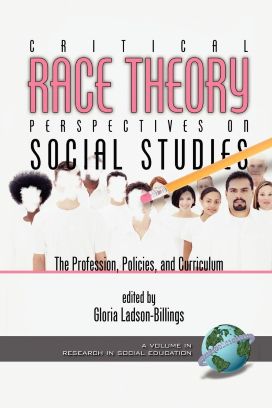
CRT in education was, to my knowledge, first theorized by Gloria Ladson-Billings. In the late 1990s and early 2000s, she adapted the work of the theorists in legal studies to her own field of social-studies research. In the introduction to her 2003 edited volume, Critical Race Theory Perspectives on Social Studies, Ladson-Billings makes the major tenets of this now mis-defined theoretical perspective pretty clear:
- Racism is rampant, foundational to the U.S., and present in its institutions, even when that isn’t readily apparent to everyone. She writes, “CRT begins with the notion that racism is ‘normal, not aberrant, in American society’ (Delgado, 1995, p. xiv), and, because it is so enmeshed in the fabric of our social order, it appears both normal and natural to people in this culture.”
- Minoritized perspectives and the histories of marginalized people are subject to erasure. However, “In the case of social studies, CRT examines the way racism is made invisible through the curriculum…[and] CRT can serve as an analytic tool to explain the systematic omissions, distortions, and lies that plague the field.”
- Social studies, as a profession of educators and education policymakers, is predominantly white. Therefore, “CRT’s analysis of the social studies profession helps to uncover the systematic way that people of color are discouraged from pursuing careers in the social studies.”
- Social-studies instruction and most of its textual materials are Eurocentric. Thus, CRT calls for “textual deciphering…that requires us to look, not only at what is present in these documents, but to ask pointed questions about what is missing.”
That’s it.
Critical Race Theory in education has been under serious assault for the last five years or so, though. Opponents of (something like) CRT change its meaning in order to present it as hurtfully guilt-inducing to white learners. Opponents seem to be changing the meaning of lots of words these days…words like antisemitism, woke, and indoctrination. This is ironic on a few fronts.
For one thing, people who practice CRT in education are likely tuned into the importance of word redefinitions. As critical analyzers of text and racialized narratives, they likely see the moves — including obfuscation — that white supremacists make when they’re assailing inclusivity but don’t want to look like they are.
CRT is not a threat because it’s divisive reverse racism or “woke indoctrination,” whatever that is. CRT is a threat to the old world order because it is very serious antiracist educational activism. To opponents, it must be mischaracterized because it isn’t particularly assailable on its own terms, as data-driven as it is. (See Ladson-Billings & Tate, 1995, “Toward a Critical Race Theory of Education.” See also Ladson-Billings’ 2009 “Who You Callin’ Nappy-Headed?”)
Ladson-Billings is a researcher. Her work, and that of people who followed in her footsteps, is empirical and scientifically methodical. Thus, as the best theory and research do, CRT even applies its criticality to itself. (See Ladson-Billings’ 2006 “The Evolving Role of Critical Race Theory in Educational Scholarship.”)
Critical-race theorizing is in conversation with related scholarship. It is also foundational to newer work. For instance, in the field of educational research — and not political propagandizing — there is a healthy academic dialogue about the matters that concern CRT. Some of the most interesting aspects of that body of work explore methods of instructing white or mixed-race classrooms on touchy matters of race.
Gross and Terra’s 2020 Teaching and Learning the Difficult Past is a favorite of mine. It contains practical and empirically derived wisdom written by dozens of teachers which would quell the fears of anti-inclusion politicians — if those politicians somehow supported critical thinking and social equality. (Fears like theirs, by the way, are also addressed by antiracist educational researchers like the Grim Educator team in Canada.)
Even though it is very purposefully formulated to support minoritized, especially Black, students, CRT in education is not anti-white. In her 2003 article “It’s Your World, I’m Just Trying to Explain It,” Ladson-Billings writes, “It is important to be clear that there is nothing wrong with [the European epistemological] mode of thinking. What is wrong is the imposition of this mode on all people and the dismissal of modes of thought that conflict with it...” The demonization of CRT and wokeness, and the meaning-reversal of so many words, are exactly the kinds of things that critical theorists notice and strive to make clear to others.
“Two plus two equals five” is a famous line from George Orwell’s 1984, signifying the utter breakdown of reasoning that happens when the minds of previously thinking individuals are assaulted by misinformation, disinformation, and propaganda and confused by disingenuous wordplay in states run by aspiring tyrants.
Citizens in such a state should remember, though: Two plus two equals four.
Sarah Trembath is an Eagles fan from the suburbs of Philadelphia who currently lives in Baltimore with her family. She holds a master’s degree in African American literature and a doctorate in Education Policy and Leadership. She is also a writer on faculty at American University. She reviews books for the Independent, has written extensively for other publications, and, in 2019, was the recipient of the American Studies Association’s Gloria Anzaldúa Award for independent scholars for her social-justice writing and teaching. Her collection of essays is currently in press at Lazuli Literary Group.