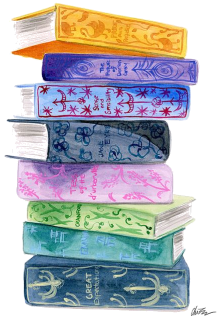
Have you noticed that romance novels are everywhere?
I read several British Mills & Boon romances while in high school in India but didn’t pick up another such story for years and years afterward. The experience of reading these novels as a teen was much like eating candy: enticing but somewhat hollow. I eventually grew out of romances as other books became more appealing.
Then, suddenly, a few months ago, I had the urge to start reading them again. Maybe my empty-nester status had something to do with it. I was now acutely aware of a void in my life that I’d perhaps glossed over before. At the very least, books about love can allow a single person to access some semblance of romance, even if by proxy. These books also feel safe and cozy, since the trials and tribulations of the main characters invariably end on an upbeat note.
Surprisingly, my own rekindled interest in romances seems to have coincided with a widespread growing interest in the genre. There are now dozens of bookstores in the U.S. and Canada devoted solely to romance novels, the first of which popped up in Los Angeles five years ago. The DMV’s first-ever such bookstore, Friends to Lovers, opens in Alexandria next month.
As it turns out, there’s a whole culture around romance novels, with people exchanging recommendations and observations on Reddit. Once I found a book I liked, I was able to search for (and find) recommendations about similar stories from helpful fans. These Redditors have their own lingo that I soon became well versed in. They speak in shorthand like FMC (female main character), MMC (male main character), FM (female-male) romance, FF/WLW (female-female/women loving women), MM (male-male), and so on. Also, novels’ endings can be HEA (happily ever after) or HFN (happy for now).
Then there are the different subsets of the genre. For instance, there’s “grumpy/sunshine,” where one MC (I hope you’re keeping up with the acronyms) is irritable and morose and the other is cheerful and fun; Regency, which everyone now knows thanks to “Bridgerton”; and the self-explanatory “friends to lovers.” There are different steam levels, too, ranging from “1 out of 5” (“innocent”) to “5 out of 5” (“explicit and plentiful”).
In other words, there’s something for everyone.
Still, it wasn’t easy at first to find books that would appeal to my taste because I didn’t know what my taste was. Through trial and error, though, I discovered that my favorite type of romance was funny — with plenty of witty banter. I also liked books where the characters were smart and where the attraction simmered slowly. What was most interesting, though, was my realization that — despite being straight — I liked queer romances more than traditional ones. In fact, a lot of MM romances are written by straight women for straight women.
Lucy Lennox, an author of MM romance, has theorized why straight women enjoy male-male romance. For starters, she posits, MM romance has none of the baggage of FM romance. I find this to be true in my case: The trope of the alpha male rescuing the damsel in distress doesn’t appeal to me at all. I don’t want sexism during my attempt at escapism. Queer romances, by contrast, feel refreshing in the post-#MeToo era because they bypass such cliches and instead offer a glimpse at a different kind of love, minus the toxic power dynamic.
Gay male readers on Reddit, however, have leveled justified criticism at MM books written by women for women. They say these novels can fetishize gay men, be replete with stereotypes, and be unrealistic. Fortunately, there are now more and more male authors of MM romances (my favorite is Alexis Hall), as well as female authors who’ve gone above and beyond with their research and thus have earned the seal of approval from gay men.
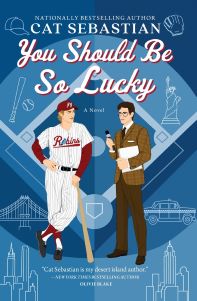
My favorite MM romance so far? You Should Be So Lucky by Cat Sebastian, which is set in New York City around 1960. The protagonists are a baseball star going through a slump and a reporter who’s mourning a loss. While I’m no fan of baseball — and have never read a book about the sport — I found myself absolutely enamored by the slow yearning the characters feel for each other at a time when being gay was fraught with danger.
Nonetheless, my phase of obsessively reading romances may be coming to an end; I’ve started enjoying other kinds of books again. But I won’t go out of my way to avoid this genre anymore — I’m well aware of the solace it offers anytime I need it.
Ananya Bhattacharyya is a Washington-based editor and writer. Her work has been published in the New York Times, Guardian, Lit Hub, Baltimore Sun, Al Jazeera America, Reuters, Vice, Washingtonian, and other publications.