On the nature and artifice of being stuck.
“There is no such thing as writer’s block,” I said, “only fear of the outcome of what we compose.” My community-college students looked at me as though I’d suggested we take a swim in the frigid waters of the lake outside our classroom window. The lake is man-made — not a lake but a pond, really. In the distance, the little fountain sputtered half-heartedly in its midst, and I wondered if my efforts to rouse their artistic sensibilities were delivered with the same perfunctory vigor.
Teaching in these days of rapid and rabid technological advancements — when students turn over intellectual struggle to their congenial friend Chatty Gippiti — feels like distributing proven tools they’ll choose not to learn to use. I’ve been thinking about these tools lately. Like trusted walking sticks, they enabled forays into the forests of textual analysis accompanied by discussions on structure, mechanics, and logic.
I’ve also been thinking about how my students have relinquished the pleasure of fearing unknown territories for the more assured footing of screenland. And I’ve been thinking about my own writing and the fears that accompanied the maiden voyages of my final drafts to publishing’s shores. The fear is different now, transmogrified by rising accusations in the industry of using AI, the very thing we purists have come to despise.
Repetitions in threes; em-dashes and colons (beloved punctuation marks I’ve used for years); mixed metaphors and clichés; academic-sounding titles without substance; inverted reasoning that mimics an algebraic reduction of our thought processes (not X, but Y); pedantic vocabulary; and consonance and alliteration to delight the unmusical among us: These are the hallmarks of LLM-produced text. Yet, when applied correctly, they are really nothing more than tools of the writing craft. Their recent vilification as proof of non-human collaboration should arouse our collective suspicion.
The novelist Olga Tokarczuk admitted her fondness for turning over research to Chat-GPT, which resulted in a social-media outcry that she should be stripped of her 2018 Nobel Prize, never mind that she received it long before AI became available to the public.
Before 2023, the greatest hindrance to my career was my inability to write a successful query letter using the kind of metadata jargon that still eludes me. Today, I must worry about writing a novel aligned with successful — but not too successful — comps while avoiding language and constructions that might be deemed artificial. Worries about both having and not having an artistic practice invite the kind of writer’s block I never believed in until now.
Sometimes, the best thing we can do is to admire artifice: “He played the piccolo on cheerful mornings to rile his neighbors, and he was fond of a carpaccio of capicola, salamino, and mortadella, not because he loved nitrate-laced cuts of cured meat, but because he loved the ease of pulling out cold meals from the fridge.” This sentence — written solely by me in the voice of AI — may be terrible, yet I sense opportunity in dismantling the partialities of the virtual beast.
Maybe we should lean into the AI-fueled madness and let go of expected outcomes. I will return this fall to my classroom with a view of the pond, and if I happen to glimpse its waters when students consult Chatty for answers, I might take a bracing mental swim to the opposite shore. Sometimes, we need to admire our talents from the vantage point of places we’ve never been before. And sometimes, the courage to do so makes all the difference in ridding us of our fears.
[Editor’s note: This piece is in support of the Inner Loop’s “Author’s Corner,” a campaign that spotlights a DC-area writer and their recently published work from a small to medium-sized publisher. The Inner Loop connects talented local authors to lit lovers in the community through live readings, author interviews, featured book sales at Potter’s House, and through Eat.Drink.Read., a collaboration with restaurant partners Pie Shop, Shaw’s Tavern, and Reveler’s Hour to promote the author through special events and menu and takeout inserts.]
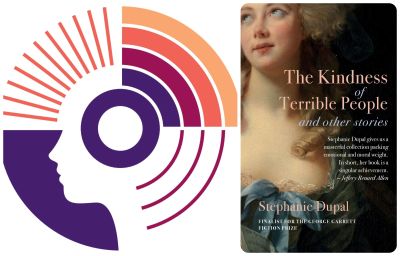
Stephanie Dupal is a professor of English at Northern Virginia Community College. The Kindness of Terrible People and Other Stories, which was published last November to strong acclaim, is her first collection. She believes in the human spirit and crusades against the machine. You can follow her ramblings about creativity and inspiration on Instagram at @stephaniedupalwriter.