Five centuries later, they’re still calling us witches.
These days, when you hear “witch hunt,” it likely doesn’t refer to the murderous persecutions that took place during the Early Modern Era in the United States and Europe. Now used to connote unfairness — or mere displeasure at being questioned at all — the words no longer carry the urgency and terror they did for their original targets.
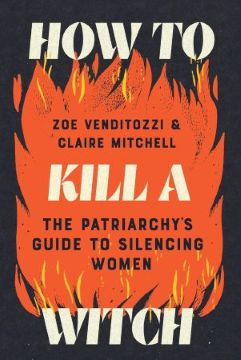
In How to Kill a Witch: The Patriarchy’s Guide to Silencing Women, Zoe Venditozzi and Claire Mitchell remind us of the term’s origin: In the 1500-1600s, thousands of people (mostly women) were accused and convicted of witchcraft. They suffered the insult of having their names, and often those of their families and acquaintances, dragged through the mud based on vague, spiteful allegations.
As if that weren’t enough, many of them were strangled to death and then burned so their bodies wouldn’t reanimate as zombies. (Yes, you read that right.) These victims weren’t simply killed; religious and secular authorities removed them wholesale from the historical record as punishment for their imagined sins.
Good thing those days are long behind us, right?
Here’s what Mitchell and Venditozzi have to say about the people convicted under the Scottish Witchcraft Act of 1563:
“[N]owhere in the legislation does it mention that witches were most likely to be women. Indeed, the wording is entirely gender-neutral. How odd then that of the four thousand or so people accused of witchcraft in Scotland between 1563 and 1736 (when the act was repealed), 85 percent of them were women. It’s almost as if there was some inherent bias against women in this patriarchal society.”
Unfortunately, that doesn’t sound so old-fashioned or far-fetched. In fact, women are still being accused of (and persecuted for) witchcraft — as in the case of a Nigerian child known as Miss B, who, in 2023, was tortured by fire for hours in front of her horrified father, then forced to flee her home with her family for fear of further retribution.
Although an elder relative has been charged with attempted murder in the Miss B case, it was only made possible through the ongoing monetary support of Advocacy for Accused Witches, a group that seeks to intervene in such cases and to foster better critical-thinking skills in children.
Let’s revisit that information: Five hundred years after witch trials ran rampant, people are still being burned alive because they’re suspected of being witches. Have we learned nothing?
Women are also still being “otherized” today in less overtly horrifying but more insidious ways. If a woman is too sexually open or exploratory, she’s a slut. If she doesn’t have “enough” sexual experience, she’s a prude. Seeking a high-powered job can be perceived as cutthroat or unfeminine (where a man would be lauded as ambitious), yet stay-at-home moms are equally devalued and dismissed.
In short, conformity remains a prized quality for women, and those who act outside the system continue to be punished — if not by fire, then in other damaging ways (including physical violence).
How do we address these continuing inequalities? “Take up space, get involved in grassroots politics, educate people around you about what happened during the witch trials, and draw the parallel with today [emphasis mine],” counsel Venditozzi and Mitchell. “When you are met with resistance, call it out.”
In a time when each day seems to bring a new calamity, keeping the past alive can seem a futile aspiration, yet it is vital. Only by honoring those who came before can we help those who follow achieve more equitable outcomes.
Mariko Hewer is a freelance editor and writer as well as a nursery-school teacher. She is passionate about good books, good food, and good company.
.png)