New collections to make life more lyrical.
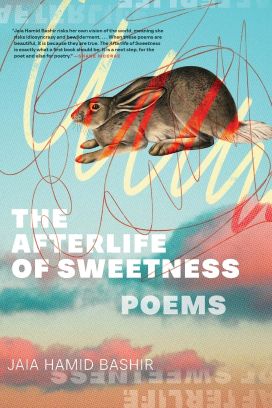
Jaia Hamid Bashir’s The Afterlife of Sweetness is Whitmanesque in its expansiveness but syncretic in its rhetorical flourish. Line after line has such curiosity and delight that I have no doubt Bashir could easily answer the question, “What would you write about if the world were just and not cruel?”
Grounded in inventive images — whether the stark landscapes of Utah or the curated halls of the Metropolitan Museum of Art — Bashir manages to allow so many layered pleasures to engage the senses and sensibilities of the reader. (One wouldn’t be amiss to recall the intelligence and wit of Jane Austen when thinking of the poems Bashir crafts in this full-length debut.) But I’m most struck by the synthesized tones and the syncretic modes that shape the book’s thinking.
First, let’s think of syncretic as multi-versal in that there are allusions to a variety of sacred texts and figures from faith traditions — thus, verses immigrate to the country of other verses — but also in the idea of parallel worlds and parallel selves. In the opening poem, “Stringing the Bow,” Bashir briefly imagines an alternative end for the poet Paul Celan — who drowned himself — one in which he is pulled from the Seine, his “lungs pressed back into rhythm.” This desire doesn’t hide its lament, as the speaker of the poem can only “underline Celan” and admit that “Time opens its hand. I am so afraid of ends.”
The effect achieved is one of sincere tenderness, one that I can hardly do justice to without quoting the poem in its entirety. Which is another way of saying: What an awe-inspiring way to open this collection. Honest and expansive and unexpected are three words that I think best characterize “Sacred Rot,” the first section of the book.
The omnipresence of the multilingual haunts these pages. As the reader walks upon the sands of English, those sands are illuminated by Urdu, Spanish, Greek, and Arabic, to name a few. I’m reminded of Joseph Brodsky’s riposte to Robert Frost, “Poetry is what is gained in translation.”
In the poem “Marrow of Mercy,” Bashir writes, “Everything is more beautiful in Urdu / and Spanish,” a sentiment that could be easy to dismiss if not for the context in which it arrives — namely, while imagining a bit of Márquez’s story “Eyes of a Blue Dog,” whose two lovers never touch except in dreams. One could read Bashir’s two specified languages as the longing between lovers who can only dream of each other. Then, in a skilled twist, the poem turns its ending to the speaker’s memory of her mother cooking mutton:
Despite its braying, I strung
a pretty ribbon bow, the evening before goat-Eid,
a token of tender despair around the animal’s neck.Good girl
I was intrigued by the pilgrimages The Afterlife of Sweetness makes in its second and third sections, “Brine,” and “Fanaa or Unparadise.” Poems like “How to Make an Ariel” and “Pegasus Tattoo on the Left” use myth and the body as points of departure to complicate a way of imagining the self. The poem “Aubade in Another Universe,” among the longer ones in the collection, operates as a love song to a beloved and is perhaps the book’s Song of Songs. In another poem, Bashir places us amid the tangible landscape of the Appalachian Trail, reminding the reader how “a private epiphany was made more secret.”
Along with variety at the content level, there’s also formal variety here. All manner of tercets, whether right- or left-justified, arrive with a sharp sense of how to manage the pace of voice and euphony. These create an antiphonal quality where the reader and the speaker alike can call out to the universe, to God, and expect in return not just the echo of one’s own voice but authentic wonder (which is perhaps the point of all prayers and all poems).
Jaia Hamid Bashir is a devotional poet whose sincerity and intelligence extend the traditions of some of her former teachers and fellow writers rooted in Utah, including Terry Tempest Williams and Paisley Rekdal. Never tightfisted with its epiphanies nor vague in seeking the sacred, The Afterlife of Sweetness reminds me, at times, of Safia Elhillo’s poems in the chapbook Asmarani. This is a debut of startling promise, specific pleasure, and honest love. Above all else, love. That’s what this collection and this poet are devoted to, and by that, I am enriched. I have no doubt many other readers will be, too.
Steven Leyva’s latest poetry collection is The Opposite of Cruelty.