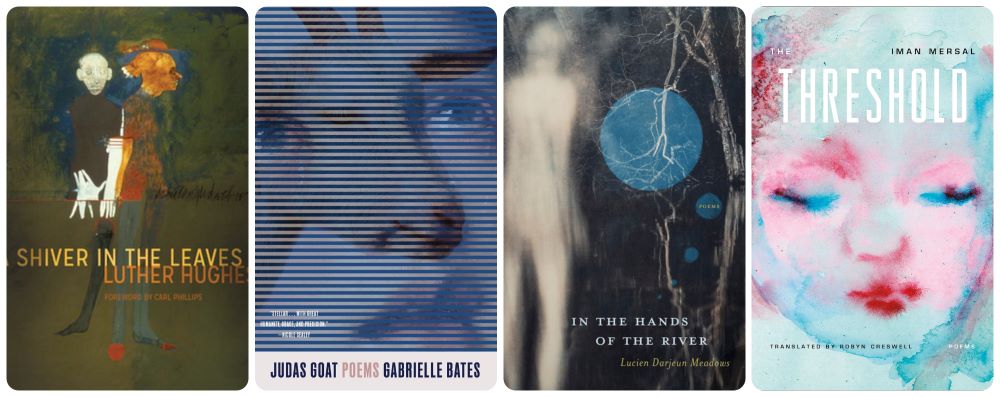
New collections to make life more lyrical.
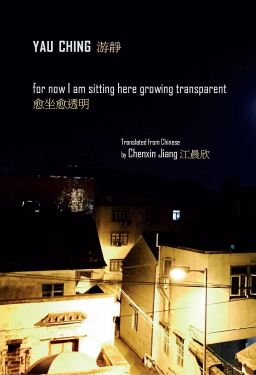
Edward Hirsch wrote in A Poet’s Glossary, “The translation of poetry inevitably strives to re-create a totality that can never be fully recovered. But something else emerges.” Joseph Brodsky reformulated Frost’s position: “Poetry is what is gained in translation.” How the reader and the fibrously human connections we call language are enriched by translation is embodied fully in Yau Ching’s collection for now I am sitting here growing transparent (Zephyr Press), translated by Chenxin Jiang.
Yau’s poems capture the omnipresence of a city’s soul, be it ominous, sublime, or ambivalent, with Hong Kong acting as the central foci of visual landscape. In “Island Country,” she writes of its ethos:
There is an island
that keeps thinking it’s a country
keeps shouting about its honor, honor, honor!
In “Hong Kong Malady,” Yau showcases the vulnerability of the city, what Jiang calls in her introduction to the book its simultaneous “insularity and openness” held in the geographical location of the city and in the psychological tension of its residents:
Being sensitive to the air is a malady
child of public housing projects, I had
headache fevers…
And, then, further down in the poem:
When I finally fled
the box called Hong Kong
my sensitivities were deadened
health itself is just numbness
deadness to the world
The book is organized somewhat like an independent-film anthology, separated into four sections: “HOME,” “YOU,” “PROSE POEMS,” and “DEATH AND ADVENTURES.” Certainly, one might intuit the sensibilities of a film auteur, not only because of the author’s education at NYU and professional experience as a film-magazine editor, screenwriter, and curator of queer film festivals in China, but also because the book includes a handful of still images.
Tonally, this organization allows for both variety and unity, but also a depth of lyrical experience and visual experience. This is why I thought “soul” was the appropriate descriptor for how Yau’s poems engage with the intersections of persona, place, and private desire. There is a fair amount of desire throughout the collection, such as in the poem “That’s how we met”:
the car will spin like a baseball you’ll be home
it’ll be clean swift and bound…
I’d forgotten this fantasy
let’s call it the tide rising in a stormthat’s how we met
Or, additionally, in the prose poem “Bauhaus Exercise in Vulgarization,” which appears twice in the book, one an early version (1989) and one a revision (2020-2021). This is from the latter:
It’s near, chicken wings, you’re craving chicken wings. Which there are many ways of eating. The same wing has many different parts. Marinated in wine grilled High tech stereoed microwave vibrated. Chicken wings, again?! Poke a fork into its armpit.
The obsessing over themes like the experience of time, the instability of language, and the malleability of identity makes Yau’s work feel full, heartfelt, and powered by an intellect that clearly values the subversive nature of the imagination. I encourage readers to engage with the way the collection journeys through physical places and subconscious ephemera.
It’s as if the aesthetics of Robert Duncan’s “Often I Am Permitted to Return to a Meadow” are being applied to Hong Kong’s urban landscapes — though that comparison may not be entirely apt. Yau’s work is clearly more rooted in womanhood even as it questions certain aspects of it. Take this passage from “A Beautiful Crisis”:
I am my mother’s
exemplar of a beautiful life
and that fills me with suspicion of myself and the world
Yau’s work is also dedicated to history and resistance in ways that are different from the Black Mountain poets of the mid-20th century, placing itself within and outside certain traditions. A Black Lives Matter activist could connect with the activism found in Hong Kong’s struggle for independence described in “You and Us”:
We are used to
debris facing backwards while being dragged forward
our backs to the pepper police batons…
All in all, for now I am sitting here growing transparent is both a portal and a port town, a place of syntax where cultures converge and we, as readers, are — like Brodsky imagined — made to consider its poetry by imagining that which it adds to us.
Steven Leyva’s latest poetry collection is The Opposite of Cruelty.