New collections to make life more lyrical.
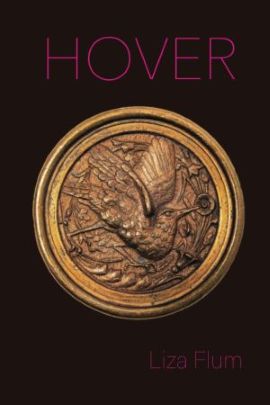
Liza Flum’s debut collection, Hover (Omnidawn Publishing), places the reader above and below the beating of “wings,” whose presence is known not by the precision of seeing, for they move too quickly, but rather by the bodies held aloft. Here, the hummingbird serves as a metaphoric emblem for the intricacies of queer, polyamorous relationships, much in the way mermaids have served as an emblem for portions of the trans community. Flum returns again and again to the iridescence and actions of the hummingbird (and other avian symbols), exploring a kind of prismatic partnership with a lover, her lover’s husband, and the speaker’s other lovers.
Sonnets are abundant throughout the collection, performing a kind of beating of wings that allows the perspectives to hover, opening valences. Sonnets bond the bodies of the figures presented and also narrate discursive poems specifically focused on the hummingbird as fauna, as well as on other people, other subjects, beyond the perichoresis of figures that centers the book. For example, in the opening of “Chimera,” Flum writes:
A dress of plumes: anything to own
a shining thing. To wrap yourself in its skin
half-rubythroat, half-human. The famous gown
sewn from 3,000 skins of Brazilianhummingbirds must have shimmered in light,
draping heavily over the body it hid.
The sonnet proceeds in a traditionally rhymed patterned, though slyly complicates (or, better yet, adds to) the resolving couplet by extending past the end rhyme with the clause “or to let it pass.” One could read that slight alteration to the sonnet form as a representation of how the speaker sees the form of the relationship she has attached herself to. Her vows to her lover are not recognized in the same way as the state sees “marriage,” but her relationship does mirror many of the same behaviors, even as her lover already exists within a marriage more legible to the state.
So, is the speaker simply an “addition” to the rhyme of someone else’s marriage, something superfluous? Is the triumvirate they form — without deception — its own kind of chimera? Flum’s maturity in allowing poems to hold and float above these kinds of questions is what makes the collection so interesting, even as it both emphatically and subtly answers, “No, we are something new and something old.”
Flying parallel to explorations of sexual desire, there is also the beauty and banality of reproductive care within these polyamorous relationships. The speaker and her lover are trying for a baby, and it that happens within the context of poems like, “On getting an IUD while Sara does transfers with embryos made of my eggs and August’s sperm.” Flum introduces some of these concerns in the book’s second offering, “On the ass,” a prose poem in the style of a rhetorical essay. Not only does it engage, as a reader might expect, with a kind of queer eros among lesbians, it also narrates how the buttocks is the site for progesterone injections, leading with the imagery of these procedures:
Today there are small bruises on your ass, not from biting or scratching or pinching like we sometimes do, but from daily needles and one milliliter hormones.
The consistent framing and reframing, both in imagery and in the way a clinical psychologist might use the terms, are what give this poem depth, and ultimately what give the entire collection depth. Plenty of ekphrasis is deployed to interesting effect, but it is the maturity of the intimacy that I find excellently rendered.
Flum manages to make the reader an intimate outsider, rather than simply a voyeur, to relationships that do not fit the hegemonic definitions our heteronormative society puts forward. She has no need for exploitative exoticism, and her speaker is not exploring out of boredom but out of a deep calling to the deep. It is the book’s soulfulness that I admire. This is a collection about the soul-work of making a family, and how we can choose delight even when we’re not fully seen, fully recognized. Even as we are in a constant state of “becoming,” as Judith Butler suggests, we can still choose delight.
Though I suspect I share little in terms of identity with Flum or her speakers, I, too, find that “I can’t seem to crop my own shadow out of the frame,” as she writes in her poem “Nature Photographer.” Hover feels like it darts in the tradition of contemporary poets like Brenda Shaughnessy and Lyrae Van Clief-Stefanon, and I am certain that it not only adds to that tradition but enriches it.
Steven Leyva’s latest poetry collection is The Opposite of Cruelty.