New collections to make life more lyrical.
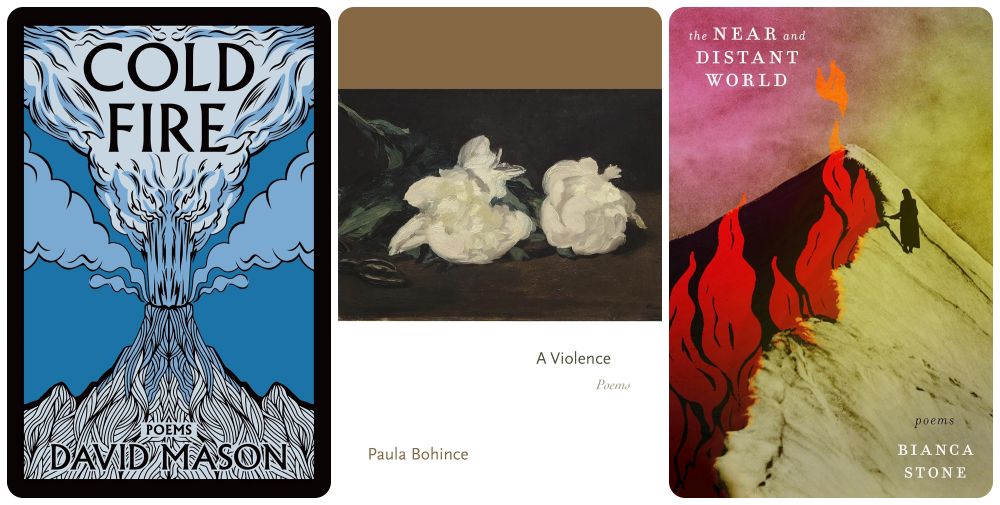
David Mason is an outdoorsman with a deep reverence for the natural world. The title sequence of his new collection, Cold Fire (Red Hen Press), speaks to the controlled-burn practice of Australian First Nation peoples. In the first of these poems, a man sets a cold fire and calls the gum tree Grandfather, then he blesses the insects and animals. I thought of W.S. Merwin, another poet who took his environmental obligations seriously, addressing insects as “elders.”
The next two poems move from the Ring of Fire and “the makings of my native hymns” to the American Southwest, where mountains rise up and basalt crystals are “like organ pipes in snow.” In the final poem of the sequence, “cold fire” emerges as an exquisite metaphor for poetry:
I burn a cold fire here that runs in lines,
a sound like laughter and the hurt that learns.Cold fire takes and teaches, and it talks in signs
until the fire and smoke are gone. And then it sings.
Mason served as poet laureate of Colorado from 2010-2014, but since 2018, he has lived in Tasmania. One section of the book focuses on poems and translations from his time in Greece. This collection captures the grandeur of these places, their light, their timelessness, their lakes and mountains, often employing a fittingly magisterial iambic pentameter.
And all things are connected. The poem “Before the Loon Calls” begins, “The long lake remembers the longer glacier.” As we paddle out across the lake, he reminds us that despite our web-based connectivity, it is here we truly connect:
All that has happened, all that will happen,
moves out of mind, a continuity
of vapor, water, ice and melting ice.
Old age passes back into the elements, and infancy contains memory. He writes in one poem of “old age residing in an infant soul.” Elsewhere, he declares, “I know identity’s a lie./Some part of us remains the fish/we were in the womb.”
His relationship to animal life is equally moving — the scruffy little cat who visits him while he’s writing, the cabin bats on the ceiling of a mountain hut who “dangled down like charms/on a friendship bracelet,” the wallabies, lizards, and rats.
In one poem, a nun must kill a trapped rat with a shovel to put it out of its misery. But she wonders if the rat might escape the “living trap” of the body and return as a clump of grass. The poem finishes:
I live with images, with kinds of death,
carry my shovel to the garden and the grass,
and refuse to say my body is a trap.
In a kind of opposite number entitled “Rejoice,” a little bush rat escapes a trap and “runs, or flies like a stone skipping over the rocks.” “Go! Go!” he says. “Don’t think. Don’t pause to look. Just go!”
Cold Fire is a revitalizing collection that burns off the dross from our tired, worn-out concepts of the world, restoring for us its inherent mystery and splendor.
*****
Reading Paula Bohince’s new collection, A Violence (Princeton University Press), I kept returning to a line in Wordsworth’s “Solitary Reaper”: “Will no one tell me what she sings?” For Wordsworth, the mere sound of the reaper’s song is enough to transport him. So here, the music of these poems, the ineffable tension between sound and sense, makes them immediately haunting. You’ll want to speak them aloud to yourself as you take your time absorbing them.
Soon, their layers begin to unfold. Bohince’s subjects are psychological and ecological crisis and recovery, the need to be nurtured, and innocence that was never protected because it was never expected to survive.
The collection is thoughtfully sequenced, opening with “Accordion Music,” whose alliteration and internal rhyme places us in the impoverished Pennsylvania homestead where she grew up “ignorant as sunshine.” Past is entangled with present, loss with innocence, and these overlap in lines like, “my doomed/daddy in clover, in blown beer foam/ like dandelions in July.”
The ephemeral nature of innocence “wished-on fluff of dying dandelions” is picked up again in one of my favorites, “The Lambs Are Not for Sale.” Here, a cherished love of purity collides with harsh reality. We are admonished to “hold fast to the fantasy,” and it’s the fantasy of the lamb’s inviolate purity that carries the poem.
For Bohince, nature is fragile and survival precarious. Eggs are left to hatch alone, and birds and birdsong disappear without our noticing. There are anomalies in nature, too: black swans, albino deer, and donkeys whose “existence seems a rebuke of symmetry.”
Distress and the sense of almost losing your grip can exist side by side with composure. In “Among Barmaids,” young women working in a dive bar have a resilience the drunks they serve know nothing about:
...We swam
Through their booze, past the pool
Table’s alien island, darts that thwacked the pricked walllike failure itself, spinning like downed ducks
to the filthy tile. Like good dogs, we fetched them.
She often writes in the space between crisis and recovery, where the latter seems a mirage. In “The Skunk,” a poem with undercurrents of unhealed trauma, she lies “on a vibrating mat meant to mimic the maternal embrace.” In “Epic Rain,” an audio meditation app plugs her in “miraculously, / to the seafloor’s fiber optics.” And that’s not even the best line of the poem! There’s always more to extract from these complex, lyrical poems, and they take unexpected turns.
Let me finish almost where I started, with “Elk Moving, Midnight in the Great Sand Dunes.” Here, the sound is felt in the sand before the herd arrives. She writes of:
...a presence
eternally moving, perceived by the snailof cochlea, that harness
which speaks to the ossicles and amplifies the miracleuntil there’s only blacker outlines against
the Milky Way’s galactic pulse.
A Violence is poetry at its magical best.
*****
Bianca Stone is a tireless interrogator of her inner life. In The Near and Distant World (Tin House), she writes of memory and the fallibility of memory, of shadow, trauma, and existential crisis, of her “whole rasping tumultuous human history/punctuated with beauty and burdock.”
She’s deeply invested in “the biological function of words” and in what poetry can do. In one poem, an internet technician picks up her collection of Tomas Tranströmer and asks, “What’s poetry like?” facing her with “the treacherous inadequacy” of trying to explain simply. The poem becomes an ecstatic ars poetica.
Stone grew up in a household infused with poetry. She’s the granddaughter of National Book Award-winning poet Ruth Stone, who served as Vermont’s poet laureate into her 90s. Bianca Stone is Vermont’s current poet laureate, and she also runs the Ruth Stone House, her grandmother’s former home, which hosts literary events.
But shadows loom. Shadow, for her, is both emptiness and the vessel from which creation springs. To put it another way, beauty and burdock are stiflingly codependent. “We hold the singular shadow in us, the deep m-other, the cosmic, looking at itself — God is in the black house,” she writes.
Masks and mirrors mimic selfhood. Even the moon’s light isn’t its own. Poets, she tells us more than once, are liars. “We go to mirrors to see what nothing manifests as,” she writes.
In another poem, entitled “The Mask,” I hear echoes of Sylvia Plath. Here’s an excerpt:
Oh, can’t sleep either?
Here, take these two little white pills.
One’s the moon, the other
the reflection of the moon
on the cold water of a November lake.
One will make you howl,
the other remain silent
same moon, see?
While sometimes drawing on Greek mythology, she’s very inwardly focused. “Thoughts at the Grave” is a contemplation of her grandmother’s gravestone and what lies beneath it. In “Dyad,” she writes, “I resent not being able to quit without serious generational catastrophic backlash.” In one prose poem, she reflects on Jordan Peele’s movie “Nope.” (I wonder if she’d considered “Get Out”!)
Not to be too flippant, but I did so long for her escape from rumination and the reflection of her eye in an espresso cup. I wanted her to lift her gaze and look beyond those five mountain ranges Frost used to write about, one behind the other under the sunset far into Vermont.
There’s a particularly evocative passage in “The Circuitous Path Towards Inertia.” She’s on the way to give a reading (there’s always a reading to get to, as she writes in the first poem), when a childhood memory comes to mind:
And you remember how little
you carried messages for yourself,
for so long, and lived as ambassador
of other’s pleasures, and suffering
until it became your own — but too
you would pretend to know the notes
on the clarinet in school band
and let random sound come to be drowned around you,
hoping to be overlooked by the conductor
and how you’d stay like that,
closing your eyes,
pretending to be swept up in the notes
until you really were — the reed in your mouth
became the same fever as the mouth
as if it had always been there.
Amanda Holmes Duffy is a columnist and poetry editor for the Independent and the voice of “Read Me a Poem,” a podcast of the American Scholar.