New collections to make life more lyrical.
John Yau has had a long career as a poet and art critic. I’ve always thought of him as a second-tier poet of the New York School, a term originally applied to the Abstract Expressionist painters. Although stylistically different than Yau, Frank O’Hara comes to mind. I’m sure they would have been good friends.
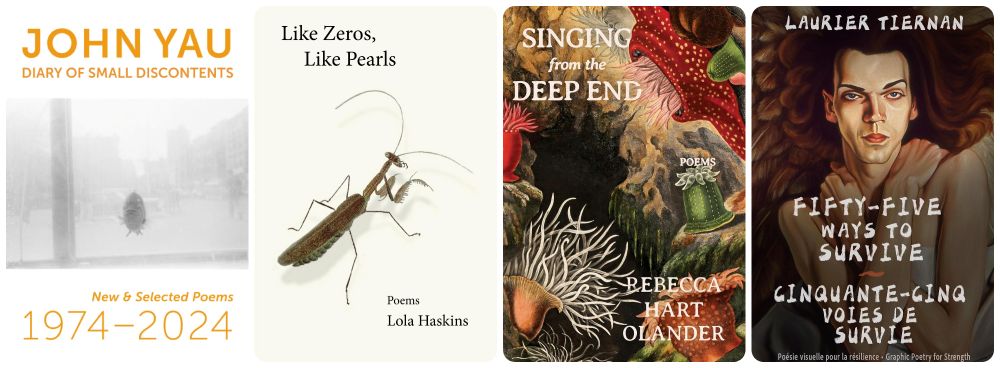
Like O’Hara, Yau has deep connections to the art world, and he’s also very much a New Yorker, but his Diary of Small Discontents: New and Selected Poems 1974-2024 (Omnidawn) underscores how he defies categorization. He’s a master of lists, abecedarians, and prose poems, as well as sestinas, villanelles, and sonnets. And he makes each form uniquely his own with his wonderful, cyclical wordplay.
Yau’s cultural references are wide and deep. But while he takes me out of my wheelhouse, and I can sometimes feel a bit lost, there’s nothing pretentious about him. In fact, he enjoys stripping the mask off those who take themselves too seriously.
After reading his poem “Variations on a Sentence by Laura (Riding) Jackson,” I don’t think I’ll ever read Laura Riding with a straight face again, and I loved his list (according to Lincoln Steffens) of those comprising Mabel Dodge Luhan’s salon. And what can be said about “In the Kingdom of Poetry,” written after Brazilian poet Carlos Drummond de Andrade? It begins:
Don’t write poems
about yourself.Don’t call attention
to your revelationsor make confessions
even if your intentionis to expiate pain
overcome guilt,temper your
understandable anger.
It goes on from here. Then there are Yau’s absurdist birthday prose poems composed throughout his 60s; his series “A Painter’s Thoughts,” which explores various approaches to painting; and his take on film noir and its arcane histories.
He’s written about his Chinese ethnicity in various ways throughout his career. Such poems as “Ing Grish” or “On Being Told That I Don’t Look and Act Chinese” are amusing on one level but painful on another. There’s often that edge — wait a minute, what did he just do there? — and a still-darker side to his “O Pin Yin” sonnets, evidently composed during the pandemic. One ends:
Only old people and those with weak immune systems die from it
What’s wrong with a little horseplay — we’re just having some fun
It’s always in the back of my mind that the world is freaking out
It’s not like they have anything better to do in the summer sun
You can’t start sobbing because gray-wrinkled people croak from it
It makes a great plot for a revenge film that all the young dream of
It’s another good reason to gather outside, drink and sneer
Since his craftsmanship doesn’t draw attention to itself, the poems can sometimes feel breezy, even dashed off. Obviously, they’re not. I sense his profession as an art critic provides him freedom, since his ego is focused elsewhere — again, I think of Frank O’Hara — so that the poems carry themselves lightly even when they’re serious.
*****
Insects make up a miniature universe buzzing all around us. But when we cross paths, we swat at them and squash them, fumigate our surroundings and slather ourselves in repellent. We might be enchanted by the occasional butterfly or ladybug, but most of the time, we find their presence annoying.
Lola Haskins maintains that, by spraying them with poison and eliminating them, “we may be changing forever not just their viability but our own.” Her new collection, Like Zeros, Like Pearls (Charlotte Lit Press), looks closely at the insect world, illuminating its fierce beauty and insisting we treat it with reverence.
The book’s title, she explains, “started out as a straightforward description of insect eggs on grass but ended up as a metaphor for our bifurcated attitude towards bugs. If they do things that benefit us, like pollinate, they are pearls and within our limits, we take care of them. If they don’t, they are zeros and depending on how much trouble they cause us, either we ignore them or we kill them.”
In spare, declarative poems, she works her way from mosquitoes, ants, and flies up through dragonflies and cicadas, uncovering the wondrous in all of them. She occasionally addresses her subjects directly; her poems seem to dance as the insects tear off their wings after copulating or perform surgery by licking each other’s wounds and biting each other’s legs off.
She’s identified a morbidly fascinating eroticism here. In an hours-long mating dance, a pterophylla camellifolia (otherwise known as the katydid) reaches underneath herself “to consume the jelly that clouds his sperm.” A queen bee “arcs across the sky / pursued by a tail of drones. / One breaks his phallus/ into her sting chamber, / falls backward, and dies.” And there’s a decidedly sadistic edge to “Glow Worm’s Dinner”:
The lampyris covers a snail’s foot
with bites until the snail
can no longer move.A few more kisses liquefy
the flesh whose sweet
juice he sucks. Finally,there remains only a shell
clinging to its grass stalk.
You asked me about love.
These haunting little poems capture the peculiar savagery of insect life — its iridescent and phosphorescent colors, its whimsical interplay between heaven and hell. She asks us to consider if insects are spirits or gods. Or are they humans transformed by the gods? Are they really a world apart? Perhaps, in some ways, they are not as different from us as we think.
*****
In Singing from the Deep End (CavanKerry Press), Rebecca Hart Olander explores the ebb and flow of female relationships. The first section, set mostly in Gloucester, Massachusetts, concerns her bond with a free-spirited mother and the mercurial nature of girlhood friendships. She begins with a quote from Ilya Kaminsky — “Poets are not born in a country. Poets are born in childhood” — and writes of her genesis at a poet.
In “Fifteen,” teenage girls “not yet us, but trying to be” drift around Harvard Square, “the hub of cool.” She’s feeling her way forward as a poet, with “poems blooming inside me / like mute swans. I tried to force life into them, / but they leaned from me with their long necks, / their music hidden.”
That notion of a fuller sense of self she’s not quite ready to embrace, one that leans away from her, resurfaces in other poems. In “On Learning to Say No,” she pulls back from a boy who sits on her bed, “resisting his advance, / as a receding wave sucks the shore underfoot / and you almost fall, but don’t, into the surf.”
The ebb and flow of ocean tides works as a metaphor throughout the collection as a continual yielding and resisting. In “Gloucester Music,” she finds herself “so ready to trade widespread uncomplicated joy for experience,” although she can still “feel that girl climbing back up my throat like a scream, burning in her hurry, and I swallow her down again deep, like drowning.”
The Jerica Poems comprising the second section of the book mourn the death of a beloved friend. She opens with a line from Jenny George: “The dead live / in clear pools, inside language.” Again, we get that ebb and flow, that push and pull, as she closely embraces her soulmate in the language of the poems while deeply grieving her loss.
“As Bees” is particularly heartrending. In it, she writes: “In your final week, I held you as a midwife does, / supporting your labor towards the next realm.”
The third and final section opens with a line by Victoria Chang: “Plant your sorrow in / the soil. Next year it will / grow into a set of oars.” The predominant focus here is motherhood and nurturing the children one must ultimately let go. The first poem takes up Tahlequah, an orca who carried her dead calf on her back for over a thousand miles:
Some say she released her, finally ready
To move on. But I can feel how her
Body might have seized when she went
Down that last time after the remains
And here were too few to gather up
“Offspring” teases out a similar image as the speaker discards tattered baby clothes that cannot be salvaged:
...If it’s unraveling
It doesn’t matter that joy is still
caught in the explosion of flowers
on a cuff. If only most choiceswere this easy to make: what to fix
save, discard.
The further into the deep end of female experience she gets, the more the waters begin to buoy her. A lightness and wisdom gleam through as her sorrows grow into oars. But it’s in that dreadful rowing against the tide that Olander’s poems are especially poignant.
*****
How does anyone survive adolescence? It can be especially perilous for those who don’t fit societal norms. Fifty-Five Ways to Survive: Graphic Poetry for Strength (Durvile & UpRoute) by Laurier Tiernan, a queer interdisciplinary artist and “survivor of self-hatred,” frames his adolescent struggle against anger and despair as a spiritual odyssey.
In the introduction, he tells us that he suffered a mental breakdown and suicide attempt as a teenager, but “by studying the veil between the spirit world and incarnation, I ascended past mere survival to achieve most of my dreams.”
The 55 poems collected here are composed in French and English (Tiernan is Canadian and grew up in a bilingual household) and accompanied by his own pen-and-ink drawings (think Rupi Kaur: simple and spiritually uplifting but a bit more daring). The battle to survive is waged, at times, as a warrior, at other times as a foot soldier, and still at others as one who hunkers down “waiting for hell to expire.”
Some steps are incremental, but he looks to the heart instead of the head for his answers:
Every night when
Darkness swallows
Any proof that
We owned lightI inhale to
Remain centered
In the fact that
I survived
In this way, he discovers that he’s never entirely alone. There can also be surprising allies and moments of shared laughter:
I never told Mémere that her
Tall thin grandson dated men but
She bought me a floral mug
Bearing the word
“PANSY” and
As we laughed together
Her two kindly eyes
Spoke of
Deep knowing
This little book might provide a lifeline for young people struggling with self-acceptance and identity issues. Tiernan demonstrates how wholeness and connection to Source are found within. What keeps him going is the certainty that his path was destined before birth, a belief which transforms him from a victim of darkness into the conqueror of it.
Amanda Holmes Duffy is a columnist and poetry editor for the Independent and the voice of “Read Me a Poem,” a podcast of the American Scholar.