New collections to make life more lyrical.
What if we are the language of others?
What if we are the words
others’ mouths cannot form
without us
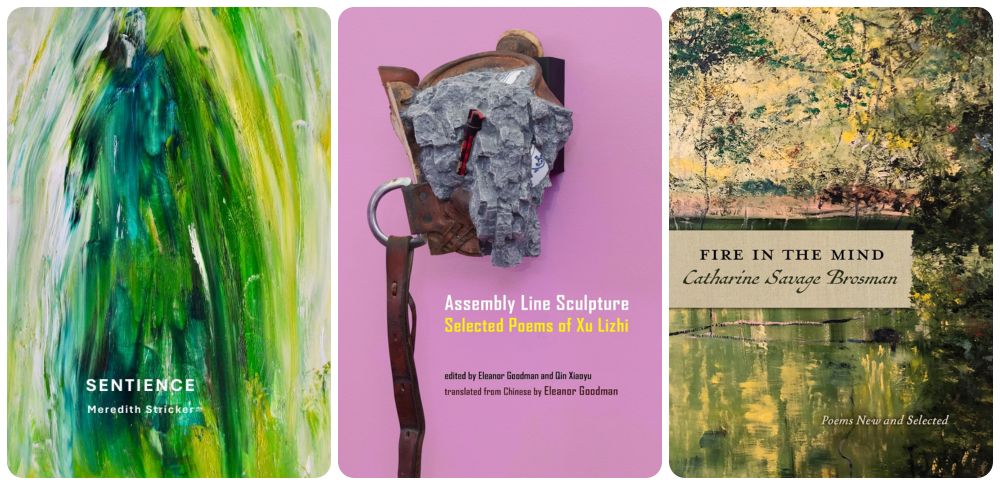
Meredith Stricker’s questions concerning interconnection and the nature of being underpin her new collection, Sentience (Omnidawn). How does humanity fit into a cross-species framework of semiotics, and what is our responsibility to the natural world?
Stricker draws on resonant passages from a range of sources — including Dickinson, Coleridge, Rilke, and Heroclitus — to form her own poetic language. She has essentially created a new architecture for ecopoetry in poems that take pleasing structural shapes and open illuminating avenues for contemplation.
She writes about umwelt, citing Jean-Christophe Bailly’s definition as “the skein that every animal forms for itself by winding itself into the world according to its means, with its nervous system, its senses, its shape, its tools, its mobility.”
But if we are engaged in a perpetual dance, what happens when one species disrupts or corrupts the umwelt of others? And what is the meaning of kinship? “When rivers are granted personhood,” she writes, “are you more or less sentient than whales.”
The air is also part of this interchange, and in various poems here, the air spreads seeds, breathes through instruments, and inflates our lungs. “Who includes us, who do we include? Trees with their oxygen out-breath?”:
and if trees
have no soul
then neither
do we
In “The b/s of the invisible,” a sequence inspired by Rilke’s line, “We are the bees of the Invisible,” she explores the collapse of bee colonies. This work was performed with audience collaboration and music composed by Kumi Uyeda. Audience members were instructed to open envelopes and read the text inside aloud at their own pace, including pauses indicated by numbers. They were also invited to move around the space — to swarm, in effect, like a hive.
As transcribed here, the lines in these pieces sometimes cascade down the page like sycamore helicopter seeds. In others, letters and syllables buzz across the page in fragments. There is also a pen-and-ink rendering of the whirling movements of bees that looks like a strange new alphabet.
I thought, as I read, about murmurations. What informs them, if not an overarching consciousness in which we live, move, and have our being? I even thought of the harmonious interconnectivity I experienced when I lived in Italy and drove in traffic there! From the outside, Roman traffic appears chaotic, but when you are part of its flow, you can do nothing but surrender to collective consciousness. I experienced a kind of stillness and serenity in doing this.
As I was writing this review, my daughter had just returned from several days in the Sahara. She told me that the desert sand is spirographed by winds into extraordinary patterns. Each grain of sand evidently makes a sound that resonates with all the others and connects them like a vast computer. Being in the desert, she said, was like being in the middle of an enormous math equation.
In the same way, Sentience takes us beyond ourselves into the sweep of collective Being. Stricker writes in “In Fast Flights” of “our commingled territorial proprioception alert to the slightest tremor of leaves.”
These unexpected and refreshing poems, or “creations,” as I’d rather call them, captivate your emotions and sense of wonder before you have time to analyze them. I doubt I fully understand them. But what I can do is feel them.
After my first perusal of Sentience, I went for a drive and, observing the world around me, felt as if everything was shimmering with mystery and collective life. This is a breathtaking collection and one of the more astonishing experiences I’ve had with poetry this year.
*****
In 2014, Xu Lizhi, a 24-year-old assembly-line worker at a Chinese iPhone factory, leapt to his death from a Foxconn building. The suicide of a factory worker was not in itself unusual. But the 200 poems Xu left behind have galvanized the Chinese migrant workers who’ve circulated them across the internet. Assembly Line Sculpture (Zephyr Press) is the first collection of his work to be published with en-face English translations by Eleanor Goodman.
“A Screw Falls to the Ground,” one of Xu’s most widely circulated poems, compares the death of an assembly-line worker to the fall of a screw. While both are essential to factory operations, they are easily replaceable, and the sound they make when falling to the ground is faint.
The screw is a powerful metaphor for Xu, as it is in other migrant-worker poetry. As reported by the New York Times in 2019, Chinese factories readily meet the enormous demand for iPhone screws that American factories struggle to produce either in sufficient quantity or in a timely fashion.
Xu writes in another poem, “I swallowed an iron moon/they called it a screw,” listing the constraints he has swallowed, including, “labor, and poverty this rusted-out life.” The poem concludes:
I can’t swallow any more
Everything I’ve swallowed roils up in my throatTo spread across my country
A poem of shame
The image of an “iron moon” combines two tropes of Chinese literature. It brings to mind the iron rice bowl of Lu Xun, which refers to a steady, well-paying job, and the moon, which often represents homesickness and longing.
Though I cannot read his poems in the original, a Mandarin-speaking friend explained to me that Xu’s poetry is informed by the gap between disparate images represented by the Chinese characters, which the reader then links together.
His exhaustion is palpable in Goodman’s translations. In “Rented Room,” for example, she uses a blunt, spondaic meter: “where I eat, sleep, shit, think/cough, suffer headaches, get old, get sick, never die,” to convey his emotional flatness and loss of hope. Opening the window of that tiny room each morning, Xu writes, “I’m like a dead man/slowly pushing open the lid of his coffin.”
Another poem, “Peeping,” declares:
Every night
when I hide behind my curtains
and peep out at the flushed moon
hanging from the treetops
I hesitate
over whether
I should wring
my own neck
and hang my head
from the windowsill
Assembly Line Sculpture is a shocking glimpse into a world we rarely consider or associate with our smartphones. And the flashes of beauty, as Xu reaches for a higher register, are all the more heartrending because he only experienced them in poetry. He longed to float in the ocean, to touch the sky, to somersault all the way to the moon.
*****
Catharine Savage Brosman is a Southern writer and scholar of French and American literature. She published her first poetry collection in 1972, when in her 30s, but she’s really flourished as a poet in the third age of life, having produced a dozen collections since 2000. Fire in the Mind (Mercer University Press) is a volume of new and selected poems from 15 prior collections.
Brosman is a steel magnolia with a reverence for history and a penchant for dramatic monologues in metered poetry and blank verse. Her work is old-fashioned but has a delicate grace, humor, and a self-assured voice.
You’ll find her reflecting on French and Confederate history at a Derby Day party or having cocktails at the hotel bar while waiting for a table. She enjoys European travel and sultry Southern evenings, and she weighs in on a range of Southern personalities.
I enjoyed the perspective of her love poems, especially her “Poems to Roger,” whom she met onboard a ship and who companions her in old age. One begins:
We’re toodling along on four wheels each,
Roger in his “ferrari,” a fine motorized chair suited
To his tall frame, and I in his “Lamborghini,”
His second chair, of a beautiful blue, a bit tight
For his build but fitting me perfectly
She’s also good on food, with poems about garlic, melon, asparagus, portobello mushrooms (“Where’s the bello part in portobello?”), and broccoli — and the famous statement Old Bush made about disliking the latter. “Pathetic,” she writes, “For a president, a celebrated man and powerful.”
And, of course, there’s gumbo:
Though not a chef, nor a gourmet, I know
well what I like, and why: no froth, no fluff,
in food, speech, friends; a trace, a cameo
at most. The genuine is quite enough.
A standout is “Hats: a Portrait,” in which an elderly woman, “Crazy D, the neighbors say behind her back,” considers her vintage wardrobe of kid gloves, fur collars, boas, high-heeled shoes, and hats, which evoke her pedigree and memories of the past.
Brosman’s heart runs well, as she writes in one poem, and she is nothing if not true to herself. Even while a certain rigidity in style occasionally kept me at arm’s length, her craftsmanship and the singular perspective of her advanced age (she is now in her 90s) make Fire in the Mind a rare pleasure.
Amanda Holmes Duffy is a columnist and poetry editor for the Independent and the voice of “Read Me a Poem,” a podcast of the American Scholar.