Revisiting Richard Powers’ The Overstory in the aftermath of this summer’s wildfires.
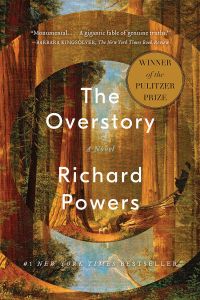
Trees live in a long, slow time, and humanity lives in their shadow. Without trees, we cannot survive. In the aftermath of the wildfires that tore through French forests this summer, I revisited Richard Powers’ Pulitzer Prize-winning novel, The Overstory. “Long answers need long time,” he writes in it, “and long time is exactly what’s vanishing.”
This summer in France, where we have a family home, we experienced some of the hottest temperatures on record. With no air conditioning (hardly any houses here have it) and no fans (they all sold out — even the Blanc de Meudon sold out), I covered myself in wet towels to sleep at night. The rivers shrank, and green fields turned gold. People are saying they don’t expect rain until October.
I like to imagine I live in the presence of long time here. But perhaps I am simply reminded of it. The previous owner of this house, whose family lived here since the 1800s, kept a log on one of the walls, documenting the annual return of the swallows. They have nested in the eaves of the barn for generations.
Similarly, The Overstory opens with the Hoel family, who, over several generations, photographs a chestnut tree on their farm. Put all together, the hundreds of pictures — one taken each month — reveal the slow, purposeful growth of the tree and its long, dignified story.
But as Hemingway famously observed about bankruptcy, it happens gradually, then suddenly. And the wildfires we are experiencing now are the result of greenhouse gases built up decades ago. “Harm was never imminent enough,” Powers writes. “Imminent at the speed of people is too late.”
He informs us that trees send warnings to each other that humans can’t hear. We learn along with one of the novel’s characters, who is almost deaf, how we might listen to them. She tells us:
“Other creatures, bigger, slower, older, more durable — call the shots, make the weather, feed creation and create the air.”
I asked my 4-year-old grandson, Hal, as we walked under a canopy of plane trees in Richelieu this summer, what he thought about them. “They are very big and they talk to us,” he said, as a breeze blew through the branches. They were saying I love you, he told me.
Reading The Overstory in small excerpts and after many years, I’m savoring the language. There are a lot of characters who are difficult to keep straight, but I realize now that their individual histories matter less than the way they eventually come together — as activists — to protect the giant redwoods from deforestation.
The novel is structured like the underground root system of trees, so it takes over 500 pages for all the disparate branches of the story to intersect. “Forests mend and shape themselves through subterranean synapses,” Powers writes. “And in shaping themselves, they shape, too, the tens of thousands of other linked creatures that form it from within.”
The characters suffer myriad challenges, including near death, infertility, electrocution, bombing, and stroke. Some of them are on the spectrum, which makes them more alert to the sense of time experienced by trees. They are more tuned into the natural world. We come to feel that those better adjusted to social norms are less evolved, if not delusional.
Here in Rigny-Ussé, I feel like I’m living in the presence of the past, but the Taffoneaus, whose family has lived here for five generations, tell us that this village, which now has only a single shop, once had several bakeries, blacksmiths, clothing stores, mushroom sellers, and grocers. Everything changed, they said, with the arrival of the first tractor in the early 1960s. Before that, there were horses. There used to be 80 farms; now there’s one.
“People have no idea what time is,” Nick Hoel says in the book. “They think it’s a line, spinning out from three seconds behind them, then vanishing just as fast into the three seconds of fog just ahead. They can’t see that time is one spreading ring wrapped around another, outward and outward until the thinnest skin of Now depends for its being on the enormous mass of everything that has already died.”
“What do all good stories do?” one character asks toward the end. “They kill you a little. They turn you into something you weren’t.”
The Overstory will do that. It will kill you a little. It reminds us that the Earth does not belong to us. We are just one species. Trees were here hundreds of millions of years before us and they are far more patient. If we make the planet uninhabitable for ourselves, there is one consolation: After we’re gone, the trees will come back.
Amanda Holmes Duffy is a columnist and poetry editor for the Independent and the voice of “Read Me a Poem,” a podcast of the American Scholar.
_1.png)