Our Week in Reviews: 10/17/26
- October 17, 2026
A recap of the books we’ve spotlighted in the past few days.
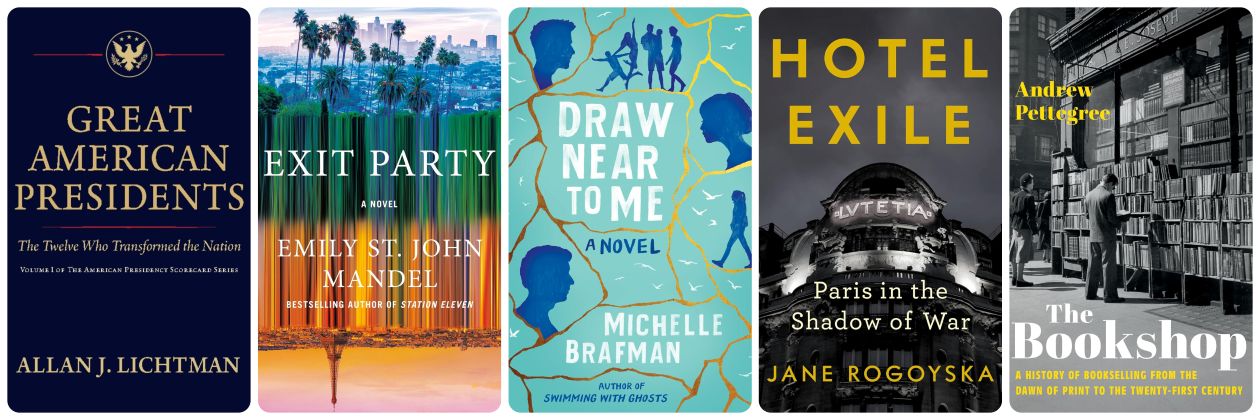
Great American Presidents: The Twelve Who Transformed the Nation by Allan J. Lichtman (Bancroft Press). Reviewed by Kitty Kelley. “In the pages that follow, Lichtman captures the humanity of each man — their faults and foibles, coupled with their titanic strengths. He then grades them on what he calls the Crisis Key, the Transformation Key, the Moral Vision Key, the Hidden Hand Key, the Stewardship Key, the Realignment Key, the Institution Builder Key, the Narrative Key, the Diplomatic Pivot Key, and the Adaptability Key. The only president to turn all 10 keys of greatness, ‘the architect of the modern American state and its place in the world,’ is Franklin D. Roosevelt. ‘His legacy lives on not only through policies and precedents but also in the very fabric of American political life.’”
Exit Party: A Novel by Emily St. John Mandel (Knopf). Reviewed by Mariko Hewer. “This painful description sounds eerily similar to the ICE detention facilities being run in the U.S. right now; perhaps we’re closer to this version of reality than we’d like to think. Yet, amidst all the chaos and surveillance of Mandel’s novel, tendrils of hope emerge from the rubble. It is the author’s great gift to be able to blend the apocalyptic with the mundane, the terrible with the awe-inspiring. Exit Party delivers on both fronts.”
Draw Near to Me: A Novel by Michelle Brafman (Keylight Books). Reviewed by Carrie Callaghan. “That families willingly live on such a knife’s edge, vulnerable to the deep pain of losing a loved one yet still committed to each other, is one of the mysteries of human relationships. Brafman does excellent work in excavating those ties, examining not only the individual toll of addiction but the shared wages of loss and love. None of her characters are perfect, and some are even unpleasant. But they represent the real, messy complexity of family, and she has crafted a gift to readers willing to delve into the fractured human heart.”
Hotel Exile: Paris in the Shadow of War by Jane Rogoyska (W.W. Norton & Company). Reviewed by Jethro K. Lieberman. “Despite her book’s title, Rogoyska’s account of the war is only fleetingly about the Lutetia itself; the subtitle does almost all the work. The hotel is not so much an actor in a drama as it is the stage on which the story of three disparate groups plays out: emigres, mostly from Germany, who escaped to Paris throughout the 1930s; officers of the Abwehr, the German military-intelligence service, which took over the hotel in late 1939; and, after the liberation of the city in August 1944, the deportees and POWs for whom the Lutetia served as a repatriation center.”
The Bookshop: A History of Bookselling from the Dawn of Print to the Twenty-First Century by Andrew Pettegree (Basic Books). Reviewed by Dennis Drabelle. “Paperbacks, once considered déclassé (they were typically how-to books or lurid novels), came into their own in the mid-20th century thanks in large part to students’ need for cheap editions — my own high school in St. Louis had an in-house paperback-book store starting in 1960. With the advent of Penguin and other reputable lines, the classics became available to the masses at cut rates. Pettegree also chronicles the conversion of books into prestige items as collectors sought first editions and glossy reprints from such outfits as the Folio Society. Books and bookishness as sources of civic pride went official with the designation of Edinburgh, Scotland, as the first UNESCO City of Literature in 2004.”
Don’t miss another excellent book review, author interview, or feature! Subscribe to our free newsletter and follow us on Instagram, Facebook, Pinterest, Bluesky, and LinkedIn. Advertise with us here.