Our Week in Reviews: 11/14/26
- November 14, 2026
A recap of the books we’ve spotlighted in the past few days.
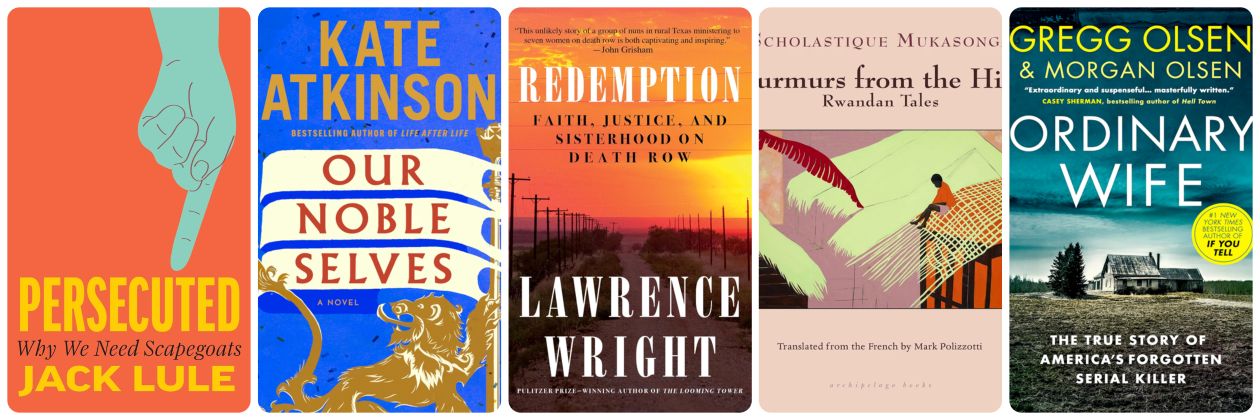
Persecuted: Why We Need Scapegoats by Jack Lule (Johns Hopkins University Press). Reviewed by William Rice. “The two 20th-century thinkers the author is most in debt to for their ideas are the American Kenneth Burke and the Frenchman René Girard. Burke, according to Lule’s paraphrase, speculated that scapegoating is not ‘a problem that arises when people come together. Scapegoating is at the very [center] of how people come together.’ Burke further believed that this moral scourge is a natural product of language: In defining what is and is not, who belongs and who doesn’t, we inevitably create outsiders who are prime targets for scapegoating.”
Our Noble Selves: A Novel by Kate Atkinson (Doubleday). Reviewed by Bob Duffy. “Gracefully weaving undertones of pain and bereavement into over-the-top spoofery calls for exceptional subtlety, and here the effect succeeds brilliantly. Atkinson is a proven whiz at mingling tonal elements: Her previous books range widely in setting and spirit — a clutch of detective yarns, along with a quartet of historical novels that blend strains of speculative fiction, magical realism, and social comedy.”
Redemption: Faith, Justice, and Sisterhood on Death Row by Lawrence Wright (Knopf). Reviewed by Kitty Kelley. “Lawrence Wright unites these two disparate groups in the foreword to Redemption: Faith, Justice, and Sisterhood on Death Row and makes a humane appeal to our conscience. Their legal pleas exhausted, the women have been living for years in cramped, fetid cells, waiting to be summoned to the death chamber. Some are grandmothers who’ve spent their entire adult lives behind bars, decades and decades. In that time, many inmates, once considered godless killers, have traveled the long ‘road to redemption,’ prompting Wright to question whether they still deserve to die.”
Murmurs from the Hills: Rwandan Tales by Scholastique Mukasonga; translated by Mark Polizzotti (Archipelago). Reviewed by Bárbara Mujica. “Alluded to rather than described in detail, the German and Belgian occupations of Rwanda provide the backdrop for these tales. European authorities radically altered Rwanda’s political and economic structure, and Catholic missionaries assumed control of education and healthcare, ignoring ancient cultural traditions. As anti-colonial movements swept Africa in the 1950s, Belgian officials shifted their support from the Tutsi elite to Hutu political leaders, triggering mass violence against Mukasonga’s people, the Tutsis.”
Ordinary Wife: The True Story of America’s Forgotten Serial Killer by Gregg Olsen and Morgan Olsen (Notorious Press). Reviewed by Diane Kiesel. “Despite the titillating subject matter, Lyda’s story is not that compelling, at least as presented by the Olsens. In fairness, when writing about century-old crimes, authors are limited in their source material to contemporary newspaper articles and, if they’re lucky (the Olsens were), trial transcripts and prison records buried in government archives. Unfortunately, the authors rarely place into context what they learned from these key sources.”
Don’t miss another excellent book review, author interview, or feature! Subscribe to our free newsletter and follow us on Instagram, Facebook, Pinterest, Bluesky, and LinkedIn. Advertise with us here.
