Our Week in Reviews: 11/7/26
- November 7, 2026
A recap of the books we’ve spotlighted in the past few days.
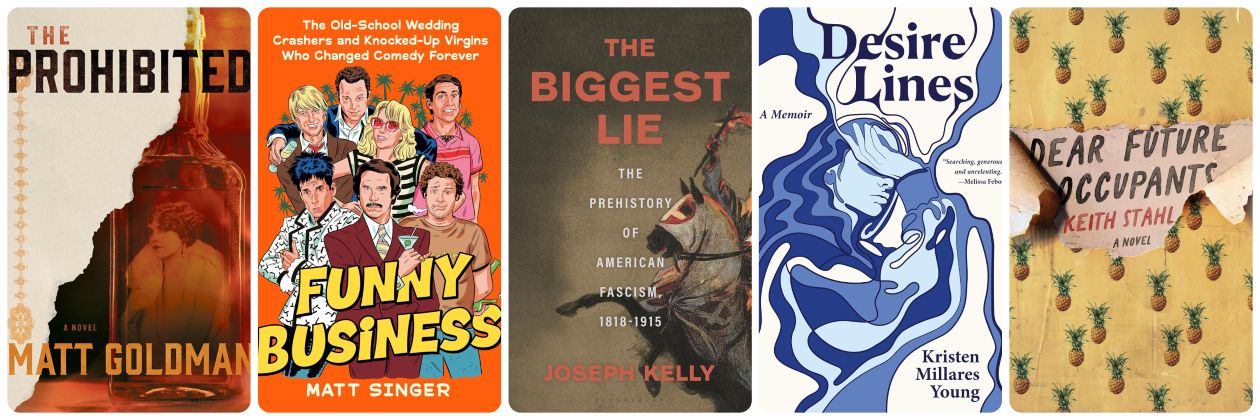
The Prohibited: A Novel by Matt Goldman (University of Minnesota Press). Reviewed by Priyanka Champaneri. “Goldman keeps the plot threads and characters coming, but the most central opens the book: Willie, having run afoul of a local bootlegger by setting up a side-hustle whiskey operation, fakes his own death and skips town in a plan orchestrated by Rose. He’s supposed to lay low but can’t resist the lure of easy money selling booze in a life where his charm has so far guaranteed an exit out of any scrape.”
Funny Business: The Old-School Wedding Crashers and Knocked-Up Virgins Who Changed Comedy Forever by Matt Singer (G.P. Putnam’s Sons). Reviewed by Chelsey Stone. “Maybe this was at least in part because, according to Singer, Apatow and Stiller kept ‘indulging in their weirdest impulses.’ ‘The Cable Guy,’ for example, was a dark thriller in which an unhinged cable-company employee (Jim Carrey) crosses innumerable boundaries with a client. But they weren’t just after the bizarre; Singer explains that Apatow and others were adamant about portraying real life (such as when Apatow put his own kids in ‘Knocked Up’ and let them interact organically with the adults) and what felt true to them (like Rogen writing ‘Superbad,’ a screenplay about sexually repressed teenagers, while he still was one).”
The Biggest Lie: The Prehistory of American Fascism, 1818-1915 by Joseph Kelly (Bloomsbury Publishing). Reviewed by Peggy Kurkowski. “He develops his thesis over three sections that consider the nation in three critical stages: the new republic (colonial/revolutionary era), the second republic (the Civil War/Reconstruction), and the American empire (the Gilded Age/turn of the century). A crucial ideological and philosophical divergence occurred between the new-republic period and the second, he contends: From 1776 until the 1820s, most Americans believed in the Jeffersonian notion that ‘all men are created equal,’ but this belief fractured with the Missouri Compromise of 1818.”
Desire Lines: A Memoir by Kristen Millares Young (Red Hen Press). Reviewed by Yelizaveta P. Renfro. “Millares Young’s style is often oblique and even evasive; it’s as though she’s speaking in circles around the abuse, sometimes deflecting with meta-commentary, sometimes disappearing into the background behind her research. She protects herself, understandably, but the result can be a tone that is detached and emotionally distant, keeping the reader at arm’s length and never quite revealing what is most tender and vulnerable.”
Dear Future Occupants: A Novel by Keith Stahl (University of Wisconsin Press). Reviewed by John P. Loonam. “Some of the pleasure of Dear Future Occupants comes from watching the characters’ hijinks and the shame they feel over their lack of shame. But a good deal of the fun also lies in the story’s satirical nostalgia. Spending time amid the narrow-minded pains of a previous generation — when being gay was a radical act of freedom and getting high was an illegal form of rebellion — offers a respite from the narrow-minded pains of our own generation.”
Don’t miss another excellent book review, author interview, or feature! Subscribe to our free newsletter and follow us on Instagram, Facebook, Pinterest, Bluesky, and LinkedIn. Advertise with us here.