Our Week in Reviews: 2/28/26
- February 28, 2026
A recap of the books we’ve spotlighted in the past few days.
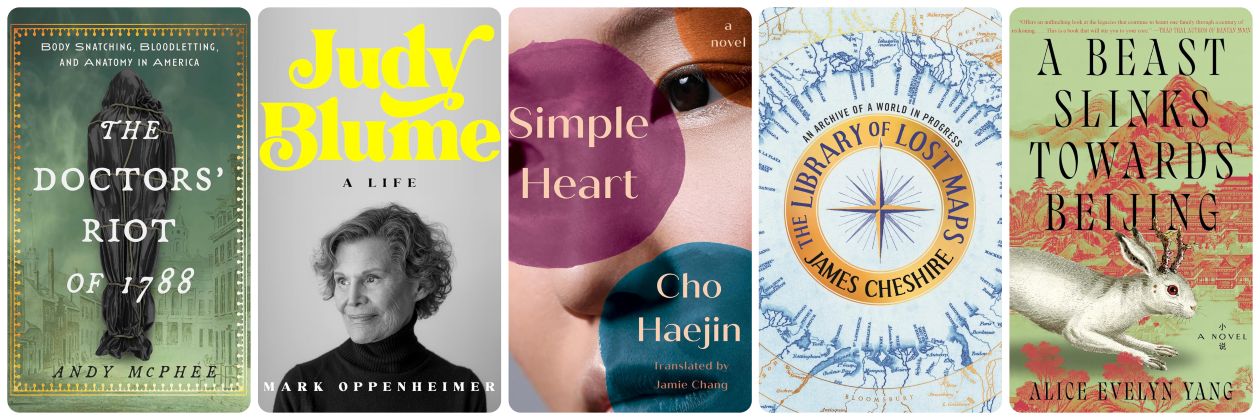
The Doctors’ Riot of 1788: Body Snatching, Bloodletting, and Anatomy in America by Andy McPhee (Prometheus Books). Reviewed by Diane Kiesel. “Ideally, a book about dissecting bodies should get to the heart of the matter early on. Unfortunately, the details of the titular riot aren’t revealed until page 124. After the first chapter, which sets up the conundrum between respect for the dead and the need to advance science, McPhee takes a long detour into the history of colonial America that could’ve been recounted in a few pages (if not paragraphs). It’s hard to fathom how lengthy passages about the Revolutionary War, the weaknesses inherent in the Articles of Confederation, and the drafting of the Constitution move the narrative forward.”
Judy Blume: A Life by Mark Oppenheimer (G.P. Putnam’s Sons). Reviewed by Kitty Kelley. “An unabashed fan, he decided to honor his idol with his first biography, for which Blume gave him full access. She sat ‘for hours of interviews, in person and on the telephone.’ She answered ‘hundreds of questions by email’ and offered access to her husband, her children, her assistants, her friends. Oppenheimer sent her his first draft, and she responded with dozens of pages of corrections and additions. Not since Boswell has a biographer bagged such a bonanza.”
Simple Heart: A Novel by Cho Haejin; translated by Jamie Chang (Other Press). Reviewed by Alice Stephens. “While I appreciate Cho Haejin’s inclusion of adoptees in Simple Heart, I was frustrated by the bending of facts to fit neatly into a heartfelt story of identity. Both of her main adoptee characters retain some language and strong memories of Korea. One of the travesties of intercountry adoption is the utter erasure of one’s cultural origins; most Korean adoptees are left bereft of language and culture, with even those adopted at an older age losing their native tongue once they’re assimilated into their new homes. (Ironically, Nana is bad at eating with chopsticks, which is the one skill that many adoptees are able to reclaim.)”
The Library of Lost Maps: An Archive of a World in Progress by James Cheshire (Bloomsbury Publishing). Reviewed by Jennifer Bort Yacovissi. “Of all the cartographic journeys Cheshire takes us on, the most fascinating to me (and to him, I think) is that of mapping the ocean floor. It’s startling to be reminded of just how recently the theory of plate tectonics was validated. What’s revelatory is learning how the meticulous, yearslong project — driven primarily by two dedicated cartographers, Marie Tharp and Bruce Heezen, and an artist who made the maps come alive in the world’s imagination, Heinrich Berann — produced the maps that made the theory concrete and incontrovertible.”
A Beast Slinks Towards Beijing: A Novel by Alice Evelyn Yang (William Morrow). Reviewed by Marcie Geffner. “Weihong and Ming tell their stories from Ānshān, an industrial area in China’s northeastern Liáoníng Province. The area was occupied by the Japanese from 1918 to 1945, and then by the Soviet Red Army near the end of World War II. After the war, the area was returned to China, only to be caught up in the country’s violent and repressive Cultural Revolution in the late 1960s. The author steers clear of China’s Communist politics to focus instead on Ming’s life under the oppressive Japanese occupation and Weihong’s involvement in the brutality of the Cultural Revolution.”
Don’t miss another excellent book review, author interview, or feature! Subscribe to our free newsletter and follow us on Instagram, Facebook, Pinterest, Bluesky, and LinkedIn. Advertise with us here.