Our Week in Reviews: 3/7/26
- March 7, 2026
A recap of the books we’ve spotlighted in the past few days.
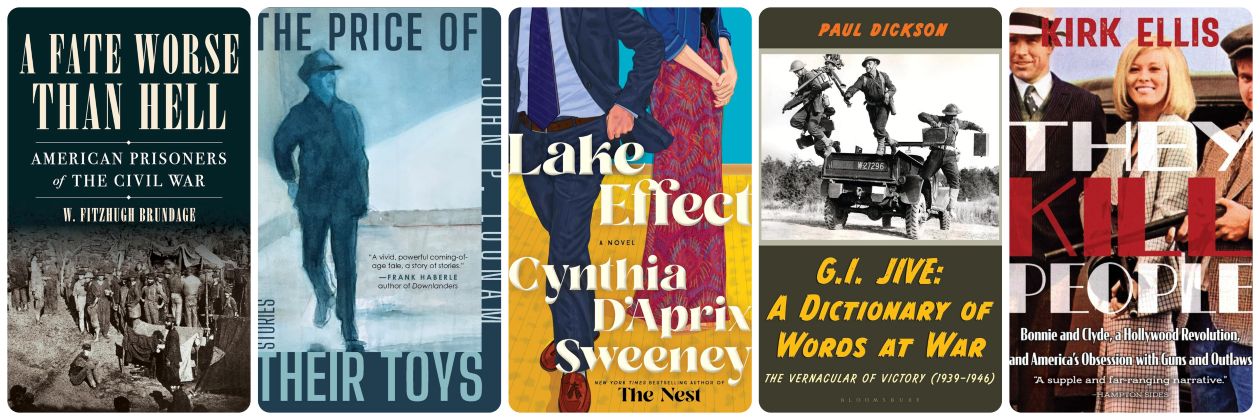
A Fate Worse than Hell: American Prisoners of the Civil War by W. Fitzhugh Brundage (W.W. Norton & Company). Reviewed by Paula Tarnapol Whitacre. “It takes fortitude to open a book titled A Fate Worse than Hell in these turbulent times. Fair warning if you do: You’ll quickly become mired in the horrendous conditions faced by Civil War prisoners on both sides. But persevere. Historian W. Fitzhugh Brundage not only introduces us to the war’s prisoners, officials, and places, but also discusses the long-term impact of the prison system on Civil War memory and, more broadly, on modern warfare.”
The Price of Their Toys: Stories by John P. Loonam (Cornerstone Press). Reviewed by Chris Rutledge. “Part of what leads men to be isolated is the sense of competition we foster among ourselves. In the aforementioned ‘Running,’ Sam’s new friend Martin sabotages a toilet repair Sam has made, though his reasoning isn’t clear even to himself. Sometimes, guys just undermine other guys to lift ourselves up. In ‘Even Richard Nixon,’ the narrator plays upon the Secret Service agent’s insecurities, asking him, ‘Are you jealous…Some other agent is actually guarding the President while you’re stuck here guarding his empty office.’ How can the agent not be hurt by being reminded of his insignificant task?”
Lake Effect: A Novel by Cynthia D’Aprix Sweeney (Ecco). Reviewed by Randy Cepuch. “Although there are dozens of other characters — it’s hard to keep track of them all, and the various subplots rarely matter — much of the story is told from the point-of-view of Clara, the elder daughter. She’s the most devastated by her mother’s action because it leads to a stormy parting with her own romantic interest, Dune. She copes by learning how to cook, and she’s good at it. At this point, you may have noticed that a weather word of one sort or another has sneaked into nearly every paragraph of this review so far. Lake Effect itself is less subtle. While it doesn’t open with the weather, it relentlessly hits readers over the head with a snow shovel to make the point that Rochester is often cold and grey.”
G.I. Jive: A Dictionary of Words at War: The Vernacular of Victory (1939-1946) by Paul Dickson (Bloomsbury Academic). Reviewed by Lawrence De Maria. “Some particular American military grumblings date from World War I (known as ‘the War to End All Wars’; what a crock). But slang really took off when WWII started. A few Britishisms from its early days survive, but it wasn’t until 1940, when Americans were drafted for the fight, that things truly got going.”
They Kill People: Bonnie and Clyde, a Hollywood Revolution, and America’s Obsession with Guns and Outlaws by Kirk Ellis (High Road Books). Reviewed by Diane Kiesel. “Nonetheless, ‘Bonnie and Clyde’ pushed the envelope with a pivotal scene in which Clyde fires through a car window directly into the face of the bank official who has jumped onto the vehicle’s running board. Before that, Penn explained, when an onscreen villain fired a shot at a victim, ‘You have somebody shoot over here and you cut to somebody getting hit over there.’ The window shot changed ‘the trajectory of the film — and of American cinema,’ writes Ellis.”
Don’t miss another excellent book review, author interview, or feature! Subscribe to our free newsletter and follow us on Instagram, Facebook, Pinterest, Bluesky, and LinkedIn. Advertise with us here.