Our Week in Reviews: 5/16/26
- May 16, 2026
A recap of the books we’ve spotlighted in the past few days.
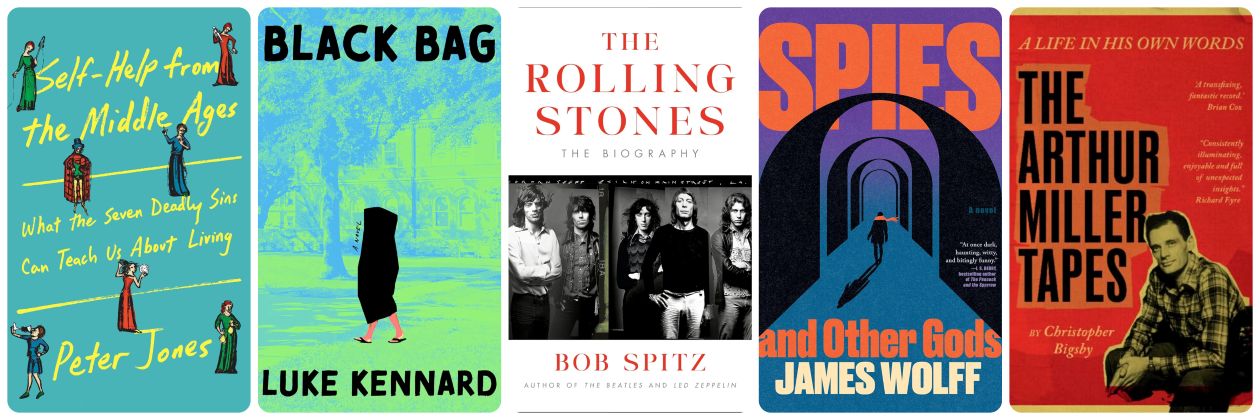
Self-Help from the Middle Ages: What the Seven Deadly Sins Can Teach Us About Living by Peter Jones (Doubleday). Reviewed by Eliza McGraw. “Jones’ humility allows readers to identify with him even if they lack his extraordinary depth of understanding about antiquity. ‘If this is a self-help guide,’ he writes, ‘it’s also a self-help journey.’ One challenge facing the author is that people today might not be able to reel off the deadly sins. They seem archaic, or like a device for a horror movie. But Jones’ narrative, which keeps his own experiences close, enables him to balance deep dives into the Middle Ages with modern-day struggles. You start to see how the more things change, the more they stay the same. We humans are as flawed as ever; we just call our shortcomings by different names now.”
Black Bag: A Novel by Luke Kennard (Zando). Reviewed by Chris Rutledge. “The novel also skewers consumerism and the inevitable conformity it leads to. The narrator may be the one sporting a sack, but his ‘classmates,’ whether they intend to or not, blend together by all wearing the same ‘smart, drab…black trousers, white shirt or blouse…[or] luxury hoodies, white or a bright primary color, with an embroidered logo.’ Indeed, they take offense at the creature in their midst who dares to transgress the official dress code of today’s undergrad, even though he’s the most stylistically iconoclastic of the bunch.”
The Rolling Stones: The Biography by Bob Spitz (Penguin Press). Reviewed by Daniel de Visé. “He may have gotten some of the context wrong about the origin stories of the Stones, but I wouldn’t know. And he interviewed none of the core surviving members for this book, as far as I could tell. But let me say this: I’ve read plenty of biographies of British bands by British authors, and they never, ever take the time to explain the curious workings of the British educational system and other odd British-isms. Spitz does. Thank you.”
Spies and Other Gods: A Novel by James Wolff (Atlantic Crime). Reviewed by Bruce J. Krajewski. “Lies, concealment, and deception — the fundamental tools of spycraft — can manifest a world of paranoia, a feeling that reality is an illusion, that every action must be premeditated, that spontaneity is dangerous0, that no one can be trusted. The conversations you have turn out to be, as le Carré put it, ‘as much about what to conceal as about what to say.’ Two of the novel’s main characters are friendless, demonstrating the human toll of their chosen world. It’s Immanuel Kant’s nightmare: everyone treating everyone else as a means to an end.”
The Arthur Miller Tapes: A Life in His Own Words by Christopher Bigsby (Cambridge University Press). Reviewed by Kitty Kelley. “Arthur Miller died on February 10, 2005, the same day of the same month on which Death of a Salesman premiered on Broadway. His tombstone reads simply, ‘ARTHUR MILLER WRITER.’ The playwright would be pleased with Christopher Bigsby’s illuminating recollection of their friendship, in which the author allows his revered friend to spread his multicolored wings, proud as a peacock.”
Don’t miss another excellent book review, author interview, or feature! Subscribe to our free newsletter and follow us on Instagram, Facebook, Pinterest, Bluesky, and LinkedIn. Advertise with us here.