Our Week in Reviews: 5/2/26
- May 2, 2026
A recap of the books we’ve spotlighted in the past few days.
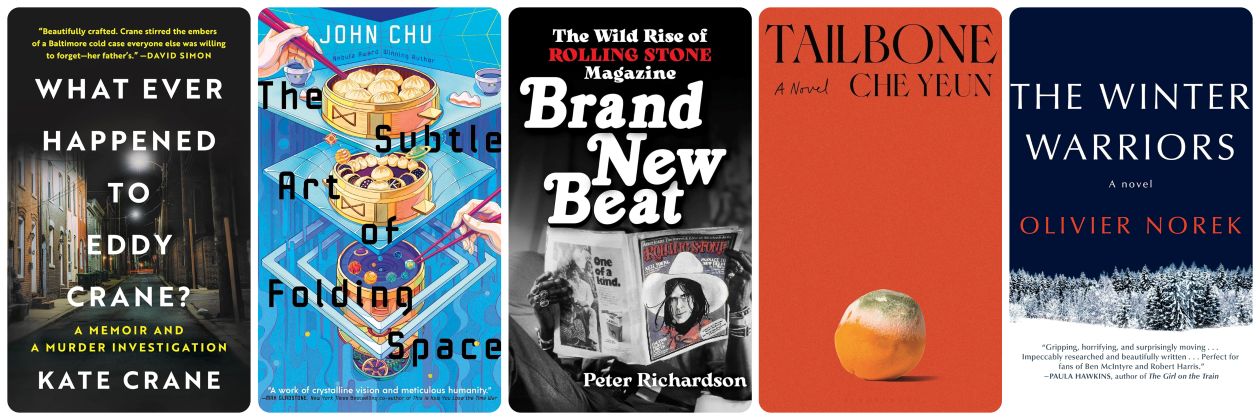
What Ever Happened to Eddy Crane?: A Memoir and a Murder Investigation by Kate Crane (Hanover Square Press). Reviewed by Diane Kiesel. “Part true-crime saga and larger part coming-of-age memoir, Crane’s book explores her father’s disappearance and the wreck it left in its wake. Although she grew up to be an accomplished author and writes about her life in the shadow of her father’s death was clarity and care, his loss took its toll. Crane suffered depression and other health issues. Her mother retreated into a shell of silence, her sister smoldered with anger, and her grandmother cried a vat of tears.”
The Subtle Art of Folding Space by John Chu (Tor Books). Reviewed by Andrea M. Pawley. “Infinite universes and skunkworks exist, and maintaining them is crucial. The universes’ physics will be compromised if anomalies in the skunkworks’ gates and valves aren’t fixed. When Ellie encounters one such anomaly keeping her comatose mother alive, she knows that leaving the faulty area alone is out of the question; Vera would never let such an irregularity persist. So, Ellie corrects it, and her mother dies. The fix was the right thing to do. Vera’s illness had gone on for an inexplicable amount of time, after all, and caused a great deal of suffering.”
Brand New Beat: The Wild Rise of Rolling Stone Magazine by Peter Richardson (University of California Press). Reviewed by Douglas C. MacLeod Jr. “But Brand New Beat is more than a sweeping chronicle of a magazine and its creators. Richardson’s impressive work is also a timeline of what was happening in America during the 1960s and 1970s. By weaving a chapter-by-chapter tapestry that expertly combines popular culture, economics, politics, and social shifts, the author has crafted an able study of American-style capitalism and the volatile space it inhabits.”
Tailbone: A Novel by Che Yeun (Bloomsbury Publishing). Reviewed by Alice Stephens. “With her ill-begotten gains, the girl blows her money on junk food, makeup, and cigarettes. Free to be an ‘irresponsible selfish slob,’ she fritters the days away, eating corn dogs, dyeing her hair, and aimlessly riding the metro. On a train, an older man asks if she’s being sex-trafficked. ‘We really used to be a country full of girls like that,’ he tells her. ‘Sold all over the country…That’s how poor they used to be. How poor we all used to be. Before the war and after. But all that’s gone now. Now it’s just girls like you, healthy and educated and sure and lazy. That’s what happens when you’re free to go anywhere you want.’ Despite South Korea’s hard-won prosperity, women are still selling their bodies to survive.”
The Winter Warriors: A Novel by Olivier Norek (Atlantic Monthly Press). Reviewed by Lawrence De Maria. “The Finns battled the elements, too, of course. But they had warm clothing and fast skis, the latter of which they utilized masterfully. By the end of the brief war — which concluded in March 1940 after diplomatic maneuvering by the Allies, whose attention was focused warily on the Nazis — Finland had suffered around 70,000 casualties. Unofficial reports put the Soviet Union’s casualty count exponentially higher. Stalin had expected a walkover. Instead, he got a wake-up call.”
Don’t miss another excellent book review, author interview, or feature! Subscribe to our free newsletter and follow us on Instagram, Facebook, Pinterest, Bluesky, and LinkedIn. Advertise with us here.