Our Week in Reviews: 5/23/26
- May 23, 2026
A recap of the books we’ve spotlighted in the past few days.
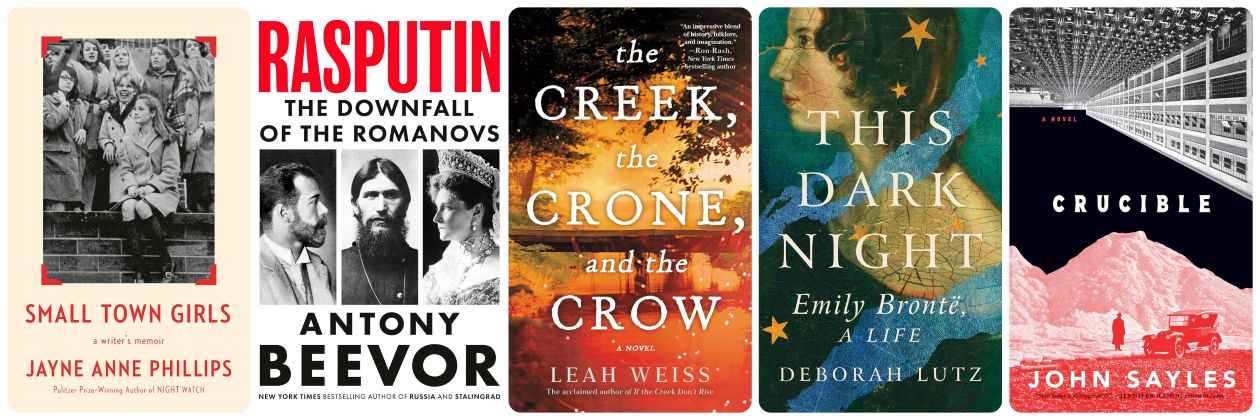
Small Town Girls: a writer’s memoir by Jayne Anne Phillips (Knopf). Reviewed by Kristin H. Macomber. “Small Town Girls begins with descriptions of Phillips’ hometown, Buckhannon, and her family’s longtime connections to and livelihoods in the Allegheny Mountains. She provides an insightful historical overview, connecting the region’s verdant past, from ‘a thousand years of paradise for flora and fauna,’ to its current beleaguered state, with its rivers poisoned and its forested topography scratched away — the result of a succession of assaults from timber milling and coal mining, strip mining and mountaintop mining, and finally, fracking. The chapter titled ‘Paradise Lost: West Virginia,’ which weaves Phillips’ family chronology through the state’s centuries of downward spiral, should be required reading in every U.S. history class in America.”
Rasputin: The Downfall of the Romanovs by Antony Beevor (Viking). Reviewed by Anne Eliot Feldman. “The turbulent years that follow only fortify their connection. The tsarina increasingly relies on ‘Our Friend,’ as she and Nicholas call Rasputin, for advice and consolation, and conversations with the holy man bring the tsar ‘a sense of relief and calm.’ Yet, as salacious rumors and press reports of Rasputin’s incessantly atrocious behavior toward women run rampant and gain momentum, all anyone in elite circles can think of is how to get rid of him.”
The Creek, the Crone, and the Crow: A Novel by Leah Weiss (Sourcebooks Landmark). Reviewed by Olesya Salnikova Gilmore. “The mystery isn’t really a mystery at all, but the novel is a wonderful portrait of a time and place and culture told with truth and, more importantly, love. The reader can’t help but root for Kate and Lydia to find the answers to the riddle — and to their own past traumas. They and the other characters make Baines Creek come alive as a real place, one you could point to on a map and visit (though the road there might be bumpy).”
This Dark Night: Emily Brontë, A Life by Deborah Lutz (W.W. Norton & Company). Reviewed by Stuart Kay. “Notwithstanding Charlotte’s verdict that Emily ‘had no worldly wisdom; her powers were unadapted to the practical business of life,’ This Dark Night evidences her domesticity and anchors the account firmly in the everyday. Emily’s hours were filled with running the house — by sewing, baking, and cleaning — and she looked after the sisters’ finances, including their shares in the York and North Midland Railway Company. Her piano playing — she played with ‘precision and brilliancy’ — and her love of animals provided release.”
Crucible: A Novel by John Sayles (Melville House). Reviewed by Jennifer Bort Yacovissi. “Certainly, countless works of historical fiction feature large casts of characters and long slices of time yet still succeed as coherent wholes. So, what’s missing here? Drama. Endless plot points aside, the endeavor feels strangely inert. Sayles is an accomplished writer, but he’s allowed himself to fall prey to the historical novelist’s trap of shoehorning it all in — fascinating little details his research unearthed that he can’t resist including. I’m still scratching my head over his insistence on describing two different cartoons in almost frame-by-frame depth.”
Don’t miss another excellent book review, author interview, or feature! Subscribe to our free newsletter and follow us on Instagram, Facebook, Pinterest, Bluesky, and LinkedIn. Advertise with us here.