Our Week in Reviews: 5/30/26
- May 30, 2026
A recap of the books we’ve spotlighted in the past few days.
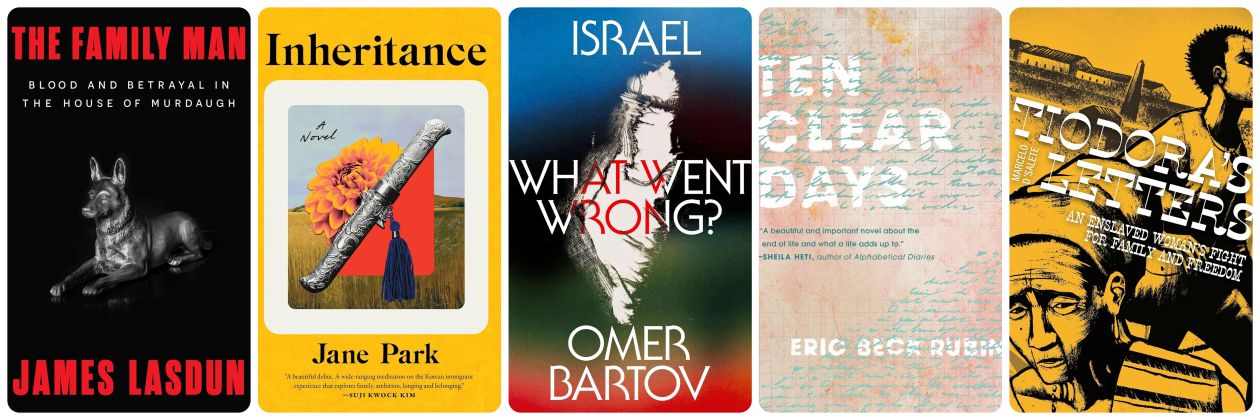
The Family Man: Blood and Betrayal in the House of Murdaugh by James Lasdun (W.W. Norton & Company). Reviewed by Diane Kiesel. “Often, when a writer can’t get out of his own way and injects himself into the narrative, it’s to the detriment of the story. Not so here. The English-born Lasdun, a stranger to the American South, takes readers on his journey through the Low Country. Initially unsure Murdaugh was guilty, Lasdun’s painstaking reporting slowly convinces the author — and us — that the jury got it right. The Murdaugh saga, which riveted the true-crime world, is a tragedy of Shakespearian proportions. Thus, The Family Man is a huge step above standard ‘Dateline,’ ‘48 Hours,’ or ‘20/20’ television fare (i.e., the wife is dead, the husband did it, change the channel).”
Inheritance: A Novel by Jane Park (Pegasus Books). Reviewed by Nicole Yurcaba. “The novel offers a unique heroine: Anne represents a new generation of Korean-Canadians balancing two cultures and navigating 21st-century social pressures while attempting to honor their heritage. As a woman who’s struggled with her identity since childhood, Anne suddenly has an opportunity to gain true insight into a past about which her parents never spoke. When she finds a trove of her father’s old letters — which she must have professionally translated because she doesn’t know sufficient Korean — the discovery serves as a turning point in her life.”
Israel: What Went Wrong? by Omer Bartov (Farrar, Straus and Giroux). Reviewed by Paul D. Pearlstein. “The author further points out that Israel doesn’t have a written constitution or bill of rights, but that the nation’s leadership — all the way back to its founding — has declared its support for equality for all. Still, the sentiment seems more an appeal to the world stage than an accurate reflection of national will. Israeli leadership apparently doesn’t want equal rights for Palestinians, nor do Palestinians want them for Israelis. A ‘two-state solution’ is a convenient catchphrase for an unacceptable and unsupportable political-legal fiction.”
Ten Clear Days by Eric Beck Rubin (Turtle Point Press). Reviewed by Clifford Garstang. “Mary makes it clear from the outset that she wants to die. She is 83 years old and, we learn, survived the Holocaust as a child. Her daughters disagree as to whether her wishes should be followed — she has a Do Not Resuscitate order in place — but the real question is what the hospital is required to do to comply with Canada’s Medical Aid in Dying law. The hospital is represented by a doctor who explains to Mary and the family the procedure it must follow, designed to ensure that the patient is competent by repeating her wish to die over a period of ‘ten clear days.’”
Tiodora’s Letters: An Enslaved Woman’s Fight for Family and Freedom by Marcelo D’Salete; translated by Andrea Rosenberg (Fantagraphics Books). Reviewed by William Schwartz. “In English, writing about slavery tends to focus on the peculiar institution in the Unites States. However, with its translation of Tiodora’s Letters, Fantagraphics Books seeks to do broader justice to the subject by delving into a Brazilian slavery narrative. Author Marcelo D’Salete is Brazilian himself, and this translation from the Portuguese of his award-winning 2022 graphic novel is an exceptional synthesis of grim charcoal drawing with the historical record, dramatizing the 19th-century world where the elderly slave Tiadora tried and failed to correspond with her loved ones.”
Don’t miss another excellent book review, author interview, or feature! Subscribe to our free newsletter and follow us on Instagram, Facebook, Pinterest, Bluesky, and LinkedIn. Advertise with us here.