Our Week in Reviews: 7/4/26
- July 4, 2026
A recap of the books we’ve spotlighted in the past few days.
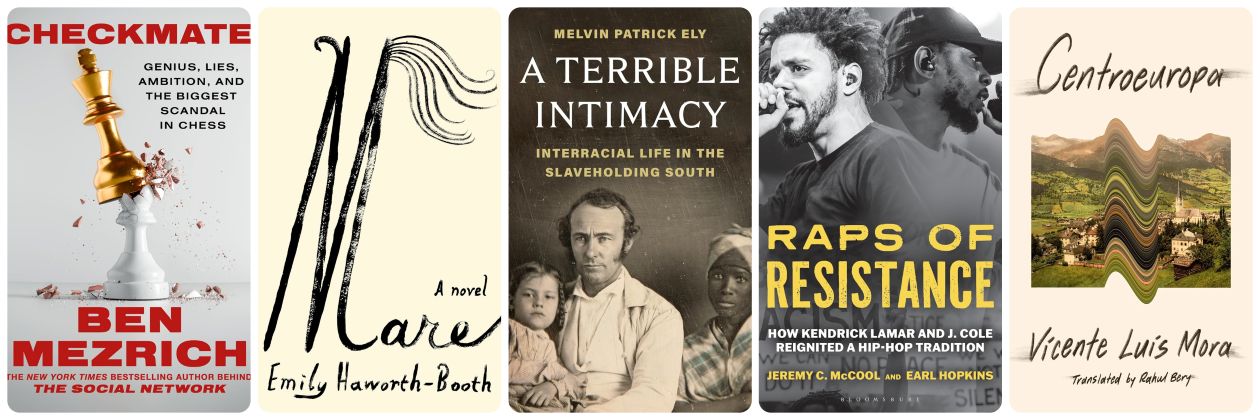
Checkmate: Genius, Lies, Ambition, and the Biggest Scandal in Chess by Ben Mezrich (Grand Central Publishing). Reviewed by Nicole Schrag. “Mezrich’s portraits of Carlsen and Niemann are the stuff of cinema. (And, in fact, an A24 film adaptation of this story is in the works, to be directed by Nathan Fielder and produced by Emma Stone.) Niemann, the ‘enfant terrible’ of chess, lives alone, mostly on the road; wears black on black; and trashes hotel rooms. Carlsen is an impassive Norwegian who, despite being well into his 30s, is accompanied by his dad to most of his major tournaments. But after Carlsen suggests to his massive online following that Niemann cheated at Sinquefield, their conflict quickly escalates to one of Niemann against the world.”
Mare: A Novel by Emily Haworth-Booth (Farrar, Straus and Giroux). Reviewed by Gretchen Lida. “All of this may make it sound like Mare is a stone-cold bummer, but there are glimmers of light and joy shining through the gloom. Lots of things in the narrative made my horse-girl’s heart sing, including the author’s inclusion of equine-specific sensory details and spot-on depictions of the human relationships that can flourish inside the barn and out. Rather than be more explicit and give anything away, I’ll leave it to readers to discover them on their own.”
A Terrible Intimacy: Interracial Life in the Slaveholding South by Melvin Patrick Ely (Henry Holt and Co.). Reviewed by Elizabeth J. Moore. “This surprising blurring of ‘us’ and ‘them’ is evident in the court cases. Enslaved Blacks accused of capital crimes like rape and murder against whites were competently and even ardently defended by white slaveholding lawyers. White witnesses might take the side of accused Blacks against their own family members. And enslaved Black witnesses contradicted the testimony of whites without evident penalty. Yet none of this should be interpreted as humane treatment of enslaved Blacks. Often, those personal ties were why the defendants ended up in the dock in the first place.”
Raps of Resistance: How Kendrick Lamar and J. Cole Reignited a Hip-Hop Tradition by Jeremy C. McCool and Earl Hopkins (Bloomsbury Academic). Reviewed by E.A. Aymar. “For devoted fans of rap, much of that history will be known, but the authors’ retelling still makes for an enlightening read. Possibly informed by Hopkins’ background as a reporter for the Philadelphia Inquirer, the authors write in compelling, mercifully non-academic prose that efficiently covers the genre’s record-spinning origins in the grimy streets of 1970s New York, the variety of its forms and regional influences, and its current worldwide acclaim.”
Centroeuropa by Vicente Luis Mora; translated by Rahul Bery (Bellevue Literary Press). Reviewed by Jennifer Bort Yacovissi. “Reminiscent of the deadpan chaos of Patrick deWitt, especially his Undermajordomo Minor, Centroeuropa shares the same misty, fairytale quality within a hard reality. The bodies, of course, play a major role: First one, then two, four, eight, and 16 soldiers turn up during Redo’s digging, all from different eras of war in this region of Prussia. Indeed, the last, largest group of corpses is a mystifying contingent wearing uniforms and carrying weapons of advanced and unknown origin that won’t become familiar to local residents until more than a hundred years hence.”
Don’t miss another excellent book review, author interview, or feature! Subscribe to our free newsletter and follow us on Instagram, Facebook, Pinterest, Bluesky, and LinkedIn. Advertise with us here.