Our Week in Reviews: 8/22/26
- August 22, 2026
A recap of the books we’ve spotlighted in the past few days.
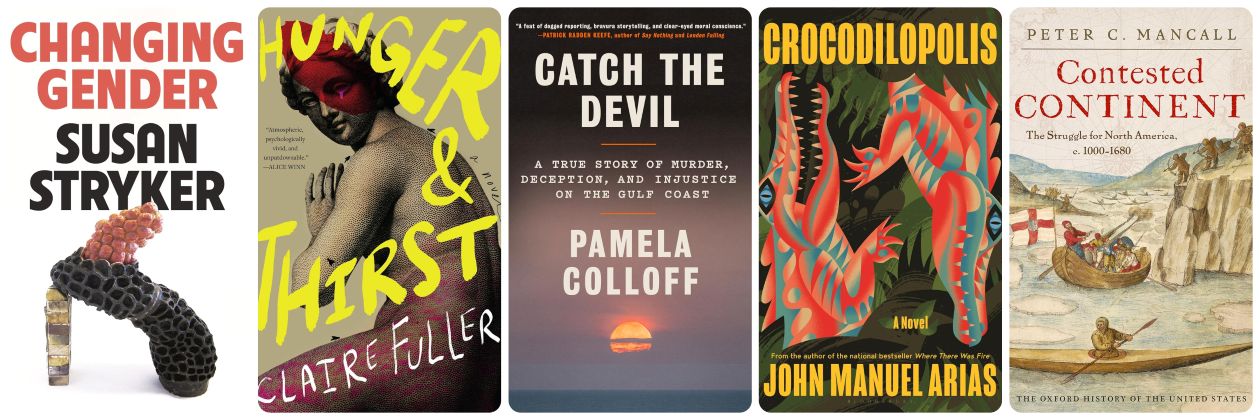
Changing Gender by Susan Stryker (Farrar, Straus and Giroux). Reviewed by Douglas C. MacLeod Jr. “Stryker wanders through the park like a modern-day Thoreau, connecting with the land, the animals, her ancestors, and Native peoples while ruminating on gender. She recognizes that the issue is not as simple as sports, unisex bathrooms, and drag storytime. Gender is rooted in psychology, linguistics, biology, and sociology — it is rooted in the I, the we, the us, and the they/them. It is objective and subjective, personal and communal. It is enjoyed and it is mourned. And, most importantly, gender, like everything else, is ‘radiantly beautiful,’ though tainted by our trespasses.”
Hunger & Thirst: A Novel by Claire Fuller (Tin House). Reviewed by Carrie Callaghan. “That murder — of whom we don’t yet know — happened when Ursula was a 16-year-old orphan in the late 1980s, working as a mail clerk in an art school. There, she labors silently but full of yearning. Though lonely, she interacts only glancingly with her social worker, her adult roommates at her dingy halfway house, and her loutish colleagues as she tries to find a place for herself. The rest of the world may be convinced by Descartes’ mind-body dualism, but Ursula has trouble reconciling the split that society wants to impose on her, a supposed divide between her traumatic history of abandonment and her animal appetites.”
Catch the Devil: A True Story of Murder, Deception, and Injustice on the Gulf Coast by Pamela Colloff (Knopf). Reviewed by Diane Kiesel. “Ethical prosecutors know that snitches who trade information to save their own hides are problematic; proceed with caution. Since 2017, at least a dozen states have passed laws to curb or regulate the practice. But Colloff didn’t find many who questioned relying on Skalnik as a closer. Moreover, she met with Skalnik in a federal prison near the end of his life, but he never explained how he’d heard more confessions than a Catholic priest. As a former prosecutor for legendary New York County district attorney Robert M. Morgenthau — whose mantra was to ‘do justice,’ and who eschewed capital punishment — I found this book horrifying. It should be required reading for every law student who hopes to handle criminal cases.”
Crocodilopolis: A Novel by John Manuel Arias (Bloomsbury Publishing). Reviewed by Mariko Hewer. “The story of the Oreamundo brothers is interspersed with both their family’s history and the broader history and culture of Costa Rica. The boys grow up side by side but live in functionally different households: While Osario is his mother’s little king, Seth lingers on the periphery, raised largely by his great-aunt and grandfather. When Seth is cast out of the family mansion as a teenager after a violent confrontation, Osario experiences profound betrayal at the perceived abandonment, and a rift begins to yawn between them.”
Contested Continent: The Struggle for North America, c. 1000-1680 by Peter C. Mancall (Oxford University Press). Reviewed by John A. Farrell. “At a moment when the telling of American history is a soccer ball in the culture game, Mancall — an historian from the University of Southern California — gives it to us straight. This is a difficult book to read at times, but it is admirably free of conservative cant and liberal sanctimony. It is a clear-eyed saga about the best and worst in humanity, not a screed on settler colonialism, a preachy treatise on race and gender, or a glowing ode to capitalism. Dutch. Swedes. Norse. Spaniards. The Oyo and Ashanti. The Portuguese. The French. Indians. The Brits. There is no system, no race, no tribe or nationality to single out for condemnation.”
Don’t miss another excellent book review, author interview, or feature! Subscribe to our free newsletter and follow us on Instagram, Facebook, Pinterest, Bluesky, and LinkedIn. Advertise with us here.