Our Week in Reviews: 8/29/26
- August 29, 2026
A recap of the books we’ve spotlighted in the past few days.
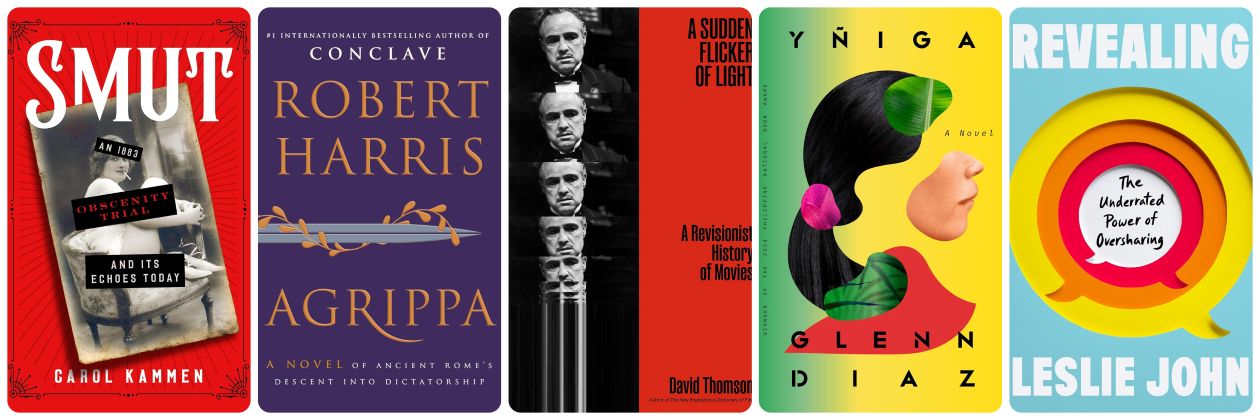
Smut: An 1883 Obscenity Trial and Its Echoes Today by Carol Kammen (Paul Dry Books). Reviewed by Kitty Kelley. “Professor Kammen centers her story on the trial of Jefferson and Helen Beardsley of Ithaca, New York, who were arrested for ‘selling and exhibiting obscene pictures.’ The Beardsleys were found guilty, fined $300 (approximately $10,000 in 2026), and spent anywhere between four and six months in prison. The author believes the outcry for “social purity” then is just as earsplitting today. As the French proverb posits, ‘Plus ça change, plus c’est la même chose.’ The more things change, the more they stay the same.”
Agrippa: A Novel of Ancient Rome’s Descent into Dictatorship by Robert Harris (Doubleday). Reviewed by David O. Stewart. “Somewhat vexing is the promise in the book’s subtitle to reveal ‘Rome’s Descent into Dictatorship.’ Perhaps the writer hoped to match the drift of today’s politics by crafting an instructive saga of how autocracy supplants popular governments. Perhaps he meant for us to see the emptiness of Agrippa’s public life as a harbinger of where we are headed. But the narrative forgets that goal and instead wants us to admire Agrippa. No one, least of all Agrippa, mourns the loss of republican ways.”
A Sudden Flicker of Light: A Revisionist History of Movies by David Thomson (Simon & Schuster). Reviewed by Dennis Drabelle. “Further along, Thomson skewers two hitmakers for the current puerility of most American movies. ‘In so many respects, [George] Lucas is uninteresting; he has never really thought to advance on his or our teenage attitudes. But with Steven Spielberg, unwittingly yet with zeal and in good humor, he ended the best hope for American cinema.’ With ‘Jaws’ and other crowd-pleasers, Thomson asserts, Spielberg ‘came upon art experimenting with difficulty or doubt, talked if off the edge, and advised those un-American urges to shut down.’”
Yñiga: A Novel by Glenn Diaz (Coffee House Press). Reviewed by Frances Thomas. “‘Sleep’ is the book’s opening word, functioning as both a time stamp — it’s the middle of the night, and Yñiga should be asleep but is not — and a distillation of atmosphere, the after-dark entropy that fills every scene, no matter where the sun hangs in Diaz’s fictional sky. Across the street from where Yñiga smokes, soldiers are in the midst of arresting a fugitive general, a ‘decorated butcher of peasants and activists,’ who has been hiding above the local bakery. His capture mounts a spectacle of light and sound that startles some of Yñiga’s neighbors awake, but through it all, she is unmoved, verging on catatonia.”
Revealing: The Underrated Power of Oversharing by Leslie John (Riverhead Books). Reviewed by Antoaneta Tileva. “The book offers much scientific evidence for how to make disclosure decisions bravely and wisely, not just by recklessly oversharing. One major finding that John ably explains is that people often underestimate the downside of concealing, which is a function of our tendency to overestimate the weight of the emotional events being concealed.”
Don’t miss another excellent book review, author interview, or feature! Subscribe to our free newsletter and follow us on Instagram, Facebook, Pinterest, Bluesky, and LinkedIn. Advertise with us here.