Our Week in Reviews: 9/12/26
- September 12, 2026
A recap of the books we’ve spotlighted in the past few days.
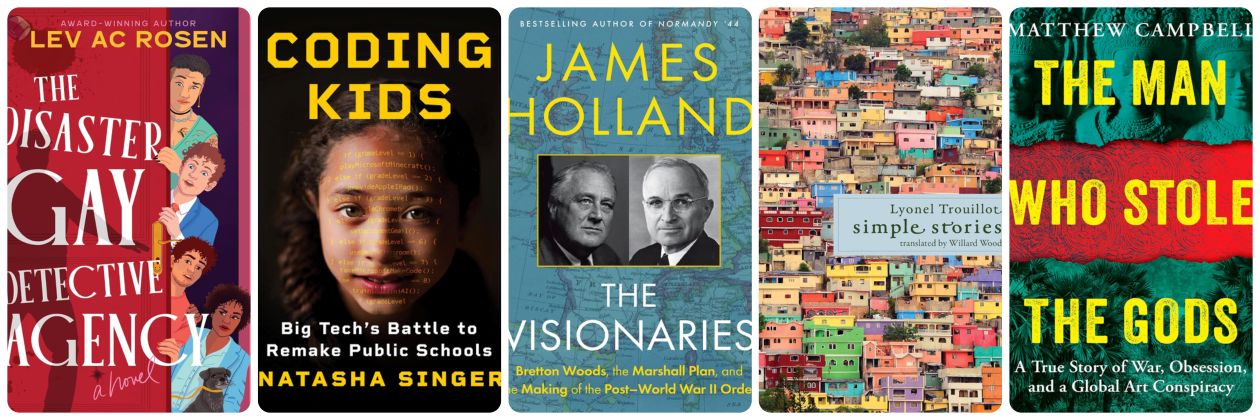
The Disaster Gay Detective Agency: A Novel by Lev AC Rosen (Poisoned Pen Press). Reviewed by Nick Havey. “Brandon, the group’s messy cis-gay nightmare, is a hotel concierge who foolishly hooks up with a guest named Jon who calls for an extra towel — a move that Rosen reminds us is a classic porn trope. The tryst sparks the action of the rest of the book: Jon was, it turns out, maybe a spy and maybe embroiled in an international arms deal provisioning access to black-market/dark-web information to the highest bidder. He vanishes overnight but leaves behind his phone, which Brandon treats as if it’s an earring on a nightstand: the standard left-behind reason to make a second date. It’s not.”
Coding Kids: Big Tech’s Battle to Remake Public Schools by Natasha Singer (W.W. Norton & Company). Reviewed by Aran Shetterly. “If I can’t stop looking at my smartphone, we all seem to be asking right now, what will this technology do to our children? Singer does not attempt to resolve these concerns, at least not directly. Rather, Coding Kids homes in on something more fundamental: the financial and political power Big Tech wields to tilt important debates about the physical, cognitive, and emotional effects of social media on children in its favor and to make skeptics feel like they’re fighting from behind, nearly powerless to resist the tsunami of new and untested technologies — and the curricula built around them — that are taking over our public schools.”
The Visionaries: Bretton Woods, the Marshall Plan, and the Making of the Post-World War II Order by James Holland (Atlantic Monthly Press). Reviewed by Jonas Vaicikonis. “Holland writes with the confidence and clarity of an historian who knows his material intimately. But the book hints at fascinating questions it never fully explores. Many contemporary debates over globalization, sovereignty, foreign aid, and America’s role in Europe were already visible in the late 1940s. Holland touches on these issues but rarely lingers long enough to explore them in detail. A deeper examination of those fault lines would’ve made the book even more relevant to modern readers.”
Simple Stories by Lyonel Trouillot; translated by Willard Wood (Other Press). Reviewed by Susi Wyss. “What provides extra depth to these and the other tales in Simple Stories is the way Trouillot sometimes switches the point of view to provide the reader with a fuller perspective than what any one individual character sees and understands. In ‘The Prodigal Child,’ for instance, we meet a thirtysomething man who spent two years studying in Europe and is working on a ‘treatise on the negation and invention of self.’ He has nothing but disdain for his mother’s ‘coarse country manners…her peasant blouse and her stupid sayings.’ Only when the POV switches to his mother’s do we learn that he’s living in an asylum and what is happening to the manuscript he’s working on.”
The Man Who Stole the Gods: A True Story of War, Obsession, and a Global Art Conspiracy by Matthew Campbell (Portfolio). Reviewed by Mariko Hewer. “For the most part, books about art crimes don’t involve a lot of bloodshed. Such stories seem better suited to an ‘Ocean’s Eleven’ spin: eccentric, chaotic, even a little whimsical. But in The Man Who Stole the Gods: A True Story of War, Obsession, and a Global Art Conspiracy, reporter Matthew Campbell tells a very different sort of tale.”
Don’t miss another excellent book review, author interview, or feature! Subscribe to our free newsletter and follow us on Instagram, Facebook, Pinterest, Bluesky, and LinkedIn. Advertise with us here.