Our Week in Reviews: 9/19/26
- September 19, 2026
A recap of the books we’ve spotlighted in the past few days.
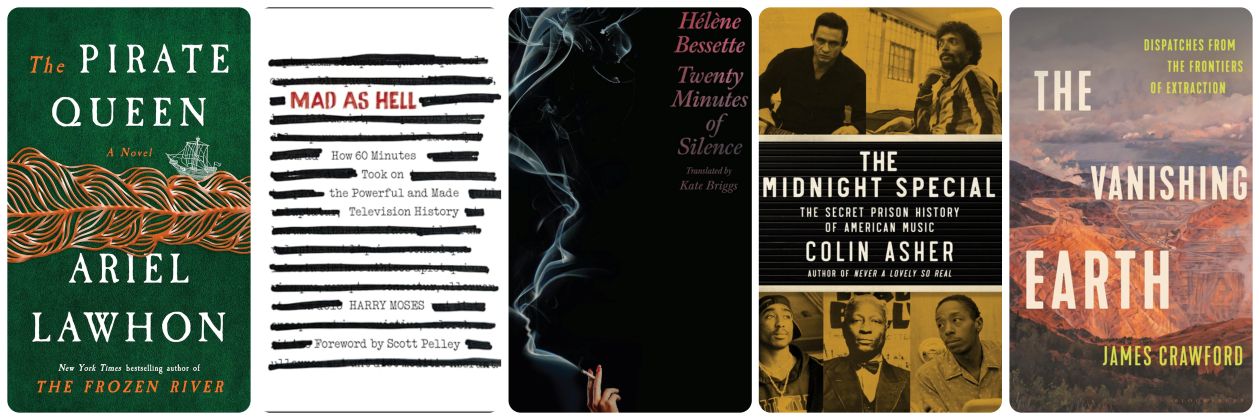
The Pirate Queen: A Novel by Ariel Lawhon (Doubleday). Reviewed by Jennifer Bort Yacovissi. “Donal’s out-of-wedlock birth does not hinder him from being his father’s presumptive heir as chieftain. One problem, though, is that Eóin is a captain with a fleet of ships — the O’Malley clan motto is ‘Powerful by Land and Sea’ — and Donal does not like boats or the open water. Grace, on the other hand, revels in both, demanding at age 5 to accompany her father and his crew on trading voyages, a request he flatly refuses. Girls don’t sail.”
Mad as Hell: How 60 Minutes Took on the Powerful and Made Television History by Harry Moses (Prospecta Press). Reviewed by Kitty Kelley. “Like Don Quixote tilting at windmills, Moses seemed to gallop toward exposé journalism, determined to wallop bad guys and canonize good ones. He best illustrates this in his chapters on the crew from ‘60 Minutes,’ where he was once a lead producer for Mike Wallace, Dan Rather, Ed Bradley, Diane Sawyer, and Lesley Stahl, none of whom fare well in these pages. The adage ‘No man is a hero to his valet’ seems particularly applicable to this lot.”
Twenty Minutes of Silence by Hélène Bessette; translated by Kate Briggs (New Directions). Reviewed by Samantha Neugebauer. “Unlike Lili Is Crying, Twenty Minutes of Silence is a whodunit, albeit a stripped-down, experimental one. The premise is that a man — a father, a husband — has been killed during the night at his home in the north of France. His wife and 15-year-old son were home and, consequently, are the lead suspects. Their maid was also present, though she doesn’t provide anyone — the reader, the detective — any real clarity.”
The Midnight Special: The Secret Prison History of American Music by Colin Asher (W.W. Norton & Company). Reviewed by Charles Caramello. “Colin Asher says of his engaging study, The Midnight Special, that ‘trying to write a definitive history of American prison music would be quixotic. This book isn’t that. Instead, it focuses on five albums and the lives of the musicians who made them, each of which has something distinct to say about the ways that policing, and incarceration, have shaped our musical culture — affecting our perception of an artist’s work, choosing who is able to perform, record, and tour, and influencing the development of musical style.’ Though clearer on what the book isn’t than on what it is, Asher’s précis captures its capaciousness and peripatetic focus.”
The Vanishing Earth: Dispatches from the Frontiers of Extraction by James Crawford (Bloomsbury Publishing). Reviewed by Julie Dunlap. “More promising alternatives comprise the book’s vital last section, ‘Repair.’ Interviews with carbon-capture engineers, rebel architects, conservation biologists, and climate-lawsuit litigants signal that the ‘anti-extraction movement’ is diverse and growing. The son of a fossil-fuel engineer, Crawford writes movingly about an Indigenous-led campaign to stop oil drilling in an Ecuadorian rainforest, where saving giant otters, spider monkeys, 567 bird species, and trillions of insects is as important as supporting villages and reducing carbon emissions. In 2008, the effort culminated in the world’s first constitution to recognize rights for the natural world. To Crawford, that victory represents a perceptual shift toward understanding that ‘not extracting could be worth as much as extracting.’”
Don’t miss another excellent book review, author interview, or feature! Subscribe to our free newsletter and follow us on Instagram, Facebook, Pinterest, Bluesky, and LinkedIn. Advertise with us here.