A close reading of Garth Greenwell’s Small Rain.
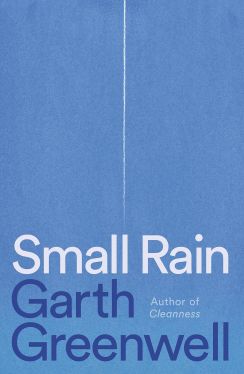
In the wake of a recent and excruciating shoulder injury, I sought succor in Small Rain, Garth Greenwell’s latest wonder of a novel. I’d read it once before, shortly after it came out, and so I knew the subjects at its heart — illness, isolation, and the perennial question of how to lead a meaningful life. The content is heavy, and yet I had a hunch that this book, more than any other, might transport me from the maddening banality of my physical pain.
Thankfully, my hunch proved accurate. As I lay supine on the couch, popping Advil like candy while my shoulder embarked on its agonizingly slow march to healing, I clung to the pages of Greenwell’s novel, grateful (at many times to tears) for its remedial insights.
Bodily suffering is infamously hard to write into, as articulated by Virginia Woolf in her essay “On Being Ill.” The problem, she wrote, is that illness demands an entirely new lexicon, at once “primitive, subtle, sensual, obscene,” as well as “a new hierarchy of the passions; love must be deposed in favour of a temperature of 104; jealousy give place to the pangs of sciatica; sleeplessness play the part of villain, and the hero become a white liquid with a sweet taste.”
To be inside a failing body, then, is to grapple for words that don’t exist and to be consumed by desires that are routinely ignored by literature. But in Small Rain, Greenwell gives language to the specificities and mortifications of corporeal suffering, vaulting its ignoble dregs — urine-stained sheets, needle-blasted veins, strangers’ gloved hands poking and prodding at our tenderest parts — to the realm of the divine.
The novel takes place over a few short weeks, during which an unnamed narrator drops into a terrifying, near-catastrophic health crisis. The malady appears suddenly, with no apparent cause or precedent, and its murky etiology calls for a slew of medical interventions with uncertain outcomes, less a treatment protocol than a hellish game of whack-a-mole.
And though much of the action occurs in a single hospital room, the setting is anything but static. Frequent flashbacks and quiet yet craterous dialogue — Greenwell is a master of vernacular moments, stylizing them into tight coils of consequence — tether the cloistered narrator to an edgeless outside, reminding him, always, of what escapes his grasp.
As if the world of this book weren’t dismal enough, it’s set in the early days of covid-19, creating a Russian-doll effect of nested nightmares. But reading it feels nothing like a nightmare: It feels like a gift. What Greenwell offers us, line by gorgeous line, is communion with the universe of pleasure dwelling in the shadows of the mundane.
Take one short scene that occurs about two-thirds into the book, when the narrator has finally been granted the all-clear to have a cup of coffee. He asks his longtime partner, L, to bring one from the hospital café, and when he lifts it to his lips, sheer ecstasy ensues:
“I pried off the plastic lid and brought the cup to my face, not sipping yet but breathing in the smell, at which I moaned in pleasure, which made L laugh. The moan was genuine, the smell of the coffee was pure pleasure, it must have been a jolt of dopamine, the addict’s reward; and then I brought the waxed rim of the cup to my lips and took the smallest sip I could, drawing it in with my breath; if I only got one cup a day I wanted to make it last. The deprivation was almost worth it for the intensity of those first few sips, the way immediately they eased the low buzz of discontent that radiated even through the oxy. The headache didn’t go away exactly, but it loosened its claws as my mind sharpened, my thoughts cleared; I felt the pleasure in my whole body, a slow spark along my arms and legs, my spine, traveling down and then back up again. How can this be legal, I said to L.”
Greenwell’s previous two books, What Belongs to You and Cleanness, are lauded for their unapologetically artful sex scenes, but I would argue that the passage above radiates with comparable heat. It’s in the radical attention to each gradation of joy: prying off the lid, breathing in the coffee’s ambrosial smell, titrating the smallest-possible first sip, savoring that sip as it travels like a slow spark along the limbs…
The progression of details is downright sexy. And I don’t mean sexy in a bodies-between-the-sheets sense; I mean it in the way that Audre Lorde spoke of the erotic. To Lorde, the erotic is a sacred reservoir of internal feeling, a life-giving energy that swells from our deepest desires. It is a profound awareness of the physical, emotional, and psychic needs that animate a body and a sustained commitment to fulfilling them. It is about presence, dropping into the seat of yourself where it’s safe to be sensual and loving and ravenously, courageously wanting. It is asking for a cup of coffee and partaking in its liquid warmth like you would a kiss from a beloved.
I believe the power of this passage, and Greenwell’s overarching oeuvre, lies in his use of the erotic to gild microscopic increments of movement. This crafted eroticism isn’t limited to pure pleasure — we see it directed to less lovely sensations, too, like the persistence of the narrator’s headache even after imbibing his drink. But the claws of the ache loosen, allowing for a sharpening of his mind and a clearing of his thoughts. The coexistence of all this pain and pleasure underscores just how entwined they are as modes of being. Hurt and happiness do not exist in diametric opposition; they are intimate bedfellows, nourished and exhausted and made meaningful by each other over and over again.
In the passage with the coffee cup, Greenwell accomplishes what the Russian literary critic Viktor Shklovsky said all art exists to do: “make the stone stony.” By that, he meant art has the potential to defamiliarize us from the objects, rituals, and general drudgery of our everyday lives, to take what is known and transform it into something wondrously new. The true power of art lies not in aesthetics — a dazzling wash of color on canvas, a line of poetry that draws shivers up the spine — but in how those aesthetics invite a fresh way of sensing the world.
I never knew a shitty cup of hospital coffee could inspire such a surge of beatific feeling, but for Greenwell’s narrator, it does. And because I hold Small Rain in my own hands, I feel it, too.
My shoulder is almost better. I can’t say I’m happy that I hurt it, but perhaps where it led me — to Small Rain, with its numinous grammar for pleasure and pain — was worth it.
Frances Thomas is a writer based in Brooklyn and an MFA in Nonfiction Writing candidate at Columbia University. Her work has appeared in Slate, Dazed, American Literary Review, Longridge Review, the Maine Review, and elsewhere. She writes to build safe spaces for hard conversations. You can find more of her work on her website.