Tommy Orange’s There There offers a searing reading experience.
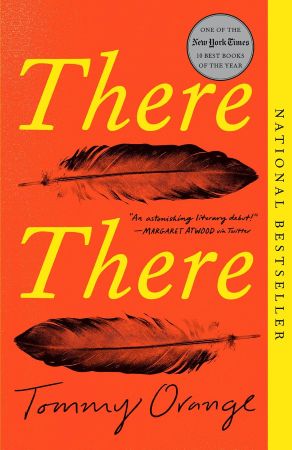
A supernova streaked across the sky in 2018, announcing the publication of Tommy Orange’s first novel. There There arrived with a crash of thunder, trumpeting a Native American author who commanded attention and admiration for giving voice to a community long marginalized. Critics fell at his feet, and the awards were impressive: The book was a finalist for the Pulitzer Prize and the Andrew Carnegie Medal, and it received the American Book Award, the PEN/Hemingway Award, and the John Leonard Prize from the National Book Critics Circle for a first book by a new voice.
And that voice — loud and profane, pained and eloquent — demanded to be heard.
Orange grabbed his title from a comment Gertrude Stein made after a 1937 visit to Oakland, California, to see the rural home where she’d grown up. Saddened to find that her childhood farmhouse, with its garden of eucalyptus trees and rose bushes, had been razed to make room for an industrial park, she wrote, “There is no there there.”
For Stein, memory had been molested by urbanization. So, too, for Orange, who grew up in Oakland with a white mother from Upstate New York and a father who was an enrolled member of the Cheyenne and Arapaho tribes of Oklahoma. “You kind of are both and neither,” the author told Powell’s Books, “because you’re not enough, not white enough on the white side and not Native enough on the Native side.”
There There presents a cast of 12 Native American characters, all associated in some way with Oakland, who converge on the city for the occasion of the Big Oakland Powwow. Some of those raising children have tried to shield the young ones from abuses by the non-Native American world and have removed all traces of Native culture from their homes. A few hide their feathered headdresses and forbid youngsters from attending the powwow. Of course, this drives the kids to scheme and plot about how to get to the event and what they’ll do once inside the Oakland Coliseum. Tragically, the result will be mayhem and murder.
Orange’s novel throbs with the injustices still being suffered by the descendants of America’s first residents, who, for the most part, no longer live on reservations. “We know the sound of the freeway better than we do rivers,” he writes, “and the smell of gas…and burned rubber better than we do the smell of cedar or sage or even fry bread.”
The characters pulsate with a defiance that often leads to the abyss of alcoholism, the scourge of Native Americans. Most of the characters are touched in some way, as the author admits he was, by drugs and alcohol. Among the cast are Tony Loneman, born with fetal alcohol syndrome, who sees “The Drome” each time he looks in the mirror, and Jacquie Red Feather, who works as an addiction counselor but still struggles with her own alcoholism. In an interview in the Guardian, Orange called out the stereotype about Indians and alcohol — the myth that they have a metabolic weakness for drinking to excess:
“People conveniently want to think that, because they don’t want to look at why somebody might be going to something to stop the pain or help with whatever they’re trying to cover up or not think about.”
There There might be difficult to digest for some white, middle-class readers unaware of the pathos of Native Americans and their utter displacement in society today. Over 70 percent live in urban, non-reservation areas across the U.S. While some deny their roots and try to escape merciless discrimination, others cling to their heritage without apology. Orange’s novel introduces them all as it barges into the complacency of white America with angry insistence that Native Americans deserve a seat at the table. “We haven’t seen the Urban Indian story,” says one character. “What we’ve seen is full of the kinds of stereotypes that are the reason no one is interested in the Native story in general.”
The book offers a brief but bruising introduction to the plight of Indians in America from 1621 forward and the massacres that tried to obliterate them. “Living in urban areas represents our sheer will and ability to adapt and survive,” Orange remarked to Alta Journal in 2021. In the novel, he writes:
“We are the memories we don’t remember, which live in us, which we feel, which makes us sing and dance and pray the way we do, feelings from memories that flare and bloom unexpectedly in our lives like blood through a blanket from a wound made by a bullet fired by a man shooting us in the back for our hair, for our heads, for bounty, or just to get rid of us.”
There There is not an easy read, but it’s a powerful story told by a master whose voice seems to spring from a supernatural force, perhaps the same one that sparks thunder and lightning and shooting stars.
Kitty Kelley is the author of seven number-one New York Times bestseller biographies, including Nancy Reagan, Jackie Oh!, and Elizabeth Taylor: The Last Star. She is on the board of the Independent and is a recipient of the PEN Oakland/Gary Webb Anti-Censorship Award. In 2023, she was honored with the Biographers International Organization’s BIO Award, which is given annually to a writer who has made major contributions to the advancement of the art and craft of biography.