When others decide you’re not where you’re from.
I was 14 when the planes struck the World Trade Center. I was attending a small international school in Washington, DC, alongside many immigrant and diplomat families. I loved the feeling that we were all connected, through history and culture, to faraway places. My parents told me stories about Baghdad, Palestine, and Beirut, and I relished the Orientalist, whitewashed Disney-fied versions of my heritage that I got to see: “Aladdin,” “Lawrence of Arabia,” “Arabian Nights.” The world felt small and welcoming, and DC felt like a little microcosm of our planet.
That changed the day the principal called an emergency assembly and told us about the attack. There were a few chuckles, then a stirring silence as we all tried to make sense of what was just said. Planes. Hijacking. Attacks. As students spilled out of the auditorium and wandered, wide-eyed and shocked, back in the direction of their classrooms, we shared the same fear. Our city was a target.
The school closed for a few days and began receiving threats from fearful xenophobes. “Go back to where you’re from.” But I had nowhere else to go; I was an envelope with no return address marked “return to sender.”
At night, I woke up to the thwop-thwop of helicopters and the flash of daylight illuminating my whole bedroom. The president declared war on Iraq. I felt afraid, unsure of whom to trust and where I fit in my newly divided world. I became hyper-aware of mutterings in the hallways, on high alert for hateful quips. I was in the school library when I heard one classmate state loudly, “All Arabs are terrorists,” as if I wasn’t there, as if we hadn’t known each other since first grade. The murmurs of agreement knocked the wind out of me.
My parents warned me to be careful about whom I disclosed my ethnicity to. Hate crimes were on the rise. My light skin kept me safe, but my name was a flag.
“Where are you from?” they’d ask at parties.
“DC,” I’d respond hesitantly.
“Where are you really from?”
The little kid inside me curled into a ball, hiding behind the veneer of whiteness. It took me decades to identify the cleaving that those sentiments created within me, the ways in which I held onto my “American” identity while feeling “other.” Those comments questioning my true origin sprouted a longing for a faraway place that would claim me as its own.
Over the years, I moved to different cities, perhaps hoping to find a place that felt just right, but each time I returned to DC, relieved to ride home along the Potomac River, lined with trees and monuments.
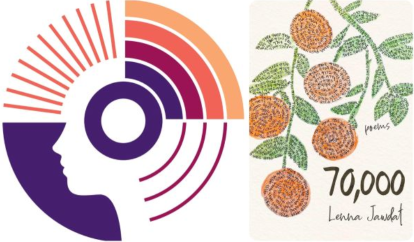
In my writing, I return to these themes over and over: diaspora, longing, belonging, visibility, and invisibility. I excavate my inner world and grapple with feelings of dispossession by the only home I’ve ever known and the ones I’ve never seen. When I began writing my debut book, 70,000: Poems, about the mass destruction of books from Palestinian collections, I realized I no longer wished to be invisible, even as the fear prior to publication day gripped me. The silence that I thought was keeping me safe was actually keeping systems of power in place and keeping me siloed.
I could choose to speak up.
Sharing my work publicly has allowed me to connect, as a more nuanced version of myself, to people who share my experiences and values. We are all connected, maybe especially in DC, where you can encounter people from all over the world as you walk down our tree-lined streets.
[Editor’s note: This piece is in support of the Inner Loop’s “Author’s Corner,” a campaign that spotlights a DC-area writer and their recently published work from a small to medium-sized publisher. The Inner Loop connects talented local authors to lit lovers in the community through live readings, author interviews, featured book sales at Potter’s House, and through Eat.Drink.Read., a collaboration with restaurant partners Pie Shop, Shaw’s Tavern, and Reveler’s Hour to promote the author through special events and menu and takeout inserts.]
Lenna Jawdat is a DC-based writer and therapist of Palestinian and Iraqi descent. Her work has been published in Poet Lore, the Massachusetts Review, the Margins, and elsewhere. Lenna received her MFA in creative writing from IAIA in May 2024. Her debut book, 70,000: Poems, was chosen by the American Booksellers Association for the Summer/Fall 2026 Indies Introduce and July 2026 Indies Next lists.