Cherishing the ghosts of holidays past.
Thanksgiving. Among tangible souvenirs of past holidays are handprint turkeys our kids made in kindergarten. The teacher (the only one the three had in common over the years) drew an outline of each student’s hand. The palm became the turkey’s body, the thumb its head, the fingers the feathers. Same general template, but each hand a little different, and each turkey further individualized by the colors the artist chose, and whether the template was filled in carefully or with line-defying exuberance.
I’ve been musing on intangible souvenirs, too, my reified memory template of my own childhood holidays. The general outline remains consistent from year to year but is filled in differently — sometimes brighter, sometimes darker.
My parents, Nelle and John, my younger brother, Don, and I celebrated almost every year with my father’s sister and her husband, and our next-door neighbors. Anne, Wells, and daughters Kim, Laurie, and Tara were our closest friends, our extended family.
Nelle and Anne met on a Boston streetcar in 1946, on the way to their first day teaching at the same school. Their spouses were studying on the G.I. Bill. The couples bonded. The spouses graduated. Anne and Wells moved to St. Louis for his residency, my parents to Philadelphia for his teaching position. After a few years of long-distance friendship, both came to Maryland in the mid-1950s with their first young children in tow. Soon, the families built houses side-by-side in a new suburb, thanks again to the G.I. Bill.
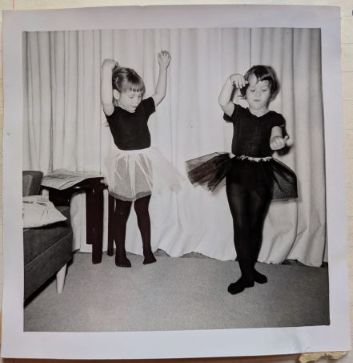
Kim and I, born in 1953, grew up almost as close as sisters. We ate and slept at both houses, played in the shared woods between.
Next in age order, Laurie and Don were almost Irish twins and played an interminable Monopoly game. Caboose Tara was baby sister to us all.
Most feast days, we gathered at our house. We ate appetizers beside the hearth: carrot sticks and my mother’s signature oatmeal molasses bread, with whipped butter and thin shavings of cheddar. Anne or my aunt might also contribute pâté or a suspicious smoked fish. The kids drank cider and cranberry juice; my aunt and uncle brought the sherry, Anne and Wells the wine. We adjourned to the long aluminum folding table in the family room for turkey and twice-baked potatoes. The kids avoided the congealed lemon Jell-O salad with avocado and grapefruit.
The shared holidays and ordinary days continued after Wells left the family. My parents circled the wagons around Anne and the girls. Anne went back to work, joining the administration at the elementary school where Mom taught and we kids were students.
Kim and I turned 12 that fall and began junior high. She was my guide to teenage culture. We shopped (without our mothers!) for Wrangler jeans and knock-off white go-go boots. She kept a stapler in her locker to shorten skirts. At our sleepovers, I dozed off to her steady monologue about boys and gossip. A night owl, further fueled by Diet Pepsi, she listened to WINX into the wee hours.
Our paths diverged in high school and thereafter. Briefly, in our 20s, we both lived in Boston. I still have the sugar cannister she gave me when breaking up her apartment. She moved to Binghamton, New York, where Anne grew up and Kim’s grandmother lived.
Kim stayed in Binghamton, marrying Karl, and raising their son, Jimmie. I eventually returned to Maryland and raised our kids there with my husband, Harry. My parents and Anne still lived a few miles away in our childhood homes.
Kim visited over the holidays. Telephone calls held us together in between. Then, in what seemed no time at all, a new century began. Soon, we were keeping vigil at our parents’ deathbeds, supporting each other at the memorial services. Anne went first. Kim was mistress of ceremonies at the service, vivacious in red heels her mother would have loved. John died a few months later, and soon after, Nelle followed.
Kim was diagnosed with M.S. She came down regularly to consult a specialist, until travel became difficult. I went north too few times. We visited in the room Karl built for her with floor-to-ceiling windows so she could watch her birds. She loved watching Jimmie and his family even more.
When she could no longer answer the phone, Karl brought it to her. Honest but uncomplaining, only once did she say how much she missed dancing with Karl to the radio in the kitchen.
We spoke on September 24, 2024, her birthday. She was turning 71 a few months behind me, but she’d always been ahead of me in living and loving. We both knew she would soon go ahead of me again.
“I was thinking of that oatmeal bread,” she said just before our goodbye. “I’d love to have a taste of that bread.”
I hung up and baked her a birthday loaf. Oats and molasses make a sticky dough, best to knead a long time. But there wasn’t much time. I barely let the loaf cool before wrapping and mailing it.
I called a few days later.
“Thanks for the bread. I thought I’d have to wait till Christmas,” she said, with a shadow of her hearty laugh.
Karl called 10 days after. She’d slipped away. Though he kindly did not tell me, I learned she’d grown too weak to eat some time before. She may never have tasted the bread. Knowing Karl, he might have held a morsel close enough so she could at least smell the sweetness.
Raised with Kim in Unitarian Sunday School, my belief in a hereafter is limited to what lasts here, what remains among those who loved us: memories, stories, and rare ineffable moments of felt presence.
My mother often asked where Dad was after he’d died. I would remind her. Once, too tired and sad to pour truth again into the sieve of her memory, I lied.
“He’s resting.”
“You mean the final resting,” she said, momentarily clear as the farm girl she’d been, the woman well acquainted with death she’d become.
Now, Kim has passed away into the mystery.
At my holiday feast table of memory, I raise a glass of Diet Pepsi. To Kim!
Ellen Prentiss Campbell’s collection of love stories is Known By Heart. Her collection Contents Under Pressure was nominated for the National Book Award; her novel The Bowl with Gold Seams won the Indy Excellence Award for Historical Fiction. Frieda’s Song was a finalist for the Next Generation Indie Book Award, Historical Fiction. Blogging as “Girl Writing” in the Independent bi-monthly, she lives in Washington, DC. For many years, Ellen practiced psychotherapy. Her new novel, Vanishing Point, will appear in spring 2026.