Remembering John Hersey’s Hiroshima on the 80th anniversary of the bombing.
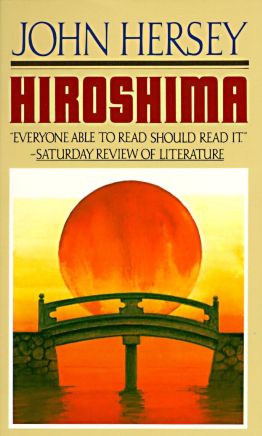
In Hiroshima, John Hersey fused six eyewitness accounts from August 6, 1945, to create a grisly description of the scene on the ground in the aftermath of the first use of a nuclear weapon in war. His style of journalism employed great restraint in not commenting on those accounts but instead allowing them to unfold for the reader to judge.
Civilians on the ground described the moment of detonation as a sudden light, similar to the flashbulb on a camera, and an eerie absence of sound prior to the subsequent firestorm. Hersey deftly avoided relying too heavily on statistics in his initial chapters. Rather, he used six pairs of eyes to detail the gruesome burns and lacerations on the living and the dead alike. His narration recreated the confusion and desperation of the eyewitnesses trying to help the wounded or locate relatives. When one’s story lulled, another’s picked up, forcing readers onward through the carnage to the Red Cross Hospital, into Asano Park, and beyond.
“Seeing” through the eyes of survivors somehow created a three-dimensional experience. The image of Rev. Kiyoshi Tanimoto reaching for the hand of a woman, only to have her skin slide off like a glove, evoked such a visceral response in me when I first read it that I still involuntarily clench my teeth and swallow hard when recalling it.
The version of the book I read included an “Aftermath” section, in which Hersey returned to Japan 40 years later and followed up with his six survivors, or “hibakusha.” Consistent with his original style, he chronicled how five of them suffered major health complications from radiation sickness or injuries sustained in 1945.
Rev. Tanimoto, who’d spent the hours and days immediately after the bombing trying to save the injured, continued his efforts later via multi-city fundraising tours in the United States that lasted several months each. The money raised benefited the “Hiroshima Maidens,” 25 Japanese girls disfigured by the bomb who were flown to New York to undergo plastic surgery. It also funded the building of the Peace Memorial Park and Museum in Hiroshima. Despite his humanitarian intentions, many Japanese considered Tanimoto a publicity-seeker.
Hiroshima remains unparalleled in terms of journalism, and its origin story stands out because it preceded one of the worst periods of book-banning in America, the McCarthy era. The New Yorker had commissioned Hersey to write about the aftermath of the bombing, and once he submitted his manuscript, the magazine’s editors managed to keep the story under wraps while they helped him perfect what became a 31,000-word article published in the August 31, 1946, issue. Later that same year, Knopf reprinted Hersey’s account in book format. This route to publication proved vital in evading domestic censorship, even though the U.S. military, then under the leadership of Douglas MacArthur, dissuaded publishers from translating the work into Japanese until 1949.
Although I left the classroom two decades ago, I still think about what books I’d teach my A.P. Lit students today. Hiroshima would be at the top of the list. Perhaps I’d pair it with The Things They Carried, Tim O’Brien’s fictionalized account of the Vietnam War; no nonfiction work comes close to so vividly capturing the devastation of battle through soldiers’ eyes.
On the 80th anniversary of the bombing of Hiroshima, we should pause to mourn the first victims of the Nuclear Age, wrestle with how our government’s decision to drop the bomb changed the world, and remember the efforts by censors to keep Hersey’s story out of some readers’ hands.
Wendy Besel Hahn was the nonfiction editor for Furious Gravity, an anthology of 50 women writers in the Washington, DC, area. Her work appears in the Washington Post, HuffPost, Hippocampus, Sojourners, and elsewhere. She lives and writes in Denver, Colorado.