Finding the light in autumn’s earlier dark.
During summer evenings on our farmhouse porch, we delight in watching the sun set. I call it the light and cloud show, though it’s not a performance. Sunset just is, no two evenings alike. Extravagant bands of gold and rose and violet soften and deepen into purple; drifts of smoky grey fade to charcoal and then black.
Other nights, storms rip and torrents racket down on the tin roof. Lightning flashes; we count the seconds until thunder rolls, awe spiked with apprehension. One stormy night long before my family came to this Allegheny ridge in 1968, the barn was hit and burned. My husband, Harry, edges the herb garden with remnants of its charred fieldstone foundation.
The evening’s entertainment isn’t over after sunset, though. Twilight raises the curtain on points of cool light, silvery green and gold, tracing evanescent patterns. Sparks flicker in the tall grass between walnut trees and meadow; tiny shooting stars swoop down the hillside. The fireflies’ light show is a performance, but we’re only an accidental audience for their aerial mating dance.
Our kids used to play catch-and-release with fireflies, holding the glow in cupped palms, filling a canning-bottle lantern with light; freeing the captives before bedtime. Now, Harry and I are content to watch luminescent trails of skywriting — indecipherable messages — vanish like invisible ink.
Although the abstract cursive is illegible to us, the soft neon calligraphy is communicative. We learned more, leaving the porch grandstand to attend the Sunday evening nature talk “Fireflies Light Up the Night” at nearby Shawnee State Park.
Ranger George, the park environmental educator, called for a show of hands: fireflies or lightning bugs? I voted with Team Firefly. George refereed, explaining that, no matter our preferred colloquial name, all are beetles. Despite their usual drab daytime camouflage, their apt family name is Lampyridae, “shining light.” Pennsylvania claims at least 30 species. One, Photuris pensylvanica, became the official state insect thanks to legislative lobbying by schoolchildren.
During the talk, George demystified the glow without destroying its magic. An enzyme, luciferase, catalyzes a chemical reaction, creating light without heat loss (magic!). The flashes? Seductive Morse-code signals. Males and females broadcast their species’ particular timed sequence of long and short blinks. Recognizing the pattern, couples find each other and mate. Afterward, the female lays eggs in soil.
Within a few weeks, larvae hatch and live underground, preying on snails and slugs, for up to two years before pupating. A couple of weeks later, pupae emerge as fireflies, living at most a few weeks.
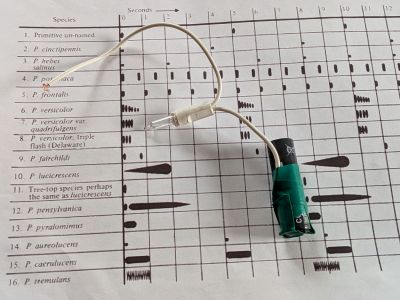
Ranger George has a hands-on, get-out-in-nature approach: Often, at the lake, he teaches kids and parents to make fish prints. Concluding his talk, he demonstrated a homemade firefly-flash simulator he’d constructed with an AA battery and a snippet of holiday wire with one tiny bulb. The plastic sheathing on both ends of the wire was stripped to expose the copper filaments. One end was taped to the battery’s negative pole; the other was left free. Turning out the lights, tapping the free end of wire to the positive pole, he created a pattern of syncopated flashes.
George then distributed simulators and a chart of signal-code patterns for 16 local firefly species. “Pick a signal,” he told us, “walk around the room, find someone flashing your signal.”
The group, a dozen adults and one kid, became a firefly mixer. Laughing and flashing, we wandered the room. When the party was over, George suggested taking the devices home to practice with our own backyard fireflies.
We did, but no fireflies were fooled. Just as well, perhaps. In P.D. Eastman’s 1958 Sam and the Firefly, communication between humans and firefly Gus, although moderated by wise owl Sam, causes chaos.
Falling asleep, I recalled a firefly night 14 years earlier. Daughter Martha was living in Mexico. I visited her in Chiapas. We traveled further south, joined by a young woman she’d met in language school, to see the ruins of Palenque and Bonampak near the Guatemalan border.
Our lodging was a thatched hut in a forest campground. Except for a woman tent-camping with her young son, we were the only guests. Howling monkeys in treetops did not dissuade me from morning swims in the shallow pool, but their nighttime shrieks amid dense tropical foliage spooked me.
Not my hut-mates. Martha and her friend, alerted by a signal system available only to those under 30, were invited to a party at a livelier campground. By flashlight, they applied eyeliner and mascara. Reluctant to stay home alone with the monkeys and lizards, I tagged along on a dark path laced with tree roots. Invisible monkeys followed, screaming overhead. The night came alive with a reassuring familiar flicker.
“What are fireflies in Spanish?”
“Luciérnagas, Mom.”
Music led us to a fire circle, dancing, and pulque. The uninvited, off-duty chaperone-mama, I sat in the shadows, looking into the darkness, enjoying the fiesta of las luciérnagas.
Now, September at the farm, the first yellow walnut leaves flutter down. Dark falls early. I fall into bed earlier, too, savoring a long summer read: What Clever Friends: The Selected Letters of Jane Kenyon and Alice Mattison. Their correspondence concerns family, friendship, and the process of creating poems and stories. Last night, as crickets rasped a raucous farewell-to-summer chorus outside the window, I picked up Kenyon’s collection Let Evening Come, turning to the title poem:
...Let the cricket take up chafing
as a woman takes up her needles
and her yarn. Let evening come...
This morning, we breakfasted on the porch. Two hummingbirds whirred, in needless competition over ample sugar nectar in two separate feeders, tanking up for the coming migration. Harry reported seeing a few fireflies after I’d turned in.
So tonight, I’ve stayed up late (for me). We sat on the porch swing, listening to crickets “warn everybody that summer cannot last forever,” as E.B. White says in Charlotte’s Web.
We watched the occasional shimmer of fireflies. Those shining lights will soon go dark. Almost time to pick up my knitting, finish the sweater laid aside in April. Time to let evening come.
Ellen Prentiss Campbell’s collection of love stories is Known By Heart. Her collection Contents Under Pressure was nominated for the National Book Award; her novel The Bowl with Gold Seams won the Indy Excellence Award for Historical Fiction. Frieda’s Song was a finalist for the Next Generation Indie Book Award, Historical Fiction. Blogging as “Girl Writing” in the Independent bi-monthly, she lives in Washington, DC. For many years, Ellen practiced psychotherapy. Her new novel, Vanishing Point, is out now.