In turbulent times, art often takes a surrealist turn.
One night, back during the pandemic, I had a vivid dream. In it, a shadow crossed the sky while we were having lunch underneath the pergola. We looked up and saw a flying tortoise. He was about to crash when my son, Alex, darted across the grass and caught him like a football. Then, the tortoise climbed out of his shell as if he was leaving a space capsule. His limbs lengthened, and he took on human proportions.
“Get some food for Tony!” I cried. “Would you like half a cabbage?”
“No, Mama,” Alex said. “He can easily eat the garden vegetation.”
When I woke up, I decided to continue writing the story as a form of lockdown entertainment. I called it “My Beloved Salamander.” Sometimes, I read bits aloud to friends and family. As my friend Steve put it, the way it evolved was either crazy or genius. “Inclined to think that it’s genius,” he wrote, “and it certainly sounds as if you are having a marvelous time with it, which may be the only thing that really matters now in an artistic enterprise.”
I’m reminded of those lines by Henry James:
“We work in the dark — we do what we can — we give what we have. Our doubt is our passion, and our passion is our task. The rest is the madness of art.”
Off and on, I’m still working on this story, which currently runs about a hundred pages. It’s like assembling puzzle pieces from the subconscious or assembling them in the way the Dadaists did, “according to the laws of chance.” I’ll put it aside, and then another puzzle piece emerges, such as when my friend Anjali told me about her favorite painting, “A Moment of Calm” by Max Ernst.
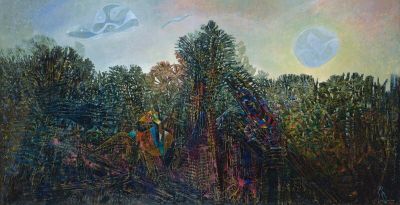
“There’s a flying tortoise in that painting,” she said. “You need to see it. It’s in the National Gallery of Art.” And when she said it, I instantly knew the painting would be in my story.
Ernst composed “A Moment of Calm” when he lived with Leonora Carrington in Saint-Martin-d’Ardèche in France at the outset of World War II. He was arrested shortly afterward as an enemy alien, and Carrington fled to Spain.
After the war, in the 1950s, Ernst made his way back to France and lived in a farmhouse called Le Pin Perdu in Huismes. It’s the next village from Rigny-Ussé, where we have a family home.
This summer, I met the current owner of Le Pin Perdu, Dominique Marchés, who gave us a tour of Ernst’s atelier and garden. A few weeks later, my daughter, Rozzie, and I found ourselves sitting with him at a huge table in his living room, talking for more than an hour about “A Moment of Calm.” He told us that after Ernst was arrested, the 21-year-old Carrington had a mental breakdown. In her panic, she sold their house to a local bar owner for two bottles of cognac. When she reached Spain, she was hospitalized.
Marchés speculates that Ernst rolled up the canvas and hid it under the eaves of the house Carrington sold; later, he reworked it. Marchés showed us a photograph of Ernst with the canvas on the wall behind him in the very room where we were then sitting and talking about it. When we parted, he asked me to send him a photograph of myself standing beside the painting in Washington, DC, so that he could compare it with pictures he had.
My husband, Ben, and I went to see “A Moment of Calm” in August. The Mall was surprisingly quiet for summer. National Guardsmen were wandering around, and there was an enormous banner of Trump’s face hanging outside the Department of Labor across from the art museum.
We found the painting in a gallery upstairs. It shows a chaotic thicket of dark brown and pink paint laid on with a palette knife, scraped downward in petaled angles, and, in some places, blotted away. Sinister reptilian creatures populate the undergrowth. It’s like peering through several states of consciousness, one reality overlaying another.
Up in the sky on the right hangs an embryonic sphere. But on the other, bluer side, a tortoise-like creature wafts along like a bubble. Strange how there can sometimes be the illusion of calm in the middle of evident chaos.
Then, a couple of weeks ago, I found another puzzle piece. While looking for a completely different book, I stumbled upon Leonora Carrington’s Down Below, a memoir about her insanity and hospitalization in Spain following Ernst’s arrest. I read it in one sitting.
Marina Warner quotes Magouche Fielding in the book’s introduction. “Surrealism wasn’t good for your health. I don’t think anyone would take it as a cure. It was like filleting fish, taking out the backbone of quite ordinary people,” although Ernst, Fielding added, “was as strong as an ox.”
But was surrealism bad for them? Or was it the chaos of the times? Surrealism was never intended as a cure. It was a response to the rise of fascism.
As the backbone is currently being taken out of our government, I find myself identifying with the surrealists. My dreams — good, bad, and occasionally prophetic — are figuring into my daily life and coming up in my writing. I don’t think I’m alone in this. Artists living through crazy times will inevitably respond to those times as they see fit.
Our doubt is our passion, after all, and our passion is our task.
Amanda Holmes Duffy is a columnist and poetry editor for the Independent and the voice of “Read Me a Poem,” a podcast of the American Scholar.