Musings on our impulse to translate nature into art.
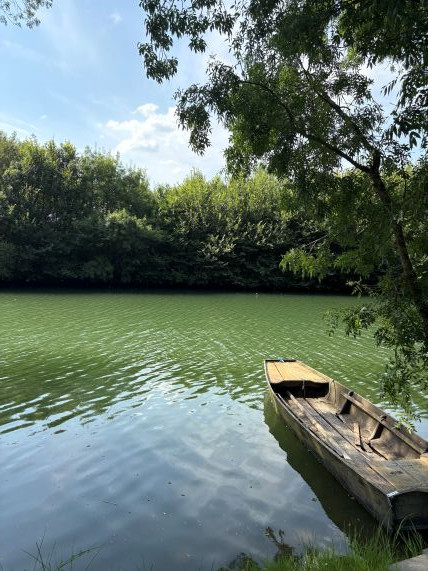
There have been some blisteringly hot days here in France this June, and sometimes we cool off by swimming in the Indre. The gate at the bottom of our garden leads to a path that runs by the river, where there are willows and a wooden boat.
The Indre is the color of jade, reflecting trees along its banks. Dragonflies hover over the water. As I step down, holding a tree trunk to steady myself, the riverbed oozes between my toes. And as I push into the water, I find myself recalling lines from Maxine Kumin’s “Morning Swim”:
Invaded and invader, I
went overhand on that flat sky.Fish twitched beneath me, quick and tame.
In their green zone they sang my name
Later in the poem, she sings a hymn while swimming, just as I recited her poem in my head, feeling at one with the landscape around me:
My bones drank water; water fell
through all my doors. I was the wellthat fed the lake that met my sea
in which I sang “Abide with Me.”
When I was a child, we had family picnics in the English countryside, usually somewhere with a beautiful view. My father, who was an actor by profession, often used to burst into song. I can picture him now, gazing across the Suffolk Downs in a moment of deep connection and joy.
A place can feel more resonant for us when we connect it to poetry, song, or painting. Sometimes, when I share photographs of Rigny-Usse and the Indre River, friends say it looks like a painting, as though framing it this way makes it more lovely.
But the place existed as itself without being filtered through our regard. The trees, the river, the dragonflies, and sky all existed before I saw them in poetic terms. They exist on their own terms, without the overlay of art, with which we make something different.
This subject is explored in depth in one of my favorite poems by Wallace Stevens, “The Idea of Order at Key West.” In the poem, the speaker hears a woman singing as she strolls along the shore. Her song draws on the natural world for inspiration, pulling something out of it, and making it her own.
But then it gets complicated. Stevens writes:
It was her voice that made
The sky acutest at its vanishing.
She measured to the hour its solitude.
She was the single artificer of the world
In which she sang. And when she sang, the sea,
Whatever self it had, became the self
That was her song, for she was the maker. Then we,
As we beheld her striding there alone,
Knew that there never was a world for her
Except the one she sang and, singing, made.
Stevens is thought to be a difficult poet, and this is quite a difficult poem. Only, who would care to unravel his meaning if it weren’t for the beauty of his language? Saying the words aloud is intoxicating. When you say this poem aloud, you are taken by its beauty, just as the singer in the poem is taken by the beauty of her song, which itself draws on the beauty of the natural world. There’s a ripple effect.
At the end of his poem, Stevens wonders why the lights of the town and the fishing boats make the environment more enchanting for him. I ask myself the same question. Why does the little boat on the riverbank makes the Indre more beautiful to me? Why does the winding path and the stone wall make it lovelier? Do human touches simply make it manageable? No question that our garden is more beautiful to me now that the brambles are gone, and it’s been planted with vegetables and flowers.
Stevens concludes that we have a “blessed rage for order” and finishes the poem with these lines:
The makers rage to order words of the sea
Words of the fragrant portals dimly starred
And of ourselves and our origins
In ghostlier demarcations, keener sounds
The heron standing in the reeds connects to nature altogether differently, as does the dragonfly hovering over the river. We think of them as part of nature and of ourselves as separate. But we are actually all part of nature.
I’m reminded of a story my dear friend the poet Carolyn Forché once shared with me, about a Taos Indian she knew called Grandpa Good Morning. He asked her what the word “environment” meant, and when she explained it, he laughed. To him, the concept was utterly absurd. He couldn’t comprehend how environment could ever be thought of as outside humanity or separate from himself.
Amanda Holmes Duffy is a columnist and poetry editor for the Independent and the voice of “Read Me a Poem,” a podcast of the American Scholar.