On Question 7 and the problem of evil.
In The Narrow Road to the Deep North, Richard Flanagan writes about Australian POWs during World War II and the cruelty they suffered in a Japanese labor camp. The story is based on his father’s experience; the elder Flanagan survived the Ohama Camp in Japan because an atomic bomb was dropped on Hiroshima. Reading that novel several years ago took a big piece out of me.
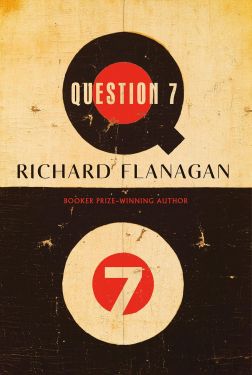
And so, it’s taken time for me to summon the courage to read Question 7, which begins with the author’s visit to Japan, where he tracked down the cruelest of the onetime prison guards. He was looking to understand evil. To encounter it face to face.
But he’s also writing here about chain reactions. How did a kiss between H.G. Wells and Rebecca West lead Wells to write The World Set Free, which, in turn, led to Hungarian physicist Leo Szilard’s discovery of nuclear chain reaction? How is it that the atrocity at Hiroshima, which wiped out more than 100,000 innocent people, saved his father’s life? And going further back to his own roots and Tasmanian heritage, how is it possible that he owes his existence to the English convicts who arrived in Tasmania and all but wiped out the Aboriginal people there? Flanagan is descended from both.
The hard truth is that none of us can claim moral superiority. Though we might not like to acknowledge it, we carry within us the capacity for deep compassion as well as unspeakable cruelty. When Flanagan meets the Japanese prison guard who tortured his father and killed others, he doesn’t find the monster he expects. Instead, he finds a frail old man who spends his days caring for a disabled daughter and who remembers nothing of what he’d done.
Where did the evil go? And where does it come from? Question 7 is the unanswerable query Chekhov poses in a short story that parodies arithmetic word problems assigned to schoolchildren. As Flanagan has it:
Wednesday, June 17, 1881, a train had to leave station A at 3 a.m. in order to reach station B at 11 p.m.; just as the train was about to depart, however, an order came that the train had to reach station B by 7 p.m. Who loves longer, a man or a woman?
Who?
You, me, a Hiroshima resident or a slave labourer? And why do we do what we do to each other?
That’s Question 7.
Perhaps there’s a good reason I’ve only just read Question 7. It speaks to me more profoundly now that I’ve witnessed a livestreamed genocide in Gaza, knowing that my country is the largest supplier of arms to Israel. We are also witnessing our country’s withdrawal from its allies as the president we elected declares that the war in Ukraine is not his problem. Our concept of who we are is shaped by our denial of uncomfortable narratives. We look away from our own crimes and tell ourselves that someone else’s atrocities are worse. Yet Flanagan asks:
“What if vengeance and atonement both are simply the lie that time can be reversed and thereby some equality, some equilibrium restored, some justice had? Is it simply truer to say Hiroshima happened, Hiroshima is still happening, and Hiroshima will always happen?”
When Flanagan questions another of the cruelest former Japanese guards as to why they’d tortured their Australian prisoners, the answer comes in calm, measured tones. You have to understand, he says, that we didn’t see them as human beings.
And here is a further question: When is it necessary to remember and when is it better to forget? When Flanagan returns to his elderly father and tells him what he’s learned and who he’s met, his father is shocked. But by the following day, he’s forgotten all about it. He is released from his own painful memories. Just as Flanagan finishes writing The Narrow Road to the Deep North, his father dies. He is finally, and permanently, set free.
I’m reminded of lines from Fady Joudah’s collection [...] and his poem “Dedication,” written for the Palestinian people:
“To those with dementia: may it save you from the full scale of terror. To forgetfulness when a mercy. To remembrance when a mercy. To those who composed songs and sang them to the syncopated thuds of annihilation. To life. To light. The light is dead, long live the light.”
At the end of Question 7, Flanagan recounts an extraordinary near-death experience — one he fictionalized in his first novel, Death of a River Guide. He tries to get at a deeper truth, yet to articulate it is almost impossible:
“There were no words. That’s the thing about words: they are not the same thing as life. We just pretend.”
And Flanagan said in Question 7 about The Narrow Road to the Deep North, “I wrote a novel seeking to understand these things. To resolve them. For the time I spent writing it I felt that the writing was a way of divining the undivinable. Only when I finished I realized I understood nothing.”
He explains that he managed to stay alive, to stop the part of himself that was not his body from rising up and away, by clinging to the pain; he was weighted to this life and experience by pain. But when we lift up to another vibrational level, the pain evaporates.
For now, it seems, we are rooted here with our pain. We must understand that the pain others suffer is also our own. We are connected to each other through our suffering and our half-truths, through the stories we tell ourselves to make sense of the atrocities we commit — and through the stories we tell to forget them.
Amanda Holmes Duffy is a columnist and poetry editor for the Independent and the voice of “Read Me a Poem,” a podcast of the American Scholar.