Reading Wuthering Heights with a group of juvenile offenders.
Those of us who’ve read Wuthering Heights know Emerald Fennell’s recent film adaptation is nothing like the novel. She claims she drew on what she imagined the story being when reading it as a teen. But not all teens are alike. I remember being shocked by the cruelty in the novel the first time I read it. I also recall being struck by its potent themes of race and class.
Fennell’s adaptation has turned the brunette Catherine Earnshaw into a blonde, changed Isabella Lynton from a victim of domestic violence into a laughingstock, and reinvented Heathcliff as a passionate white guy. All, of course, in the name of entertainment. And what’s so wrong with that?
But I can’t help seeing the movie as a missed opportunity. I’m thinking about what reading Wuthering Heights meant to a class of juvenile offenders I worked with a few years ago in a program called Changing Lives Through Literature.
CLTL was a 10-week course funded by the Fairfax Library Foundation in conjunction with the county’s Juvenile Court system. Each class ran 75 minutes, and at the end there was a completion ceremony, sometimes at the courthouse. The program was an alternative to formal court action for first-time offenders, but in this case, I was working with seven girls at a juvenile residential facility.
Picking Wuthering Heights for these girls was risky. We usually read more contemporary YA books. English was also a second language for some of them. That made Emily Brontë challenging. But I had a gut feeling about this project, and I wanted to challenge them. One girl, who’d participated in the program with me before, asked for a book with more sex and violence. Well, this one would qualify, I thought to myself. I hoped it would also take her further.
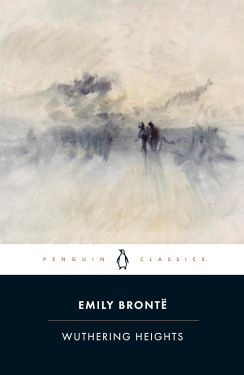
But when I passed out the books on that first day of class, their faces fell. What a boring cover, they said. They didn’t like how thick the book was or the smallness of the print, and they especially didn’t like the weird language.
I began by describing the isolation of the Brontë sisters, who lived in the Yorkshire village of Haworth in a parsonage, where they made up stories and drew pictures on their bedroom walls. I told them I’d visited the Haworth Parsonage and seen those drawings. The girls began to fidget.
“You’ll struggle with the opening chapters,” I warned them, “because they are written from Lockwood’s point of view, and he’s boring. So, if you find the first chapters difficult and boring, that’s because they are difficult and boring. Bear with it.”
I then added, “I wouldn’t have picked this book if I didn’t think you’d like it.”
That day, I drove home uneasily. What if they really hated the book? What if they couldn’t relate to it? What if reading Wuthering Heights put them off literature altogether?
As predicted, the girls found Lockwood boring. Another early problem for them was the character Joseph, who speaks in dialect. I told them not to worry too much about Joseph, and then we discussed what made Lockwood such a cold fish. I asked them to consider why Brontë might have chosen this boring narrator for the opening of her passionate story. Might it lend credibility to his account of Catherine’s ghost appearing at his window?
Next, I played them a recording of Kate Bush singing “Wuthering Heights,” and as they listened, something behind their eyes began to change. When I told them Bush was like a 1970s Lady Gaga, a spark of interest was ignited!
Things picked up when the narrator shifted to Nelly Dean. They liked Nelly. But was she biased, I asked them? Did she have a crush on Edgar Linton? The girls didn’t think so. But they all felt sorry for Hareton.
As the weeks went by, we discussed Heathcliff, who was bullied and tormented by Hindley and teased by Catherine. The girls thought Catherine had serious mental problems. They also found her irritating. But they were now amused by Joseph and had grown accustomed to his dialect.
Was there an incestuous quality to the novel, I asked? Was it possible Heathcliff was Earnshaw’s illegitimate son? Or that young Cathy was really Catherine and Heathcliff’s daughter? No, they said, because the older Cathy had dark hair, and young Cathy had blonde hair and looked too much like Edgar.
By the time we got into Book Two, everyone was hooked. They loved the many parallels: Thrushcross Grange and Wuthering Heights; the two Cathys; the several romances; the fathers and sons; the fathers and daughters; the way Brontë switches elements and unfolds them in different ways to look at things from various angles.
Toward the end of the course, I asked them to write about the character they most identified with. One girl picked Hareton because he was quiet and didn’t show his feelings much. He’d lost his mother at a young age. She identified because she, too, had lost family members and hadn’t known how to grieve them, which had contributed to her later problems.
Another girl identified with Heathcliff’s anger. She longed for him to show a good side of his nature — to come through in the end. He had been wronged and hadn’t been given a chance. It was sad that revenge had become his driving motivation.
We discussed Linton Heathcliff. Most of them decided he was weak, selfish, and manipulative. But one girl liked him. “He can’t help how he is,” she cried. “He’s sick!”
At the completion ceremony, the library awarded certificates to the girls, and they gave speeches that we had worked on together. Some of their family members were present, and the girls felt proud. Wuthering Heights had found its way into their hearts. They had risen to the challenge of a difficult text. The novel spoke to them and broadened them. It wasn’t merely entertainment.
As for their analysis of the novel, I would confidently put them head-to-head with any high school or undergraduate class. “I liked this book better than the one we read last time,” one girl said, “because I identified more with the characters.” What a wonderful discovery it was, that empathy and connection can exist across the centuries.
I wonder what she thinks about Emerald Fennell’s “Wuthering Heights.”
Amanda Holmes Duffy is a columnist and poetry editor for the Independent and the voice of “Read Me a Poem,” a podcast of the American Scholar.
.png)