How a journey to Scotland’s Hawthornden nourished my writing soul.
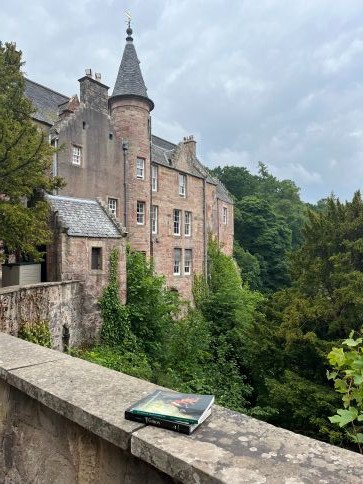
In 1618, English poet Ben Jonson walked from London to Edinburgh, then from Edinburgh to Hawthornden Castle, to visit the Scottish poet William Drummond, the castle’s proprietor. The walk took more than two months; the visit, more than four. While together, these wordsmiths filled their days much as wordsmiths prefer to do now: reading, writing, and engaging in literary criticism and gossip, especially about contemporaries. With splendid deadpan, Drummond documented Jonson’s barbs and eccentricities in his Conversations:
“Francis Beaumont loved too much himself and his own verses.”
“Jonson heth consumed a whole night in lying looking to his great toe, about which he hath seen tartars & turks, Romans & Carthaginians freight in his imagination.”
“He can get Horoscopes but trusts not in ym (sic), he…couzened a lady, with whom he had made an appointment to meet ane old Astrologer…& it was himself disguysed in Longe Gowne & a whyte beard.” [Jonson, a proto Mr. Rochester!]
Nowadays, thanks to the Hawthornden Foundation, the musings and aspirations of writers continue to echo in the castle’s twisty stairwells and many distinctive rooms, from the dining room, decorated with illustrations of handsome (and sometimes sulky) kilted men, to the fine drawing room and the seafoam salon that listens over the ever-guzzling North Esk River and forest.
For one month, the Hawthornden literary residency in Scotland (there are also residencies in Italy and Brooklyn) equips six writers with a “castle room of their own” to work on their manuscripts without distractions. Laundry, meals, toiletries, walking sticks, libraries, and a generous stipend for travel and expenses are all provided. In June, I was lucky enough to be one of the fellows.
To my knowledge, nobody in my cohort walked to Hawthornden. Instead, we were charioted from Edinburgh by our director, whom I’ll call Yeats after the name painted in Prussian blue on the door to his personal quarters. In fact, each fellow’s door bore the name of a writer serving as a kind of patron saint or (coerced-to-pay-it-forward) literary guardian: Jonson, Boswell, Evelyn, Milosz, Drummond, and Brontë (me).
 Back in the day, I’m told, under the direction of a previous Yeats, fellows were known to each other only by their avatar (“Good morning, Boswell, porridge?”). Although that’s not the case anymore, one joy of Hawthornden was arriving as strangers, just like on the pre-internet first day of school.
As long as I’ve known about writing residencies, I’ve been skeptical of them, especially the months-long ones offering puny stipends. How can anyone take that much time off work and still pay their bills? And, in this era of overproduction and shrinking cultural stature, with a publishing industry that champions the few over the many, would participants be passively cutthroat and sycophantic, vying for the attention of whichever chosen star was nearest, all mooning over whatever right author was being fawned over at the moment?
I’ve heard these stories, I’ve even witnessed them, and, knowing myself, I worried such dynamics would leave me stressed and distracted from any work I’d planned to do. So, while I thrilled at the idea of finishing my manuscript in enchanted isolation, far from everyday distractions (no Instagram! no family! no strangers’ loud music on the bus!), when I set out for Hawthornden, I braced for conflict.
Fortunately, my bracing was for naught. Since Yeats kept our bios and names to himself, we fellows could share as little or as much as we wanted about ourselves and our writing. While we ate breakfast and dinner together, silence was maintained throughout the workday. Concentration was respected and encouraged. Free to leave the grounds, we sometimes undertook side quests, long walks, and hikes. (Boswell, for one, enjoyed an intense 13-mile trek over the Pentland Hills.) But even these excursions managed to be monastic, as if, no matter where we ventured, Hawthornden’s historical magic clung to us, inoculating us against tedium and allowing us to believe once again in the seriousness of our work.
It was nice, too, to be fed. To have one’s bed made up with clean linens, one’s clothes laundered and bathroom cleaned. Save only having our own Sofia — like Tolstoy’s or Hawthorne’s — to transcribe and edit our manuscripts, no need went unmet. Feathered companions also enhanced the mood: blackbirds, jackdaws, blue tits, tawny owls, and even common wood pigeons (“their heavy trills like a hardy rug shake,” said Evelyn). One morning, a chiffchaff flew into my room and dervished over my head a few times before exiting through the screenless window. Bees, however, were my main visitors.
Each fellow decided their own level of connectivity with the outside world; I probably took the strictest approach, limiting myself to Cornell’s Merlin bird-identification app, Google Maps, and weekly phone calls with my husband. Still, news from outside trickled in. During one stormy Sunday dinner, we discussed the latest headline: U.S. Enters War Against Iran! “It’s like we’re the children in Narnia,” Milosz mused, “waiting out the Blitz in our country estate.”
Usually, our dinner conversation orbited literature, and I mean actual text — prose, poetry, drama — and not its satellites: author scandals and moral failings. Narrative choices and formal considerations of everyone from Ovid to Cusk were on the table. I’d known such highbrow conversations existed, but it’s the satellite chats that dominate social media and daily life.
I remember when the Bad Art Friend controversy broke, how the feud generated more outrage and debate than any recent fictional-character conflict I can recall. And not just because it was real. Rather, our conversations can be shallow, and many contemporary novels leave little space for honest interpersonal messiness. Jonson may have said, “Shakespeare wanted art,” but few today are willing to discuss the “want of character nuance” in many modern novels, unless that critique has been pre-approved by consensus.
Which is not to say that we around the Hawthornden table were killjoys. When real-world scandals came up, we discussed their literary echoes with vim and vigor. “Oh, that’s like Arachne!” said Brontë. And a conversation about one of Muammar Gaddafi’s less conventionally attractive (at least by Western standards) love interests morphed into a discussion of how bodies are portrayed in fiction. Examples, not just vibes.
My time at the castle has fortified me. Despite the dismal state of world affairs I return to, my passions are reaffirmed, my to-read list is longer than ever, and my mind is clearer. It’s buzzing, chirping, and full of wonder — both ancient and ongoing — as I fly home to Washington.
Samantha Neugebauer is a lecturer at NYU Washington, DC, and a senior editor for Painted Bride Quarterly.