(But understand how loaded they can be.)
I’ve been thinking a lot lately about language and the way it shapes our lives. Whether something is “alternative facts,” “fake news,” or “propaganda,” the words we use play a role in how we interpret events.
Although there are now running lists of the lies told by Donald Trump, it took the media several years to learn how to highlight them effectively; especially during his first term, news outlets were reduced to mealy-mouthed descriptions like “misleading statements” or “apparent falsehoods.” And in a post-Roe era where women’s rights are being threatened in ways both old and new, the phrase “nasty woman” is an indictment for some and a badge of honor for others.
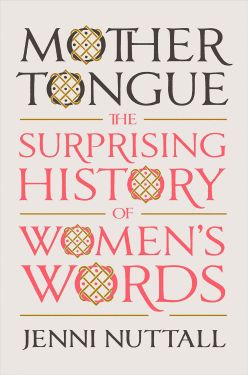
Dr. Jenni Nuttall’s Mother Tongue: The Surprising History of Women’s Words offers us some context about the way words have been used to describe women across history, examining “the first thousand years of the English language to find the beginnings of women’s words.” Nuttall collects and analyzes words from many spheres of women’s lives — menstruation and childbirth, anatomy, sex, work, and more — with illuminating results.
For example, the term “slut,” which “tarnishes women’s sexuality with associations of dirtiness or messiness…was also used as a name for a lowly female servant.” As Nuttall notes, “Slut excuses men’s blushes by redesignating poorer women who are vulnerable to sexual exploitation as women who are notoriously promiscuous.” The nature of the term thus trapped vulnerable women in a vicious cycle from which there was little escape, and the slur remains a dismissive insult to this day.
Nevertheless, women have done work to reclaim this term. After Toronto Police Constable Michael Sanguinetti asserted in a 2011 speech that “women should avoid dressing like sluts in order not to be victimized,” women across Canada and the United States organized SlutWalks to make a statement: The blame for sexual assault lies squarely with the perpetrator, and victim-shaming is no longer acceptable. (Sanguinetti later apologized for his remarks, saying he was “embarrassed.” One hopes it was a lasting embarrassment.)
In a chapter on the words used to describe women and men throughout their life stages, Nuttall notes discrepancies designed to keep men in power:
“With new industries and trades giving some women more economic opportunities and marriage being potentially less attractive, British society quickly recalibrated its views of spinsters, meeting them not so much with concerned pushback as the sort of shoving designed to stop social change in its tracks. Singlewomen [sic] and spinsters were rechristened old maids, a more mocking phrase than the equivalent term for men, bachelor, originally a word for a man in the early stages of his career as a knight, student or tradesman.”
While “old maid” has fallen out of favor, the double standard between women’s and men’s behavior remains glaring: It’s not uncommon to see conservatives assert that, while women should remain pure until (their apparently inevitable) marriage, men have a responsibility to gain experience before settling down. (With whom, one wonders, if all the suitable women are staying chaste?)
Nuttall reminds us of the benefits of passing into “old maid” territory, however:
“Once our resolve and resilience have been thickened up by all that life throws at us, bad and good, society finds us more invisible, less audible…[yet] If the eyes looking around the room care little about me, I likewise care less and less about what they might think.”
Interestingly, even terms originally derogatory to men sometimes came to be weaponized against women, the author notes:
“A 1699 dictionary defines frigid as ‘a weak disabled Husband, cold, impotent.’ It was the keenness of Victorian gynecologists (and a little later that of sexologists and psychoanalysts) to present themselves as experts about women’s many supposed malfunctions which one-eightied this term. By the first decade of the twentieth century frigid had flipped to become a label for psychosexual problems supposedly characteristic of women. Since then it has become an insult to be slung at those who reject sexual advances.”
Caught between the rock of being a “slut” and the hard place of being “frigid,” women may feel they have no good choices, but as Nuttall points out, there is freedom in embracing and reclaiming words used to shame us. (I recently came across a postcard that cheerfully proclaimed, “Howdy, slut!” alongside a smiling horse in a cowboy hat and bought it immediately.) As our language continues to change, so can we change — and conquer — with it.
Mariko Hewer is a freelance editor and writer, as well as a nursery-school teacher. She is passionate about good books, good food, and good company.