Marlen Haushofer’s The Wall offers a meditation on selfhood and wholeness.
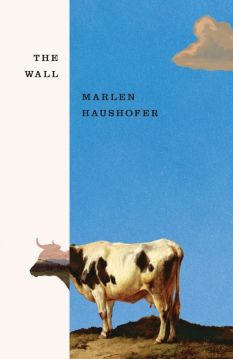
The Wall, a dystopian novel by Marlen Haushofer, was published in Austria in 1960 but only translated into English in 1990. I read it last month, around the same time I read David Szalay’s Booker Prize-winning novel, Flesh.
In Flesh, a hollow man works his way from rags to riches and then falls back to rags again. Once I started reading it, I couldn’t put it down. By contrast, I was occasionally bored while reading The Wall. The diurnal tasks absorbing its narrator include things like planting potatoes and tending a cow.
But here’s the thing: One month later, I’ve all but forgotten Flesh. Instead, it’s The Wall that haunts me. I can’t stop thinking about the ways the narrator lets go of her personal identity. The novel asks us who we are to ourselves when nobody else is around and questions our relationship to the natural world.
The story begins with a weekend family getaway to a mountain hunting lodge. It’s written as a report by a woman who has no expectation that it will ever be read by anyone. On the first afternoon, her relatives decide to visit a nearby village. Left by herself, the narrator hangs her clothes in a bedroom closet and then goes outside to sit on a bench. To her surprise, the hunting dog, Lynx, returns alone. As the evening progresses, since her relatives haven’t come back yet, she feeds the dog, prepares a light meal for herself, and goes to bed.
By morning, there’s still no sign of her hosts. So, she takes Lynx for a walk across the gorge and makes a chilling discovery. Not only is the valley completely deserted, but a strange transparent wall, or forcefield, encloses the area, and nothing can pass beyond it.
As time goes by, she marks out the boundaries of this wall. When no rescuers appear and there’s still no sign of human life, she realizes the scale of the disaster and sets about surviving on her own. She organizes supplies, rearranges the lodge, and does some gardening. On one of her exploratory walks, she discovers a cow, leads her home, and builds her a stall. Later, a cat joins their entourage.
The narrator spends her days milking the cow, churning butter, mucking out the stall, fetching hay, chopping wood, growing beans, and tending her potato field. The cat has kittens. The cow births a calf.
One season, she discovers a woodman’s hut near an alpine meadow — or alm, as she calls it — and decides to move her household to higher ground for the warmth and change, for the “fragrance of summer, the rainstorms and the evening glittering with stars.”
Our narrator’s main companion is Lynx, the dog, who she keeps telling us will eventually die. But it’s her relationship to the cow that touched me most. The narrator reflects:
“When I combed Bella I sometimes told her how important she was to us all. She looked at me with moist eyes and tried to lick my face. She had no idea how precious and irreplaceable she was. Here she stood, gleaming and brown, warm and relaxed, our big, gentle, nourishing mother.”
Meanwhile, the narrator has become thin and muscular. Her hands are covered in blisters and calluses. “My body, more skillful than myself had adapted itself and limited the burdens of my femininity to a minimum,” she explains. “I could simply forget I was a woman.”
Her clothes are now the practical shirts and work clothes left by her cousin’s husband. She doesn’t care about her outer appearance, or even about her name, which she’s almost forgotten and never writes down. She completely sheds her former selfhood. Even her attachment to others, including to her own daughters, fades into a mere abstraction.
“If I think today of the woman I once was, the woman with the little double chin, who tried very hard to look younger than her age, I feel little sympathy for her,” she writes. “But I shouldn’t like to judge her too harshly. After all, she never had the chance of consciously shaping her life.”
We all shed forms of identity from time to time to become someone different. When I read The Wall, I was living for three months with my son and his family in Tasmania. My main identity was reduced, if you will, to grandmother, mother-in-law, and mother. Now that I’ve returned to America, I’m back to being a colleague, wife, and friend. I’m back to my old routines even as the country I thought I knew is poised for reinvention.
But who am I really, outside of who I am to other people?
I suppose I get closest to myself in meditation, when all labels and relationships vanish into simple awareness. But I’ve also been reflecting on the fluid identities of those I love.
For example, when I look at my grandchildren, I see echoes of the little boy my son once was at their ages, but I do not miss him as a child because I have him as an adult. The child is somewhere within the man. But who, even, is he really? We are all ever-changing, and our country is in the throes of a seismic shift of its own.
Toward the end of The Wall, when the narrator is at the alm — on higher ground — she has a profound realization:
“I’m not sure that my new self isn’t gradually being absorbed into something larger that thinks of itself as ‘We’. It was the Alm’s fault. It was almost impossible, in the buzzing stillness of the meadow, beneath the big sky, to remain a single and separate Self, a little, blind, independent life that didn’t want to fit in with the greater Being.”
Amanda Holmes Duffy is a columnist and poetry editor for the Independent and the voice of “Read Me a Poem,” a podcast of the American Scholar.